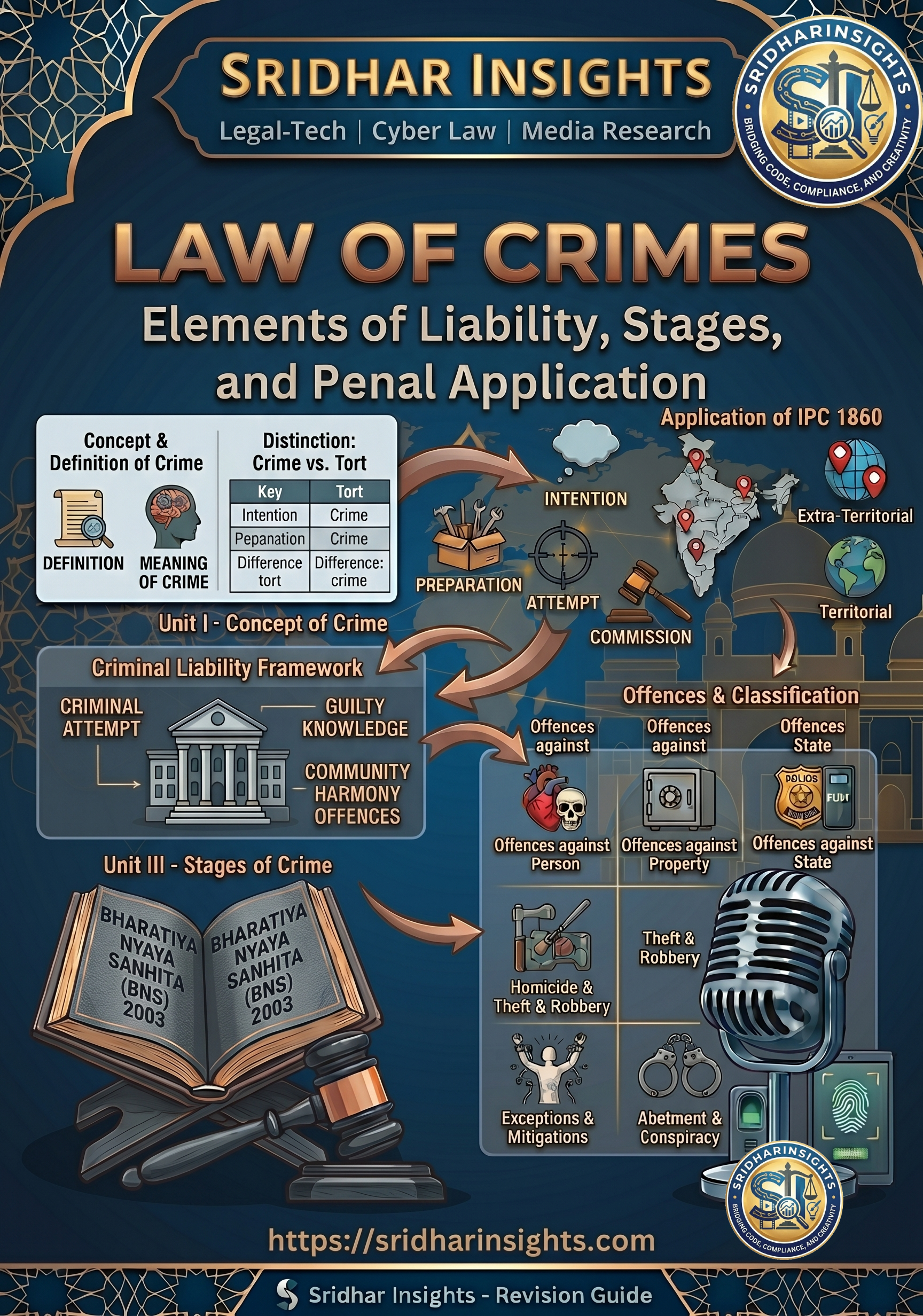
Law of Crimes (Bharatiya Nyaya Sanhita 2023)

Categories: LAW, LLB
Wishlist Share

About Course

About This Course

Master the core principles of criminal jurisprudence and the structural frameworks governing penal liability. Based on the highly acclaimed infographic architecture of Sridhar Insights, this exam-oriented course translates complex statutory definitions, multi-layered liability conditions, and landmark judicial precedents into clear, actionable, and linear text-based modules. Designed specifically for law students and legal professionals looking for a high-efficiency revision system, this course demystifies the elements of offenses, structural exceptions, and the modern transition of criminal law frameworks.

Through structured breakdowns, milestone precedents, and high-yield question banks, you will build a rock-solid understanding of criminal liability from abstract elements to practical penal application.

What You Will Learn

  • Unit I: Concept & Elements of Crime Explore the foundational definitions and meaning of crime, charting the critical jurisprudential distinctions between a Crime and a Tort. Master the essential building blocks of criminal liability—Actus Reus (guilty act) and Mens Rea (guilty mind/knowledge)—and analyze the rules governing the territorial and extra-territorial application of penal codes.

  • Unit II: General Exceptions, Abetment & Conspiracy Navigate the essential legal mitigations and defenses built into criminal frameworks. Deep dive into the statutory General Exceptions, evaluate the multi-party dynamics of Abetment (including the role of a manipulator), and unpack the elements required to establish a charge of Criminal Conspiracy under multiple legal conditions.

  • Unit III: Offences Against the Human Body Study the legal anatomy of offenses targeting the person. Analyze the strict indicators, differences, and components that separate Culpable Homicide from Murder. Master the legal boundaries surrounding Kidnapping, Abduction, Sexual Offenses, and provisions relating to Unnatural offenses.

  • Unit IV: Offences Against Property Deconstruct the structural layers of economic and property-based crimes. Learn the distinct statutory thresholds that differentiate Theft, Extortion, Robbery, and Dacoity. Evaluate the technical borders of Criminal Misappropriation and Criminal Breach of Trust.

  • Unit V: Special, Matrimonial & Public Servant Offences Examine targeted categories of criminal prosecution. Understand offenses committed by or relating to Public Servants, including public breach of trust. Master the legal definitions and criteria surrounding Forgery, Matrimonial Offences, Cruelty, and offenses against state and community harmony.

Course Features & Study Aids Include:

  • Linear Text Mind Maps: Complex penal frameworks, liability conditions, and stages of crime translated into crisp visual flows for maximum memory retention.

  • Criminal Liability Frameworks: Step-by-step progressions analyzing the four critical stages of crime: Intention, Preparation, Attempt, and Commission.

  • Modern Statutory Parallelisms: Strategic integration of classic frameworks alongside the modern Bharatiya Nyaya Sanhita (BNS) context to align your revision with the latest legal landscape.

Who is This Course For?

  • LL.B. & LL.M. Students looking for an accelerated, structurally clean visual companion to clear semester finals and comprehensive core law modules.

  • Judicial Services & Competitive Exam Aspirants targeting high-yield statutory definitions, stages of crimes, and exception metrics for state testing patterns.

  • Legal Practitioners & Compliance Researchers seeking a swift, logically mapped analytical overview bridging classic penal themes with modern criminal enforcement codes.

Show More

What Will You Learn?

  • Trace the foundational jurisprudence of criminal law and differentiate clearly between a Crime and a Tort.
  • Analyze the essential components of criminal liability: Actus Reus (guilty act) and Mens Rea (guilty mind).
  • Understand the operational limits of territorial and extra-territorial jurisdiction within penal applications.
  • Map out the four sequential stages of a crime: Intention, Preparation, Attempt, and Commission.
  • Evaluate the strict legal boundaries that differentiate a mere criminal preparation from an actionable attempt.
  • Master the essential mitigations, conditions, and legal parameters built into statutory General Exceptions.
  • Deconstruct the multi-party mechanics of Abetment and the specific liabilities attached to a criminal manipulator.
  • Analyze the structural elements required to establish a charge of Criminal Conspiracy under multiple legal conditions.
  • Distinguish between Culpable Homicide and Murder by evaluating strict statutory indicators and components.
  • Examine the precise legal thresholds surrounding Kidnapping, Abduction, and wrongful confinement offenses.
  • Understand the evolution of consent parameters, evidentiary rules, and liability metrics in Sexual Offenses.
  • Master the distinct property crime boundaries that separate Theft, Extortion, Robbery, and Dacoity.
  • Evaluate the technical borders between Criminal Misappropriation and Criminal Breach of Trust.
  • Examine crimes committed by or relating to Public Servants, including public service breach of trust.
  • Identify the strict statutory criteria required to establish the offense of Forgery and making a false document.
  • Analyze matrimonial offenses, the definition of cruelty by a husband, and domestic protection clauses.
  • Evaluate offenses targeting community harmony, public tranquility, hate speech, and actions against the State.
  • Align your historical understanding of IPC 1860 seamlessly with the modern Bharatiya Nyaya Sanhita (BNS) framework.

Course Content

Law of Crimes: High-Efficiency Exam Revision Guide for LL.B.
Master the foundational principles of criminal jurisprudence and the structural frameworks governing penal liability with this high-efficiency, exam-oriented revision course. Built upon the proven structural and visual framework of Sridhar Insights, this course translates dense statutory definitions, multi-layered liability conditions, and landmark judicial precedents into clean, highly scannable, and linear text-based modules. Perfect for LL.B. and LL.M. students preparing for semester finals, or competitive law exam aspirants seeking an accelerated command of criminal law, this course bridges abstract legal elements with real-world penal application. You will gain a rock-solid understanding of the mechanics of criminal tracking, statutory defenses, and the ongoing structural evolution of modern penal codes. Key Frameworks Covered: The Elements & Stages of Crime: Deconstructing Actus Reus and Mens Rea, while charting the progression of a crime through its four critical stages: Intention, Preparation, Attempt, and Commission. General Exceptions & Multi-Party Liability: Navigating essential statutory mitigations and general defenses alongside the strict legal boundaries governing Abetment and Criminal Conspiracy. Offences Against Body & Property: Analyzing the strict legal indicators and components that separate Culpable Homicide from Murder, as well as the distinct statutory thresholds separating Theft, Extortion, Robbery, and Dacoity. Specialized & Matrimonial Offenses: Evaluating offenses committed by or relating to public servants, forgery mechanics, and specific protections regarding cruelty and matrimonial harmony. The IPC to BNS Transition: Integrating classic penal principles alongside the modern Bharatiya Nyaya Sanhita (BNS) architecture to keep your knowledge perfectly aligned with the latest legal landscape.

  • Law of Crimes: High-Efficiency Exam Revision Guide for LL.B.
error: Content is protected !!