About Course
A comprehensive, structured course description tailored for the Jurisprudence module on Sridhar Insights:
Course Overview
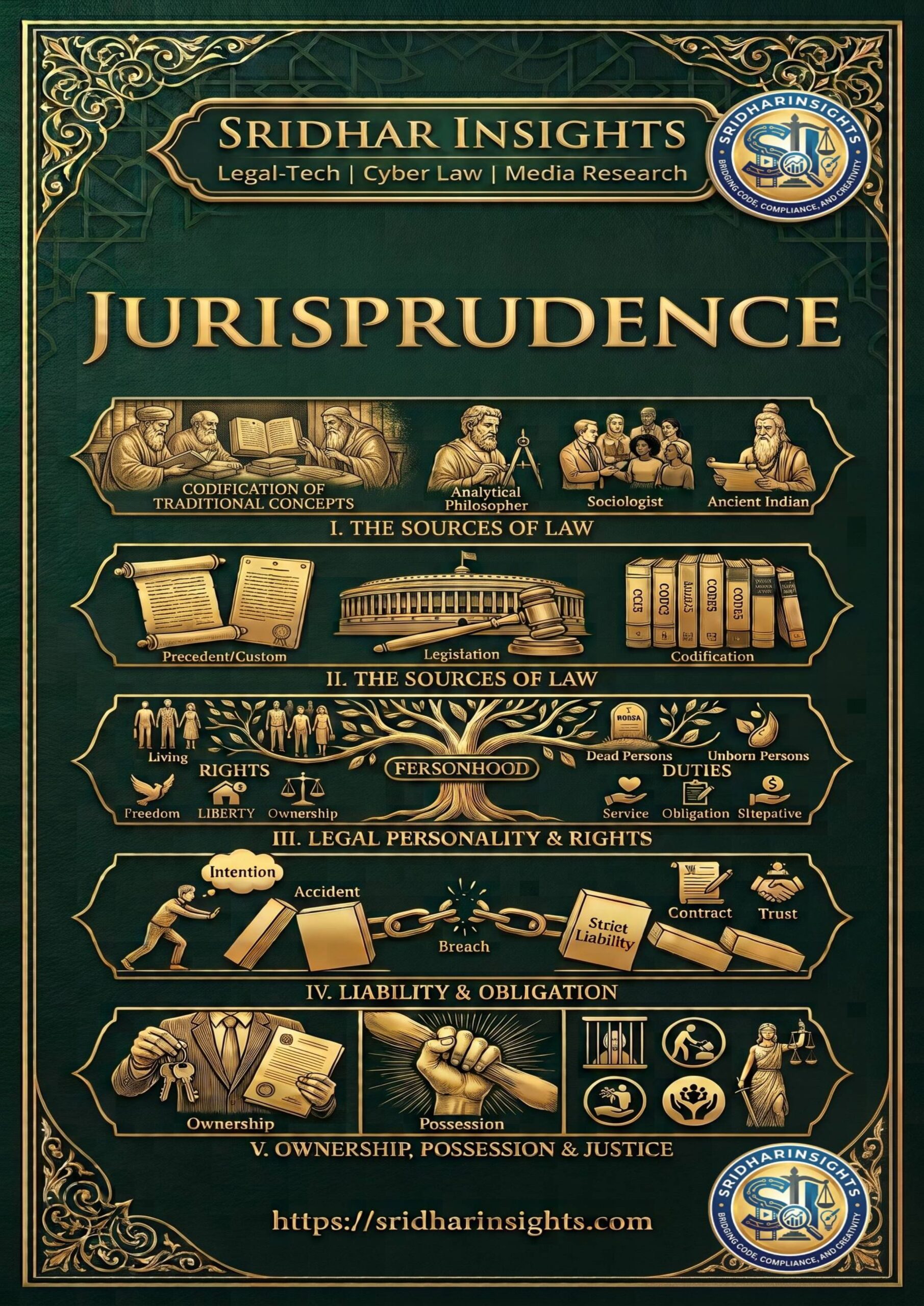
This foundational course in Legal Theory provides a systematic exploration of Jurisprudence—the philosophical grammar and structural foundation underpinning modern legal orders. Bridging traditional legal philosophy, contemporary statutory frameworks, and emerging legal-tech intersections, this course covers fundamental concepts from ancient juristic traditions to digital-era legal challenges.
What You Will Learn
- Unit I: Foundations, Schools & Theories of Law
- Meaning, nature, and definitions of jurisprudence (Bentham, Austin, Salmond, Holland).
- Elements of Ancient Indian Jurisprudence: Dharma, Rajadharma, Vyavahara, and classical sources (Shruti, Smriti, Sadachara).
- Core Schools: Analytical Positivism, Historical School (Volksgeist), Philosophical/Natural Law, and Sociological School (Social Engineering & Social Solidarity).
- Nature, purpose, and classification of law, theories of sovereignty, and the convergence of Equity, Law, and Justice.
- Unit II: Sources of Law & Codification
- Legal vs. Historical sources of law.
- Legislation: Supreme vs. subordinate legislation and core canons of statutory interpretation (Literal, Golden, Mischief Rules).
- Judicial Precedent: Stare Decisis, Ratio Decidendi, Obiter Dicta, and judgments per incuriam under Article 141.
- Custom: Requisites of a valid custom and the debate surrounding legislative codification.
- Unit III: Legal Personality, Rights & Duties
- Legal status of non-human and non-standard entities: unborn persons, dead persons, animals, and religious institutions.
- Corporate personality: Theories (Fiction, Concession, Realist) and the doctrine of lifting the corporate veil.
- Analytical taxonomy of rights and duties: Perfect/imperfect, in rem/in personam, and Hohfeld’s Jural Correlatives and Opposites.
- Unit IV: Obligation, Fault & Liability
- Sources of obligations: Contracts, Quasi-Contracts, and Trusts.
- Fault frameworks: Actus Reus, Mens Rea, Intention vs. Motive, Negligence, and Vicarious Liability.
- Strict Liability (Rylands v. Fletcher) vs. Absolute Liability (C. Mehta).
- Principles governing the measure of civil compensation versus criminal penal sanctions.
- Unit V: Ownership, Possession, Property & Administration of Justice
- Corporeal vs. incorporeal ownership and the bundle of proprietary rights.
- Elements of possession (Corpus and Animus) and possessory remedies under Section 6 of the Specific Relief Act.
- Modes of property acquisition and classification of legal sanctions.
- Theories of Criminal Justice and Punishment: Deterrent, Preventive, Reformative, and Retributive theories.
Course Highlights & Materials
- Contemporary Convergence: Analysis of emerging digital-age legal questions, including AI personhood, smart contract obligations, algorithmic sentencing, and virtual property rights.
- Practice & Assessment: Unit-wise descriptive model answers, key ratio matrices, Latin maxims, and 250+ standard MCQs aligned with competitive legal examinations (AIBE, CLAT-PG, and Judicial Services).
Course Content
Jurisprudence
Jurisprudence