About Course
Course Overview
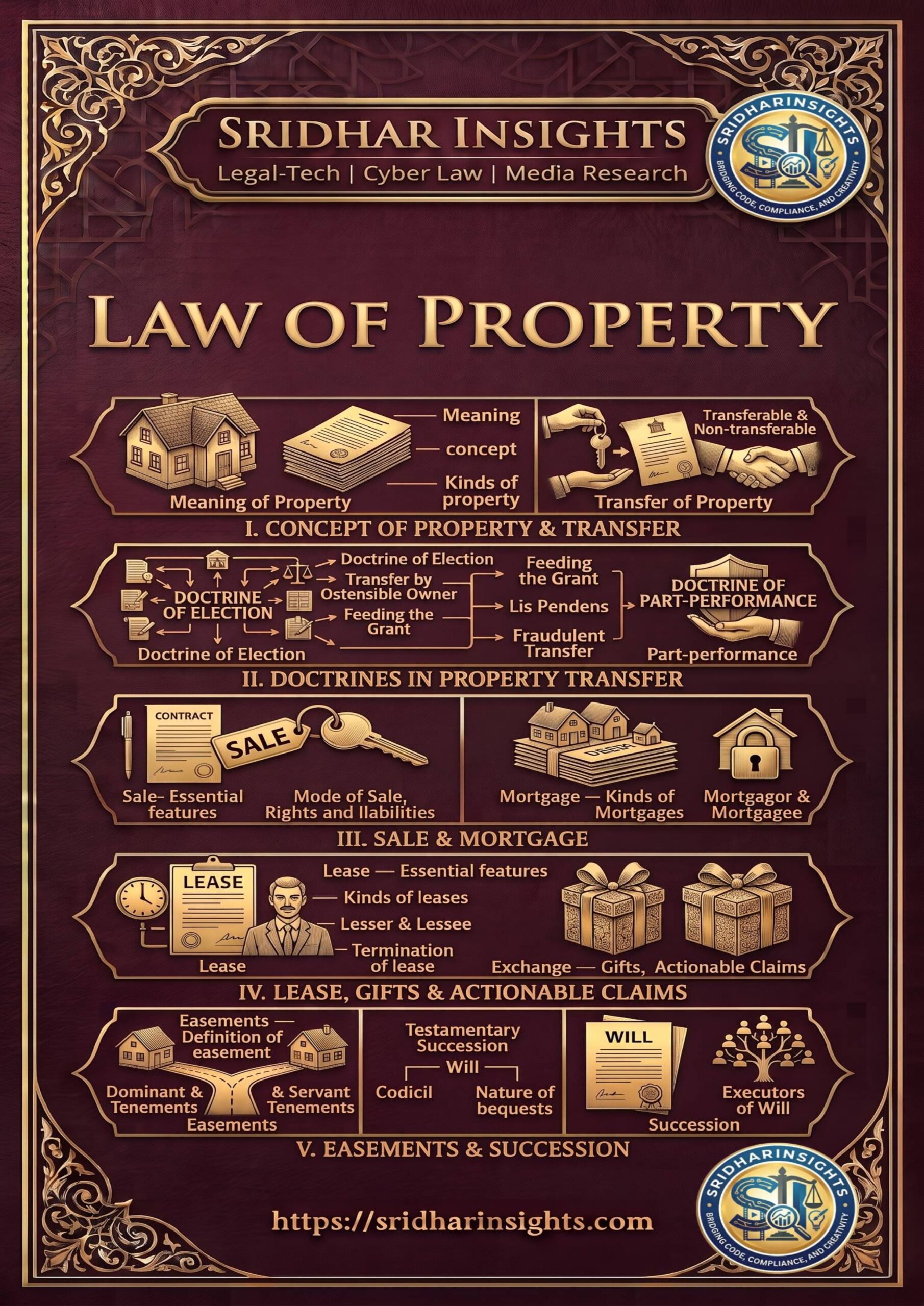
This course provides a comprehensive, analytical study of the Law of Property, centered on the Transfer of Property Act, 1882 (TPA), the Indian Easements Act, 1882, and testamentary provisions under the Indian Succession Act, 1925. Structured for academic excellence and competitive examinations, it deconstructs property conveyance mechanics, equitable doctrines, specialized transactions, incorporeal rights, and succession frameworks alongside modern digital asset intersections.
What You Will Learn
- Unit I: General Principles of Transfer (TPA, 1882)
- Meaning, concept, and statutory tests for movable vs. immovable property (Shantabai rule).
- Scope of transfer inter vivos (Sec 5) and absolute alienability exceptions under Section 6 (Spes Successionis, right of re-entry, maintenance, mere right to sue).
- Competency, operation, and modes of transfer (Sec 7–9).
- Conditional transfers: Restraints on alienation (Sec 10), restrictions on enjoyment (Sec 11), Condition Precedent (Cy-pres under Sec 26), and Condition Subsequent (Sec 29).
- Vested vs. Contingent Interests (Sec 19 & 21), Transfers to Unborn Persons (Sec 13), and the Rule Against Perpetuity (Sec 14).
- Unit II: Equitable Doctrines of Transfer
- Doctrine of Election (Sec 35): Principles of Approbate & Reprobate and compensation mechanics.
- Restrictive vs. Positive Covenants (Sec 40) and the rule in Tulk v. Moxhay.
- Transfer by Ostensible Owner (Sec 41) and Benami statutory cross-linkages.
- Feeding the Grant by Estoppel (Sec 43) and Jumma Masjid principles.
- Doctrine of Lis Pendens (Sec 52), Fraudulent Transfers (Sec 53), and the Doctrine of Part-Performance (Sec 53A) as a shield.
- Unit III: Specific Transfers — Sale and Mortgage
- Sale (Sec 54–57): Definition, essentials, contract for sale vs. sale deed, and mutual rights/liabilities under Section 55.
- Mortgage (Sec 58–100): Six statutory kinds of mortgages (Simple, Conditional Sale, Usufructuary, English, Deposit of Title Deeds, Anomalous).
- Mortgagor’s Right of Redemption (Sec 60) and prohibition of Clogs on Redemption.
- Mortgagee’s right to foreclosure/sale (Sec 67), Marshalling (Sec 81), Contribution (Sec 82), Subrogation (Sec 92), and Charges (Sec 100).
- Unit IV: Leases, Exchanges, Gifts, and Actionable Claims
- Lease (Sec 105–117): Essentials, determination under Section 111, relief against forfeiture (Sec 114), holding over (Sec 116), and the Lease vs. License distinction (Associated Hotels test).
- Exchange (Sec 118–121): Concept, mechanics, and title defects.
- Gifts (Sec 122–129): Formal requirements, execution/attestation (Sec 123), revocation (Sec 126), onerous gifts (Sec 127), and universal donees (Sec 128).
- Transfer of Actionable Claims (Sec 130–137): Written assignment, debtor notice, and equities.
- Unit V: Easements and Testamentary Succession
- Easements (Indian Easements Act, 1882): Definition (Sec 4), Dominant and Servient Tenements, acquisition modes, and distinction between Easement and License (Sec 52).
- Testamentary Succession (Indian Succession Act, 1925): Execution and attestation of Wills and Codicils (Sec 63), capacity (Sec 59), and suspicious circumstances doctrine.
- Nature of Bequests (Vested, Contingent, Onerous, Lapsed), Executor roles, and Legatee rights/obligations.
Course Highlights & Materials
- Contemporary Convergence: Practical analysis of PropTech innovations, smart leases, automated vesting, digital title deeds (e-Mortgages), and blockchain probate.
- Practice & Assessment: Unit-wise descriptive model answers, statutory drafting clauses, cheat codes, and 250+ standard MCQs aligned with AIBE, CLAT-PG, and Judicial Services exams.
Course Content
Law of Property
Law of Property