About Course
Course Overview
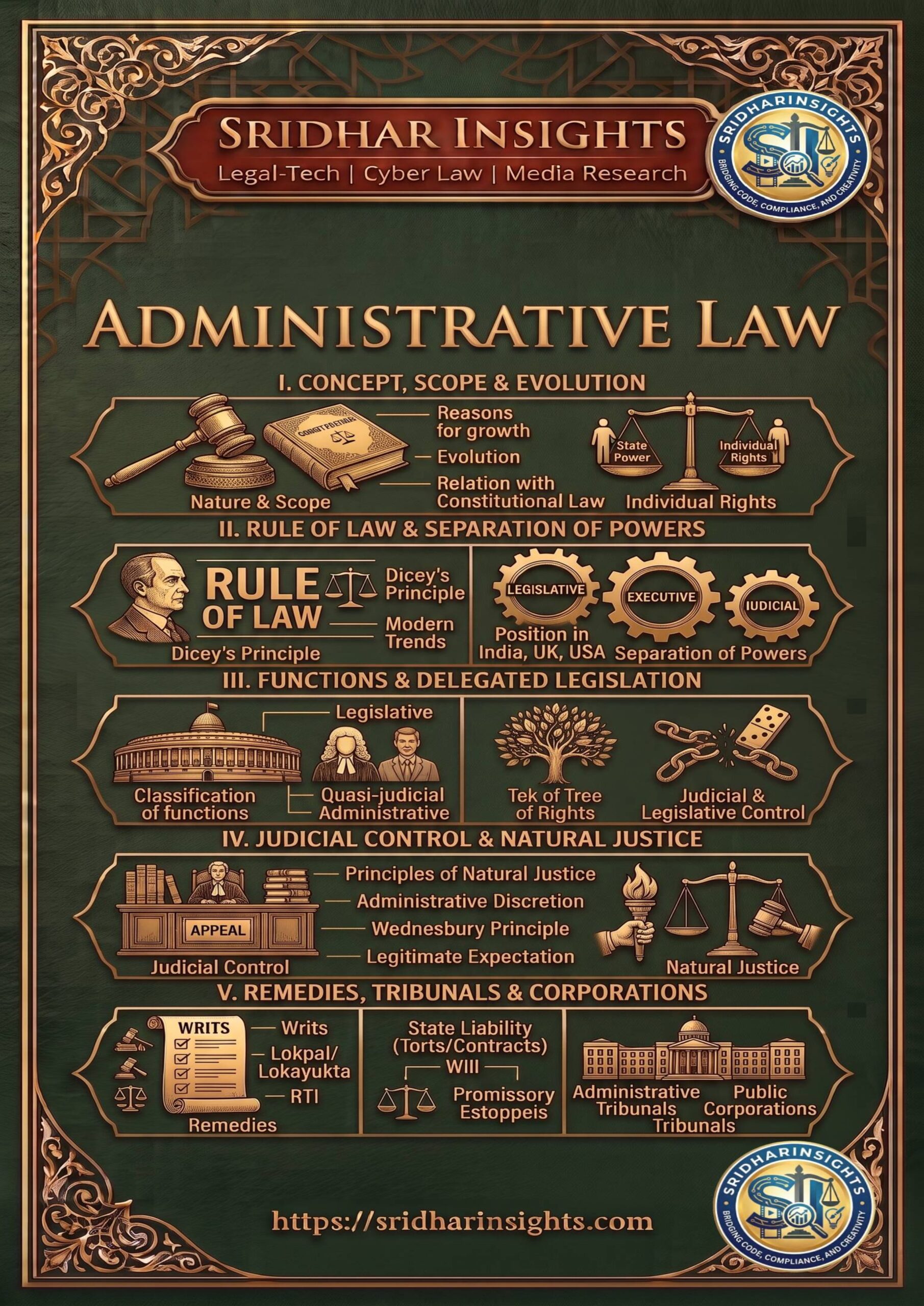
This course offers an in-depth, systematic analysis of Administrative Law, deconstructing the legal principles, judicial safeguards, and institutional checks governing executive power in the modern Welfare State. Structured for academic mastery and competitive legal examinations, it spans the nature and evolution of administrative power, the Rule of Law, Separation of Powers, Delegated Legislation, Natural Justice, standards of judicial review, and comprehensive public accountability mechanisms.
What You Will Learn
Unit I: Nature, Scope, and Evolution of Administrative Law
Meaning, nature, and juristic definitions (Ivor Jennings, A.V. Dicey, K.C. Davis).
Historical evolution: Transition from the Laissez-Faire Police State to the modern Welfare State.
Primary reasons for growth: Inadequacy of traditional courts and legislative processes.
Symbiotic relationship between Administrative Law and Constitutional Law (Ram Jawaya Kapur, E.P. Royappa).
Unit II: Basic Concepts — Rule of Law & Separation of Powers
Evolution of the Rule of Law from Aristotle and Edward Coke to modern constitutionalism.
Dicey’s classic triad (Supremacy of Law, Equality Before Law, Predominance of Legal Spirit) and its modern substantive reformulation (Delhi Declaration, 1959).
Montesquieu’s Theory of Separation of Powers: Comparative study across the USA (Rigid), the UK (Fusion), and India (Flexible with Checks & Balances).
Basic Structure doctrine linkages (Kesavananda Bharati, Indira Nehru Gandhi).
Unit III: Classification of Functions & Delegated Legislation
Functional classification: Legislative, Quasi-Judicial, Administrative, and Ministerial actions.
Delegated Legislation: Scope, practical necessity, and limits (Doctrine of Essential Legislative Functions — In Re Delhi Laws Act).
Sub-delegation (Delegatus non potest delegare) and conditional legislation.
Dual controls: Judicial review via Substantive & Procedural Ultra Vires, and Legislative oversight through Parliamentary Committees and Laying Clauses.
Unit IV: Judicial Control of Administrative Action & Natural Justice
Diplock’s Triad of Judicial Review (GCHQ Case): Illegality, Irrationality, and Procedural Impropriety.
Principles of Natural Justice: Nemo Judex in Causa Sua (Rule Against Bias) and Audi Alteram Partem (Fair Hearing and Speaking Orders).
Control of Administrative Discretion: Mala fides, irrelevant considerations, and unguided discretion (Ramana Dayaram Shetty).
Standards of review: English Wednesbury Unreasonableness vs. Continental Doctrine of Proportionality (Om Kumar, Anuradha Bhasin) and the Doctrine of Legitimate Expectation.
Unit V: Remedies, State Liability & Accountability Institutions
Prerogative Writs under Articles 32 and 226 (Habeas Corpus, Mandamus, Certiorari, Prohibition, Quo-Warranto).
Anti-corruption & transparency machinery: The Lokpal and Lokayukta Act, 2013, and the Right to Information Act, 2005.
State Liability: Tortious liability (Sovereign vs. Non-Sovereign functions, Constitutional Torts under Nilabati Behera) and Contractual formalities under Article 299.
Rule of Promissory Estoppel against the State (Motilal Padampat Sugar Mills).
Specialized bodies: Central & State Administrative Tribunals (L. Chandra Kumar), Commissions of Inquiry Act, 1952, and Public Corporations (Ajay Hasia).
Course Highlights & Materials
Contemporary Convergence: Exploration of digital governance, algorithmic administration, automated discretionary decision-making, and digital transparency portals.
Practice & Assessment: Unit-wise descriptive model answers, statutory drafting precedents, cheat codes, and 250+ standard MCQs tailored for AIBE, CLAT-PG, and Judicial Services exams.
Course Content
ADMINISTRATIVE LAW
Administrative Law