About Course
Course Overview
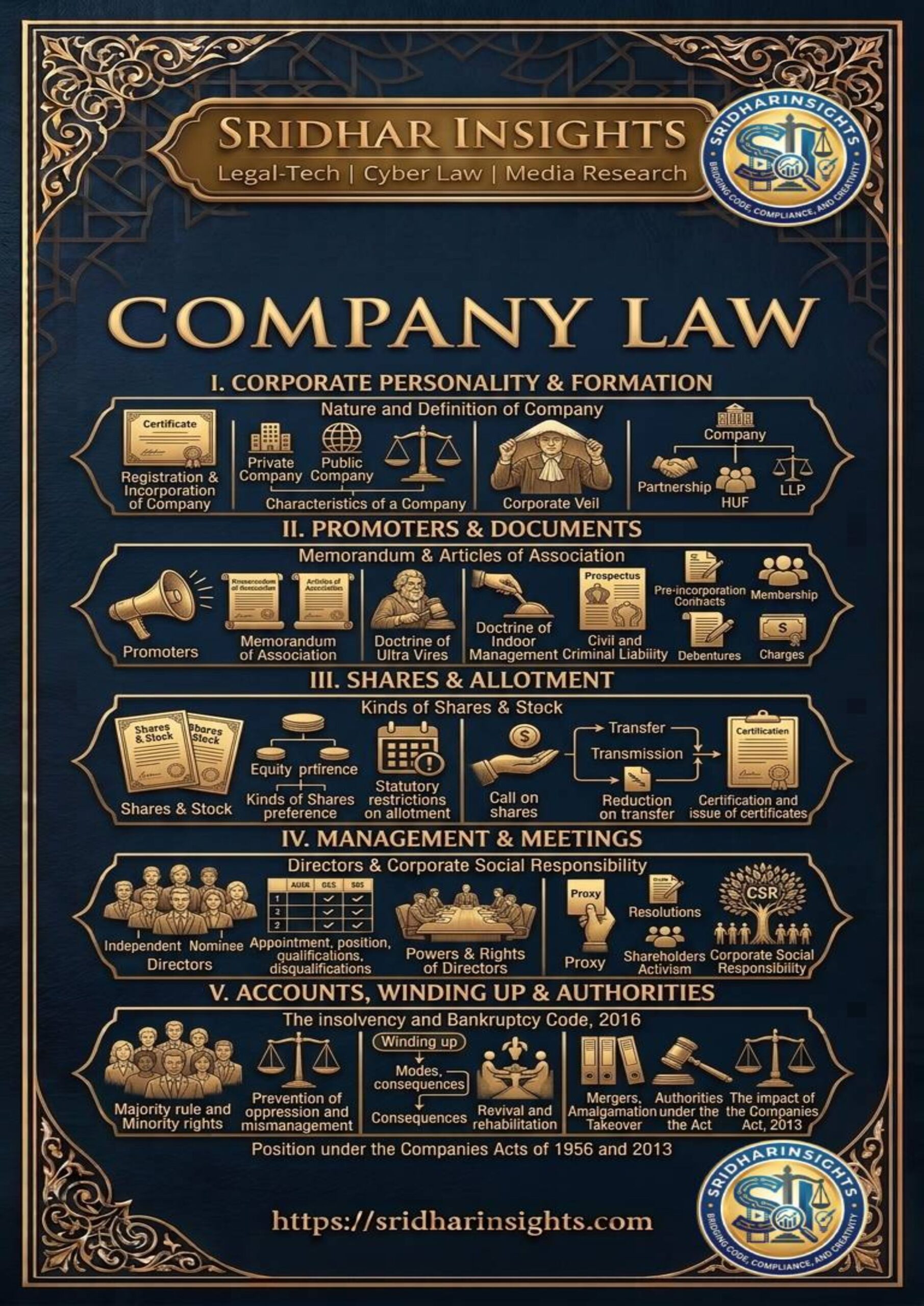
This course provides a comprehensive, rigorous examination of Company Law, centered on the Companies Act, 2013 and modern corporate governance frameworks. Designed for academic depth and competitive legal examinations, it deconstructs corporate personality, charter documents, capital raising, share transfer mechanisms, board fiduciary duties, corporate democracy, minority protection, restructuring, insolvency under the Insolvency and Bankruptcy Code (IBC, 2016), and the regulatory architecture governing Indian corporate enterprise.
What You Will Learn
Unit I: Corporate Personality, Incorporation & Comparative Structures
Nature, definitions, and core characteristics of a registered company.
Doctrine of Corporate Personality and separate legal entity (Salomon v. Salomon & Co., Lee v. Lee’s Air Farming).
Judicial and statutory grounds for Lifting the Corporate Veil (Gilford Motor, Daimler Co., Sir Dinshaw Petit, LIC v. Escorts).
Classification of companies: Public, Private, One Person Company (OPC), Section 8 charitable companies, and holding/subsidiary structures.
Comparative distinctions between Companies, Partnerships, HUFs, and LLPs.
Digital incorporation via SPICe+ and structural transitions from the 1956 Act to the 2013 Act.
Unit II: Promoters, Charter Documents, Capital Raising & Borrowing Powers
Legal status, fiduciary obligations of Promoters, and enforceability of Pre-incorporation Contracts (Kelner v. Baxter, Specific Relief Act Sec 15(h)).
Memorandum of Association (MoA), object clauses, and the Doctrine of Ultra Vires (Ashbury Railway Carriage v. Riche).
Articles of Association (AoA), entrenchment provisions, Doctrine of Constructive Notice, and the Doctrine of Indoor Management / Turquand’s Rule with its exceptions.
Prospectus (uberrimae fidei), Shelf/Red Herring prospectuses, civil (Sec 35) and criminal liability (Sec 34/447) for misstatements (Derry v. Peek, Rex v. Kylsant), and abolition of Statement in Lieu.
Corporate Borrowing powers, Debentures, Fixed vs. Floating Charges, Crystallization, and mandatory registration under Section 77.
Unit III: Shares, Share Capital, and Transfer Mechanisms
Nature of shares as movable property and chose in action (Borland’s Trustee), Stock conversion, and Equity vs. Preference shares (DVRs).
Statutory allotment restrictions, 90% Minimum Subscription rules (Sec 39), refund timelines, and the role of Underwriters.
Calls on shares, 14-day statutory notices, and penal forfeiture mechanics.
Voluntary Transfer (Form SH-4) vs. Involuntary Transmission by operation of law, pre-emption clauses in private companies (V.B. Rangaraj), and NCLT Rectification of Register (Sec 59).
Share Certificates as prima facie evidence of title and the Doctrine of Estoppel as to title/payment (Re Bahia & San Francisco Rly).
Mandatory Dematerialization (Demat) rules and abolition of bearer share warrants.
Unit IV: Directors, Meetings, Shareholder Activism & CSR
Board composition, Director Identification Number (DIN), Resident, Independent, and Women Director mandates.
Disqualifications under Section 164, vacation of office under Section 167, and codified fiduciary duties under Section 166 (Percival v. Wright).
General Meetings: Annual General Meetings (AGM — Sec 96), Extraordinary General Meetings (EGM — Sec 100), Class Meetings, and NCLT powers to convene meetings (Sec 97/98).
Procedural requisites: 21-day notice, quorum thresholds (Sec 103), Chairman duties, Proxy restrictions (Sec 105), Ordinary vs. Special Resolutions (Sec 114), and Minutes (Sec 118).
Mandatory Corporate Social Responsibility (CSR — Sec 135) framework and modern Shareholder Activism (E-voting, Class Actions under Sec 245).
Unit V: Accounts, Restructuring, Oppression, Winding Up & Authorities
Financial statements, statutory audit, mandatory auditor rotation (Sec 139), and Serious Fraud Investigation Office (SFIO — Sec 211) powers.
Corporate democracy: Majority Rule (Foss v. Harbottle), minority rights, and petitions against Oppression and Mismanagement (Sec 241–244 — Tata v. Cyrus Investments).
Corporate restructuring: Compromises & Arrangements (Sec 230), Mergers/Amalgamations (Sec 232), Fast Track Mergers (Sec 233), and SEBI Takeover regulations.
Winding Up vs. Dissolution: Compulsory winding up grounds by NCLT (Sec 271) and Voluntary Winding Up under Section 59 of the IBC, 2016.
Intersection with the Insolvency and Bankruptcy Code, 2016: Corporate Insolvency Resolution Process (CIRP) and the Section 53 Waterfall Mechanism.
Regulatory & Adjudicatory Architecture: MCA, ROC, Regional Directors, NCLT, NCLAT, Special Courts, and the absolute bar on civil court jurisdiction under Section 430.
Course Highlights & Materials
Contemporary Convergence: Insights into digital-first SPICe+ incorporation, MCA21 V3 data analytics, smart debenture crystallization, virtual AGMs, algorithmic share registries, and DAO liability.
Practice & Assessment: Unit-wise descriptive model answers, practical drafting precedents (board resolutions, writ/NCLT pleadings, statutory notices), revision cheat codes, and 250+ standard MCQs tailored for competitive law exams.
Course Content
COMPANY LAW
COMPANY LAW