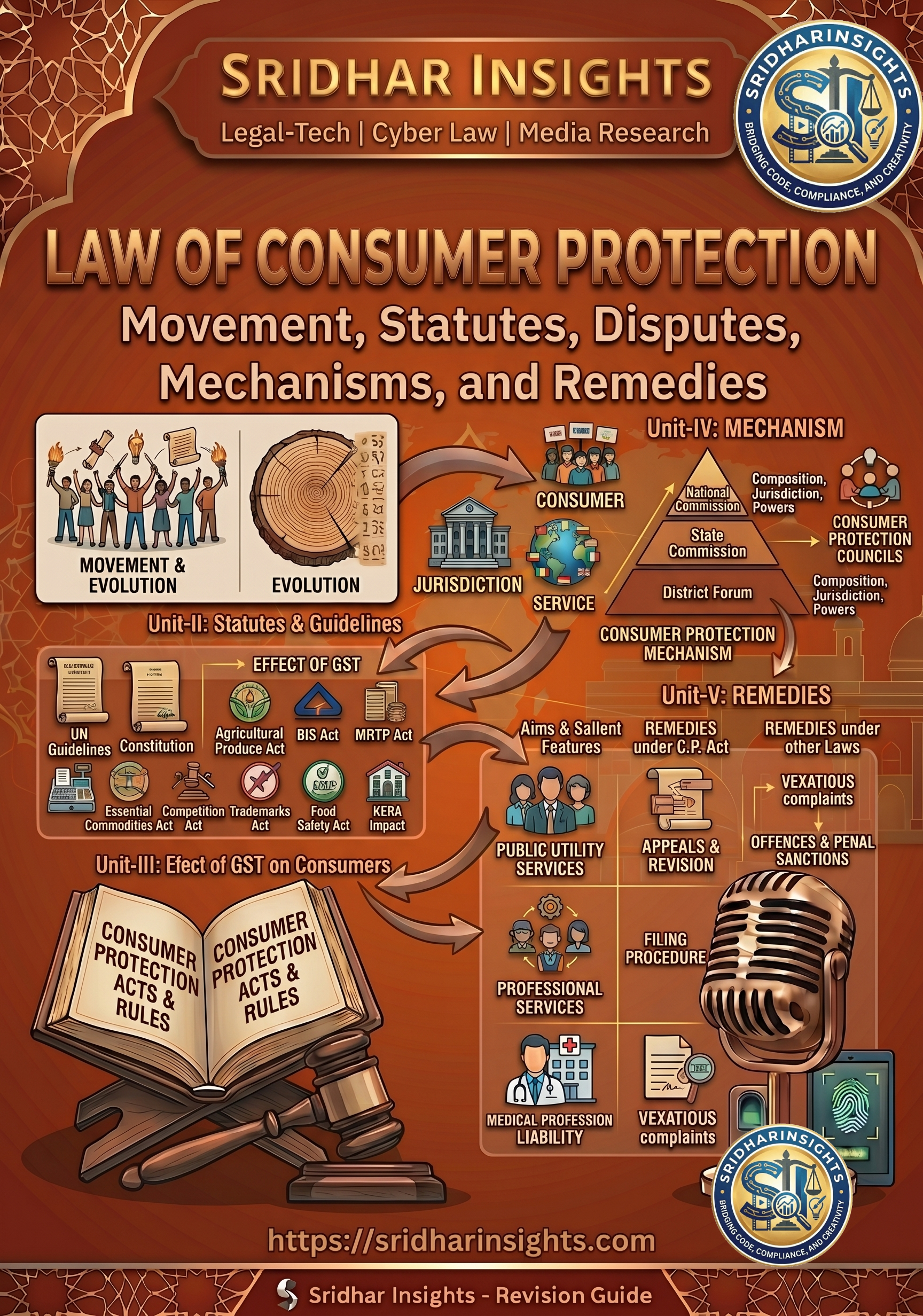
Consumer Protection Law

Categories: LAW, LLB
Wishlist Share

About Course

About This Course

Accelerate your legal studies and master the mechanisms safeguarding consumer interests in the modern marketplace. Based on the highly acclaimed infographic architecture of Sridhar Insights, this exam-oriented course translates heavy statutory frameworks, dynamic market reforms, and monumental common law breakthroughs into clear, actionable, and linear text-based modules. Designed specifically for law students and legal professionals looking for a high-efficiency revision system, this course demystifies the substantive and procedural dimensions of consumer jurisprudence.

Through structured breakdowns, milestone landmark cases, and high-yield question banks, you will build a bulletproof understanding of consumer rights, professional liabilities, and the three-tier dispute resolution machinery.

What You Will Learn

  • Unit I: Historical Perspectives & Product Liability Trace the global transition of marketplace dynamics from the harsh laissez-faire doctrine of Caveat Emptor (Buyer Beware) to the modern protective framework of Caveat Venditor (Seller Beware). Explore tortious negligence, malicious injurious falsehood, and how the milestone case of Donoghue v. Stevenson permanently dismantled the “Privity of Contract” fallacy.
  • Unit II: Statutory Framework & Allied Laws Examine the multi-layered domestic and international shield guarding consumers. Analyze the constitutional mandates (Articles 14, 21, 38, 39, 47) and understand core regulatory structures including the FSSAI Act, BIS Act, Legal Metrology Act, Essential Commodities Act, and the paradigm shift from the MRTP Act to the Competition Act. Plus, master modern sectoral reforms like RERA and the anti-profiteering clauses of GST.
  • Unit III: The Consumer Protection Act (Substantive Law) Deep dive into cornerstone statutory definitions under Indian consumer law. Learn exactly who qualifies as a “Consumer”—including the commercial use exclusions and self-employment exceptions (Laxmi Engineering Works). Master the six fundamental statutory Consumer Rights and learn to differentiate between a “Defect” in goods and a “Deficiency” in services.
  • Unit IV: Redressal Machinery & Procedure Master the structural composition, territorial bounds, and pecuniary boundaries of the Three-Tier Redressal Machinery (District Forums, State Commissions, and the National Commission/NCDRC). Study the summary trial procedure under Section 13, the laboratory testing route for defective goods, and the civil court equivalent powers vested in these quasi-judicial bodies.
  • Unit V: Remedies, Appeals, & Penalties Analyze the practical enforcement of consumer rights. Study the exhaustive list of specific reliefs available under Section 14 (Repair, Replace, Refund, and Compensation for mental agony). Navigate the strict, time-bound hierarchical ladder of appeals, the mandatory pre-deposit checks against corporate harassment, and the ultimate enforcement sword of Section 27 criminal penal sanctions.

Course Features & Study Aids Include:

  • Linear Text Mind Maps: Heavy, complex legal theories translated into logical flows for maximum memory retention.
  • Exam-Prep High-Yield Modules: Curated 10-Mark Essay and 4-Mark Short Note question banks structured to match competitive and university testing formats.
  • Rapid Revision Reference Tables: Immediate analytical breakdowns of complex topics like Unfair Trade Practices (UTP) vs. Restrictive Trade Practices (RTP), statutory deterrents, and court jurisdictions.

Who is This Course For?

  • LL.B. & LL.M. Students preparing for university final exams, midterms, or intensive revision blocks.
  • Competitive Law Exam Aspirants targeting high-yield metrics for judicial services, public administration, or postgraduate entrance tests.
  • Corporate Compliance Officers & Legal Professionals who need a practical, structurally accurate understanding of product liability, anti-competitive market tactics, and consumer dispute mechanics.


Show More

What Will You Learn?

  • Trace the historical transition of market dynamics from Caveat Emptor (Buyer Beware) to modern Caveat Venditor (Seller Beware)[cite: 1182, 1951, 1952].
  • Understand how the landmark precedent of Donoghue v. Stevenson bypassed and dismantled the archaic "Privity of Contract" fallacy[cite: 1188, 1283, 1962].
  • Apply the core elements of the tort of Negligence—Duty of Care, Breach, and Damage—to product liability claims[cite: 1188, 1307, 1970].
  • Differentiate between the economic tort of Injurious Falsehood and personal defamation within commercial frameworks[cite: 1320, 1322, 1971].
  • Link Indian Constitutional mandates like Articles 14, 21, 38, 39, and 47 directly to statutory consumer protection welfare[cite: 1192, 1367, 1975].
  • Analyze the paradigm shift from the protectionist MRTP Act, 1969 to the pro-market Competition Act, 2002[cite: 1201, 1381, 1977, 1978].
  • Evaluate public health and quality shields including the FSSAI Act, BIS Act, AGMARK, and the Legal Metrology Act[cite: 1193, 1194, 1503, 1980, 1981].
  • Assess consumer real estate protections under RERA, 2016 and the anti-profiteering safety mechanisms of the GST Act[cite: 1202, 1424, 1990, 1991].
  • Master the gateway statutory definitions of a "Consumer," including commercial use exclusions and self-employment exceptions[cite: 1206, 1546, 1547, 1997, 1999, 2000].
  • Distinguish technically between a product "Defect" in goods and a professional or utility "Deficiency" in services[cite: 1206, 1912, 2009].
  • Examine the landmark ruling in IMA v. V.P. Shantha establishing medical profession and hospital liability under the CPA[cite: 1208, 1570, 1577, 2016].
  • Differentiate between deceptive Unfair Trade Practices (UTP) and monopolistic Restrictive Trade Practices (RTP)[cite: 1207, 1599, 1920, 2017].
  • Map the exact composition, territorial bounds, and pecuniary boundaries of the District, State, and National Consumer Commissions[cite: 1219, 1220, 1221, 1664].
  • Navigate Section 13 summary trial procedures, including mandatory laboratory testing routes for defective goods[cite: 1225, 1694, 1695, 1698, 2034].
  • Distinguish between the binding adjudicatory commissions and the purely advisory Central, State, and District Consumer Protection Councils[cite: 1221, 1716, 1719, 1721, 2020, 2021].
  • Apply Section 14 statutory remedies, the hierarchical 30-day appellate ladder, and Section 27 criminal penal sanctions[cite: 1226, 1236, 1237, 1774, 1785, 1808, 1847].

Course Content

Consumer Protection Law: The Visual Crash Course & Revision Guide
Dismantle the complexities of consumer law and market regulations with this high-efficiency, exam-oriented crash course. Rooted in the proven infographic architecture of Sridhar Insights, this course translates dense statutory provisions, dynamic corporate market shifts, and milestone judicial precedents into clear, easily scannable, linear text modules. Whether you are cramming for an LL.B. semester final or mastering consumer protection for competitive public service exams, this course serves as your ultimate tactical study aid. You will journey from the historic common-law battle of Buyer Beware to the modern statutory mechanics of Seller Beware. By the end of this course, you will have a bulletproof command over consumer rights, product and medical liability, the internal protocols of the three-tier dispute commissions, and the practical enforcement procedures required to successfully penalize corporate exploitation. Key Frameworks Covered: • The Evolution of Product Liability: Breaking down how the famous "snail in the bottle" case (Donoghue v. Stevenson) crushed the privity of contract barrier. • Allied Statutory Shields: Navigating the real-world impact of FSSAI, BIS, the Essential Commodities Act, the Competition Act, RERA, and the anti-profiteering clauses of GST. • Substantive CPA Definitions: Master the technical borders of who qualifies as a "consumer," commercial exclusions, and the definitive differences between a "defect" and a "deficiency". • Quasi-Judicial Machinery: Stepping through the exact procedural routes (Section 13) and appellate ladders used by District, State, and National Commissions to award reliefs and issue Section 27 criminal penalties.

  • Consumer Protection Law: The Visual Crash Course & Revision Guide
error: Content is protected !!