About Course
About This Course:
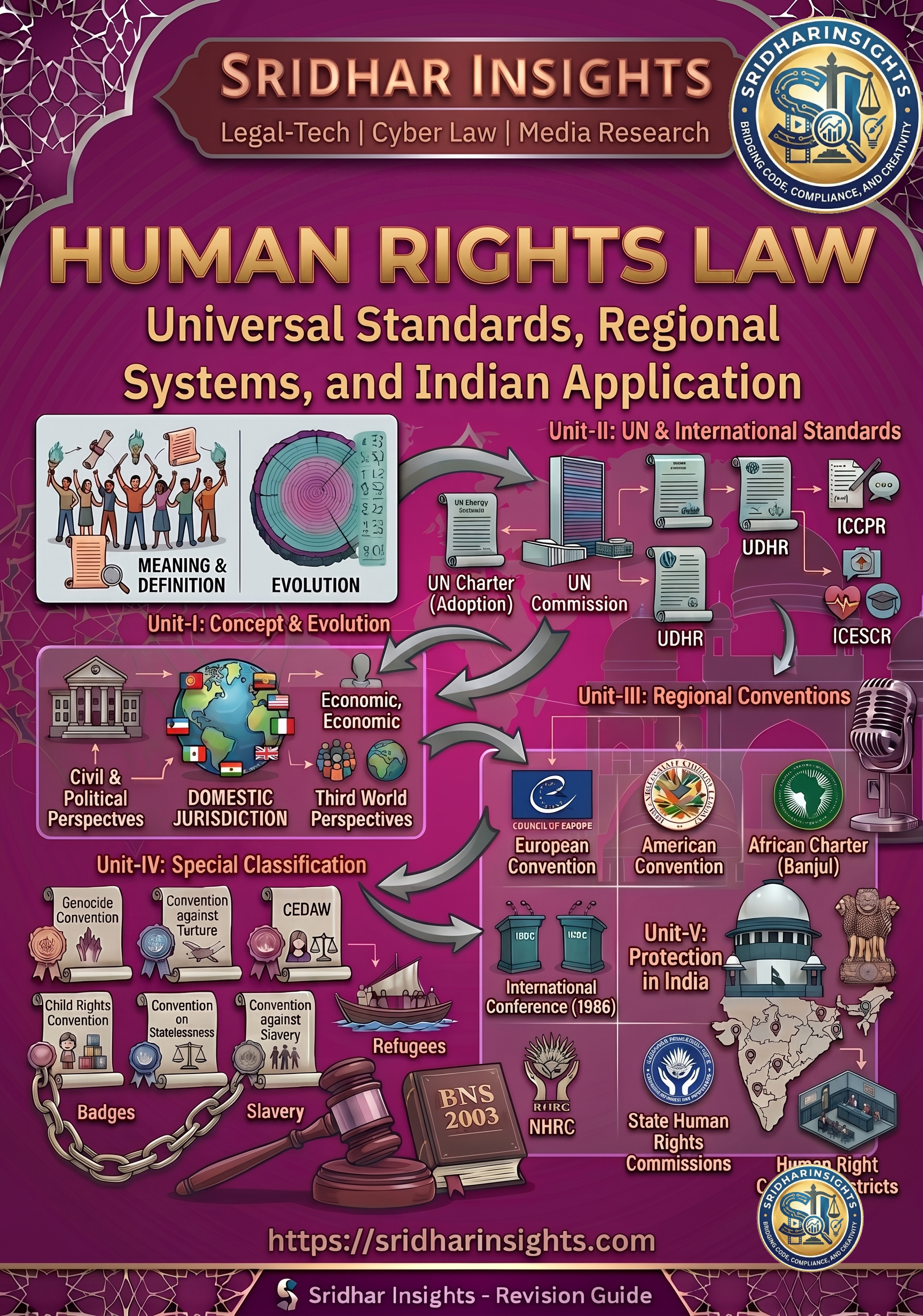
Accelerate your legal studies and master the global, regional, and domestic mechanisms that protect human dignity. Based on the highly acclaimed infographic architecture of Sridhar Insights, this exam-oriented course translates dense international treaties, ideological cold war schisms, complex regional court jurisprudences, and specialized conventions into clear, actionable, and linear text-based modules. Designed specifically for law students and legal professionals looking for a high-efficiency revision system, this course demystifies both the philosophical foundations and enforcement realities of human rights law.
Through structured breakdowns, milestone landmark cases, and high-yield question banks, you will build a rock-solid understanding of the international bill of rights and its statutory domestication in India.
What You Will Learn:
- Unit I: Foundations, Evolution, and Third World Perspectives Explore the philosophical birth of inherent human dignity from ancient Natural Law to modern codification. Study the generational classification of rights (Vasak’s 3 Generations) , the legal tension between state sovereignty (Article 2(7)) and international intervention models like R2P , and the critical post-colonial challenge raised by Third World Approaches to International Law (TWAIL).
- Unit II: The UN System and International Bill of Rights Analyze how the UN Charter formalized international competence over human dignity (Articles 55 & 56). Trace the legal evolution of the Universal Declaration of Human Rights (UDHR) into Customary International Law. Compare and contrast the immediate, negative obligations of the ICCPR with the progressive, positive obligations of the ICESCR , and map the UN enforcement transition to the Human Rights Council (UNHRC) and the Universal Periodic Review (UPR).
- Unit III: Regional Conventions on Human Rights Evaluate the decentralization of enforcement through the lens of subsidiarity. Study the European System (ECHR), its historic Protocol 11 integration , and the Margin of Appreciation doctrine. Confront the realities of military juntas through the Inter-American system (ACHR) , and explore how the African System (Banjul Charter) rejects pure Western individualism to embrace collective “Peoples’ Rights” and legally binding “Individual Duties”.
- Unit IV: Specialized International Conventions Deep dive into targeted legal frameworks protecting vulnerable demographics and prohibiting peremptory (Jus Cogens) international crimes. Master the extreme evidentiary burdens of Dulus Specialis under the Genocide Convention , the absolute prohibition and universal jurisdiction rules (Aut dedere aut judicare) of the Convention Against Torture , the substantive equality metrics of CEDAW , the Best Interests Principle of the Child Rights Convention (CRC) , and the universal rules of Refugee Law including the absolute block on Non-Refoulement.
- Unit V: Human Rights Protection in India Study the structural domestication of international covenants via the Protection of Human Rights Act (PHRA), 1993, and its compliance with the UN Paris Principles. Examine the constitution, investigative powers, and “toothless tiger” critiques of the National Human Rights Commission (NHRC)—including the crucial 2019 Amendments. Understand State Commission (SHRC) boundary overlaps and evaluate the practical operational bottlenecks of designated District Human Rights Courts.
Course Features & Study Aids Include:
- Linear Text Mind Maps: High-yield visual revision flows mapping complex systemic treaty rules to clear text segments.
- Exam-Prep High-Yield Modules: Targeted 10-Mark Essay and 4-Mark Short Note practice banks designed to match university assessment standards.
- Rapid Revision Reference Tables: Instant comparison blocks mapping out the Three Generations of Rights, ICCPR vs. ICESCR variables, Comparative Regional Architectures, and NHRC vs. SHRC parameters.
Who is This Course For?
- LL.B. & LL.M. Students seeking an accelerated, structurally clean visual companion to ace their semester finals and comprehensive exams.
- Competitive Exam Aspirants framing high-yield, accurate metrics for Judicial Services or civil service public administration mains.
- Human Rights Advocates & Policy Researchers seeking a concise, global-to-local functional overview mapping treaty standards straight to Indian statutory application.
Course Content
Mastering Human Rights Law: A Visual Revision Guide to International, Regional, and Indian Frameworks
Mastering Human Rights Law: A Visual Revision Guide to International, Regional, and Indian Frameworks