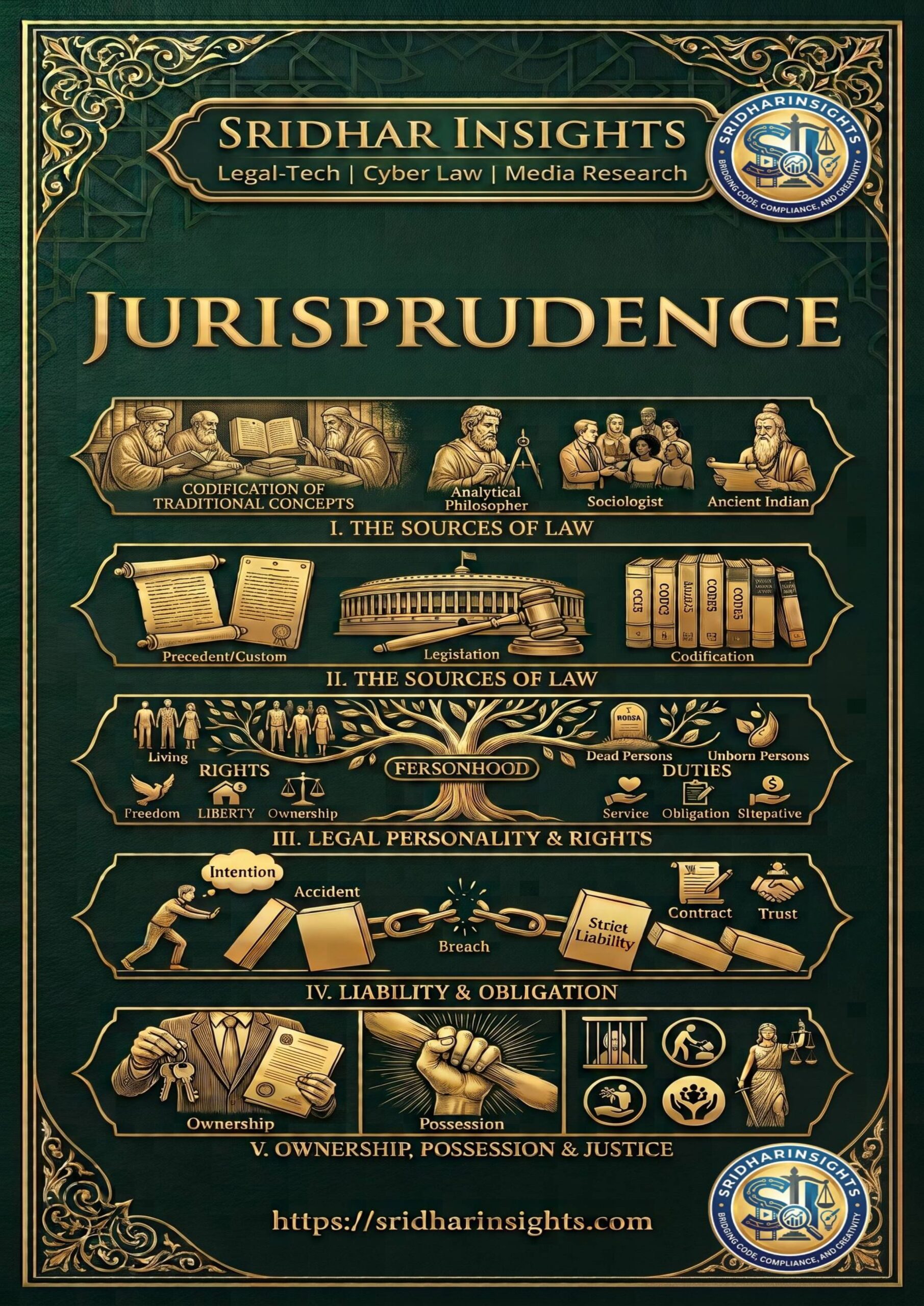
Jurisprudence

Categories: LAW, LLB
Wishlist Share

About Course

A comprehensive, structured course description tailored for the Jurisprudence module on Sridhar Insights:

Course Overview

This foundational course in Legal Theory provides a systematic exploration of Jurisprudence—the philosophical grammar and structural foundation underpinning modern legal orders. Bridging traditional legal philosophy, contemporary statutory frameworks, and emerging legal-tech intersections, this course covers fundamental concepts from ancient juristic traditions to digital-era legal challenges.

What You Will Learn

  • Unit I: Foundations, Schools & Theories of Law
    • Meaning, nature, and definitions of jurisprudence (Bentham, Austin, Salmond, Holland).
    • Elements of Ancient Indian Jurisprudence: Dharma, Rajadharma, Vyavahara, and classical sources (Shruti, Smriti, Sadachara).
    • Core Schools: Analytical Positivism, Historical School (Volksgeist), Philosophical/Natural Law, and Sociological School (Social Engineering & Social Solidarity).
    • Nature, purpose, and classification of law, theories of sovereignty, and the convergence of Equity, Law, and Justice.
  • Unit II: Sources of Law & Codification
    • Legal vs. Historical sources of law.
    • Legislation: Supreme vs. subordinate legislation and core canons of statutory interpretation (Literal, Golden, Mischief Rules).
    • Judicial Precedent: Stare Decisis, Ratio Decidendi, Obiter Dicta, and judgments per incuriam under Article 141.
    • Custom: Requisites of a valid custom and the debate surrounding legislative codification.
  • Unit III: Legal Personality, Rights & Duties
    • Legal status of non-human and non-standard entities: unborn persons, dead persons, animals, and religious institutions.
    • Corporate personality: Theories (Fiction, Concession, Realist) and the doctrine of lifting the corporate veil.
    • Analytical taxonomy of rights and duties: Perfect/imperfect, in rem/in personam, and Hohfeld’s Jural Correlatives and Opposites.
  • Unit IV: Obligation, Fault & Liability
    • Sources of obligations: Contracts, Quasi-Contracts, and Trusts.
    • Fault frameworks: Actus Reus, Mens Rea, Intention vs. Motive, Negligence, and Vicarious Liability.
    • Strict Liability (Rylands v. Fletcher) vs. Absolute Liability (C. Mehta).
    • Principles governing the measure of civil compensation versus criminal penal sanctions.
  • Unit V: Ownership, Possession, Property & Administration of Justice
    • Corporeal vs. incorporeal ownership and the bundle of proprietary rights.
    • Elements of possession (Corpus and Animus) and possessory remedies under Section 6 of the Specific Relief Act.
    • Modes of property acquisition and classification of legal sanctions.
    • Theories of Criminal Justice and Punishment: Deterrent, Preventive, Reformative, and Retributive theories.

Course Highlights & Materials

  • Contemporary Convergence: Analysis of emerging digital-age legal questions, including AI personhood, smart contract obligations, algorithmic sentencing, and virtual property rights.
  • Practice & Assessment: Unit-wise descriptive model answers, key ratio matrices, Latin maxims, and 250+ standard MCQs aligned with competitive legal examinations (AIBE, CLAT-PG, and Judicial Services).


Show More

What Will You Learn?

  • Master the foundations of Jurisprudence, tracing its evolution from ancient Indian concepts of Dharma to modern analytical, historical, philosophical, and sociological schools.
  • Deconstruct the primary Sources of Law, evaluating Legislation, Precedent (Stare Decisis, Ratio Decidendi), Custom, and principles of statutory interpretation.
  • Analyze the nature of Legal Personality, including corporate personality theories (Fiction, Concession, Realist) and the doctrine of lifting the corporate veil.
  • Navigate the Hohfeldian analytical framework of Rights and Duties, distinguishing between absolute/relative rights and mapping jural correlatives and opposites.
  • Evaluate the architecture of legal responsibility, distinguishing between civil/criminal liability, understanding Mens Rea, and applying Strict and Absolute Liability (M.C. Mehta).
  • Master the concepts of Ownership and Possession (Corpus and Animus), possessory remedies under the Specific Relief Act, and modes of acquiring Property.
  • Understand the administration of justice and evaluate the Deterrent, Preventive, Reformative, and Retributive theories of criminal punishment.
  • Apply traditional jurisprudential concepts to contemporary technological challenges like AI personhood, algorithmic sentencing, and smart contracts.

Course Content

Jurisprudence
Unit I: Foundations, Schools, and Theories of LawTitle: Unit I: Foundations, Schools, and Theories of Law Summary: Explore the foundational philosophy and definitions of Jurisprudence, tracing its evolution from Ancient Indian legal frameworks (Dharma, Rajadharma, Vyavahara) to Western schools of thought (Analytical, Historical, Natural Law, and Sociological) . Examine the nature, purpose, and classification of law, modern theories of constitutional sovereignty, and the synthesis of Equity, Law, and Justice .Unit II: Sources of LawTitle: Unit II: Sources of Law & Codification Summary: Analyze the genetic origin and formal foundations of legal rules across Legal and Historical sources . Study Legislation (supreme, subordinate, and statutory interpretation canons), Precedent (Stare Decisis, Ratio Decidendi, and Obiter Dicta under Article 141), and Custom (requisites of a valid custom), concluding with the Bentham vs. Savigny debate on statutory Codification[cite: 1].Unit III: Legal Persons, Rights, and DutiesTitle: Unit III: Legal Persons, Rights, and Duties[cite: 1]Summary: Examine legal capacity, artificial personhood, and normative relationships[cite: 1]. Explore the legal status of non-standard entities (unborn persons, deceased individuals, animals, and religious idols) and corporate personality theories (Fiction, Concession, Realist, and veil-lifting)[cite: 1]. Master the structural taxonomy of rights and duties through Wesley Hohfeld’s analytical table of Jural Correlatives and Opposites[cite: 1].Unit IV: Obligation, Liability, Fault, and SanctionsTitle: Unit IV: Obligation, Fault, and Civil vs. Criminal Liability[cite: 1]Summary: Deconstruct legal ties (vinculum juris) arising from Contracts, Quasi-Contracts, and Trusts alongside fault-based accountability frameworks[cite: 1]. Analyze Actus Reus, Mens Rea, Intention vs. Motive, Culpable Negligence, and Vicarious Liability, contrasting English Strict Liability (Rylands) with Indian Absolute Liability (M.C. Mehta) and evaluating the distinct measures of civil compensation versus criminal punishment[cite: 1].Unit V: Ownership, Possession, Property, and Administration of JusticeTitle: Unit V: Ownership, Possession, Property, and Administration of Justice[cite: 1]Summary: Explore proprietary control and institutional justice mechanisms[cite: 1]. Examine the bundle of ownership rights, the dual elements of possession (Corpus Possessionis and Animus Possidendi), and statutory possessory remedies under the Specific Relief Act[cite: 1]. Conclude with modes of property acquisition, legal sanctions, and the four primary theories of criminal punishment (Deterrent, Preventive, Reformative, and Retributive)[cite: 1].

  • Jurisprudence
error: Content is protected !!