About Course
Course Overview
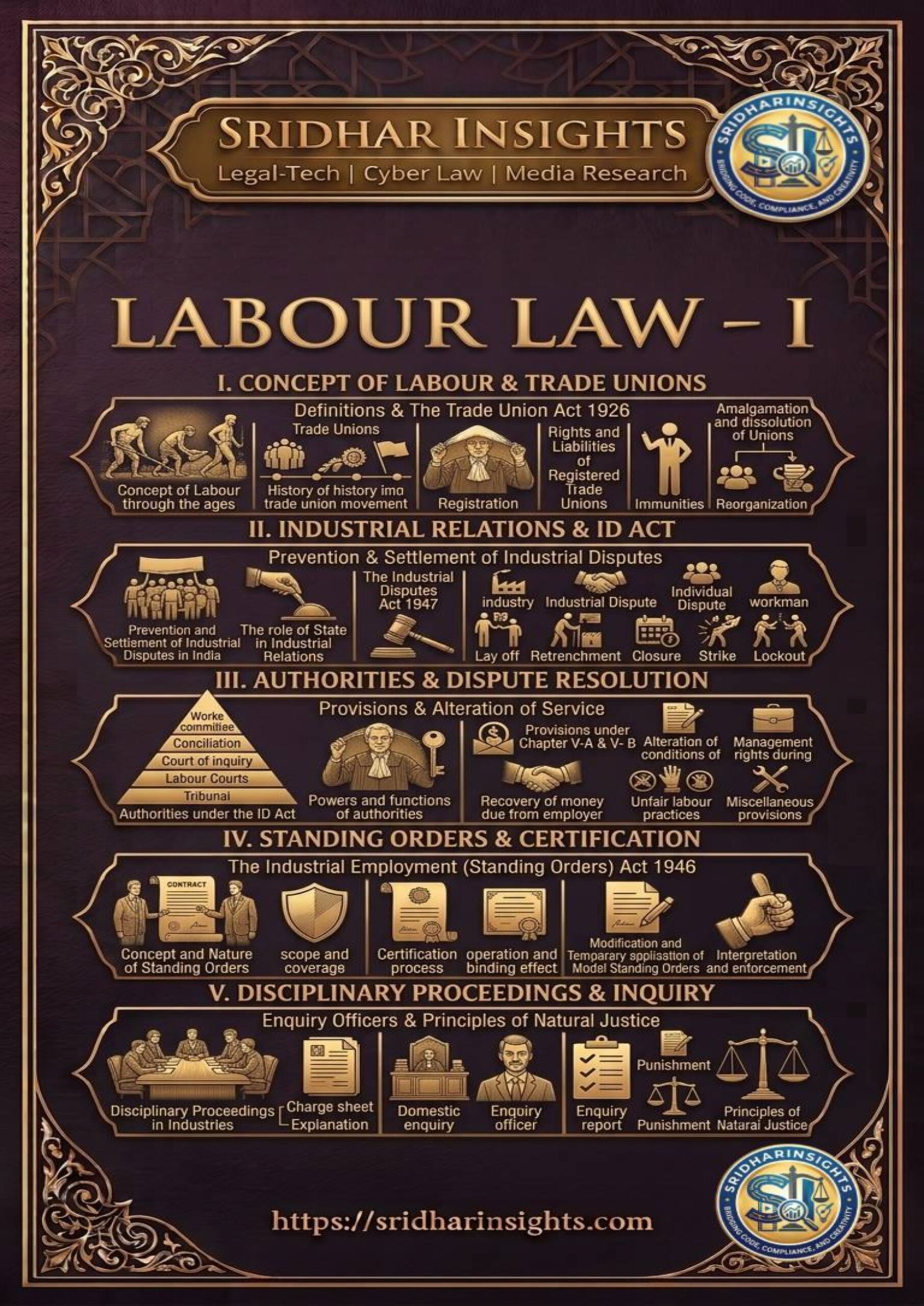
This course provides a comprehensive, systematic study of Labour Law – I, centered on the Trade Unions Act, 1926, the Industrial Disputes Act, 1947 (IDA), the Industrial Employment (Standing Orders) Act, 1946, and the constitutional principles governing industrial disciplinary proceedings. Structured for academic excellence and competitive legal examinations, it explores the evolution of labour rights, collective bargaining, dispute settlement machineries, economic weapons (strikes/lockouts), employment security provisions (lay-off, retrenchment, closure), and domestic inquiry procedures anchored by natural justice.
What You Will Learn
Unit I: Concept of Labour, History & The Trade Union Act, 1926
Evolution of labour from the Laissez-Faire police state to the modern Welfare State and ILO principles (“Labour is not a commodity”).
History of trade unionism in India: Madras Labour Union (1918), the Buckingham & Carnatic Mills litigation, and AITUC formation.
Statutory definitions of “Trade Union” (Sec 2(h)) and “Trade Dispute” (Sec 2(g)).
Registration procedure, Section 4 membership thresholds (10% or 100 workmen), and cancellation grounds.
Corporate status (Sec 13), General Fund (Sec 15), voluntary Political Fund (Sec 16), and statutory immunities: Criminal Conspiracy immunity under Section 17 and Civil Tort immunity under Section 18 (Rohtas Industries).
Amalgamation (50/60 voting rule), Dissolution (Sec 27), and Reorganization protocols.
Unit II: Industrial Relations & The Industrial Disputes Act, 1947
Role of the State as a regulator and gatekeeper under Section 10 references (State of Madras v. C.P. Sarathy).
Definition of “Industry” (Sec 2(j)) and the landmark Bangalore Water Supply Triple Test.
Industrial Disputes (Sec 2(k)) vs. Individual Disputes under Section 2A.
“Workman” criteria (Sec 2(s)), supervisory wage ceilings (₹10,000/month), and the dominant nature of duties test (Burmah Shell).
Statutory definitions and compensation rules for Lay-off (Sec 2(kkk)), Retrenchment (Sec 2(oo), Sec 25F), and Closure (Sec 2(cc)).
Legal framework governing Strikes (Sec 2(q)), Lockouts (Sec 2(l)), Public Utility Services restrictions (Sec 22), and general prohibitions (Sec 23).
Unit III: Authorities, Adjudication & Protective Provisions (IDA, 1947)
Dispute resolution hierarchy: Works Committees (Sec 3), Conciliation Officers/Boards (Sec 4 & 5), Courts of Inquiry (Sec 6), Labour Courts (Schedule II), Industrial Tribunals (Schedule III), and National Tribunals (Sec 7B).
Voluntary Arbitration procedures and statutory awards under Section 10A.
Economic protections: Chapter V-A vs. Chapter V-B (mandatory prior government permission for establishments with 100+ workmen — Excel Wear).
Management restrictions during pending disputes under Section 33 (prior permission for connected matters vs. approval for unconnected dismissals) and “Protected Workmen” status.
Summary recovery of dues under Section 33C as an execution proceeding (MCD v. Ganesh Razak) and prohibition of Unfair Labour Practices (Fifth Schedule, Sec 25T & 25U).
Unit IV: The Industrial Employment (Standing Orders) Act, 1946
Concept, nature, and binding statutory force of Certified Standing Orders (Bagalkot Cement Co.).
Scope and coverage: Applicability to establishments with 100+ workmen (and state modifications) and Section 13B exclusions.
Tripartite certification procedure (Sec 3–5), adjudication of fairness/reasonableness (Rohtak Hissar), and appeal mechanisms.
Temporary application of Model Standing Orders (Sec 12A) and the 6-month modification embargo (Sec 10).
Specialized interpretation before Labour Courts (Sec 13A — Rajasthan SRTC), employer penalties (Sec 13), and statutory Subsistence Allowance (Sec 10A).
Unit V: Disciplinary Proceedings in Industries & Domestic Enquiry
Application of Principles of Natural Justice (PNJ): Rule Against Bias (Nemo Judex In Causa Sua — Meenglas Tea Estate) and Right to Fair Hearing (Audi Alteram Partem).
Requisites of a valid Charge Sheet (Sur Enamel) and handling of written explanations.
Procedure of Domestic Enquiry: Role of Enquiry Officer, Presenting Officer, defense representation (Crescent Dyes), and evidentiary standards (preponderance of probabilities — State of Haryana v. Rattan Singh).
The Enquiry Report: Mandatory supply of the report to delinquent workers before punishment (ECIL v. B. Karunakar).
Disciplinary Authority powers, past record considerations, minor/major penalties, and Labour Court appellate scrutiny over disproportionate punishments under Section 11A (Colour-Chem Ltd.).
Course Highlights & Materials
Contemporary Convergence: Analysis of gig-economy platform workers, digital strikes, algorithmic management as an unfair labour practice, remote-work misconduct, and e-domestic enquiries.
Practice & Assessment: Unit-wise descriptive model answers, practical drafting precedents (charge sheets, strike notices, 33C execution claims, suspension orders), revision cheat codes, and 250+ standard MCQs aligned with competitive legal exams.
Course Content
LABOUR LAW – I
LABOUR LAW – I