Law of Evidence (Bharatiya Sakshya Adhiniyam, 2023)

Categories: LAW, LLB
Wishlist Share

About Course

Here is a comprehensive course description and a strategic set of tags optimized for your online course launch, completely tailored to the structure and content of your Law of Evidence revision guide.

Course Title Idea

Mastering the Law of Evidence: A Visual Revision Guide to Relevancy, Admissibility, and Witness Examination

Course Description

About This Course

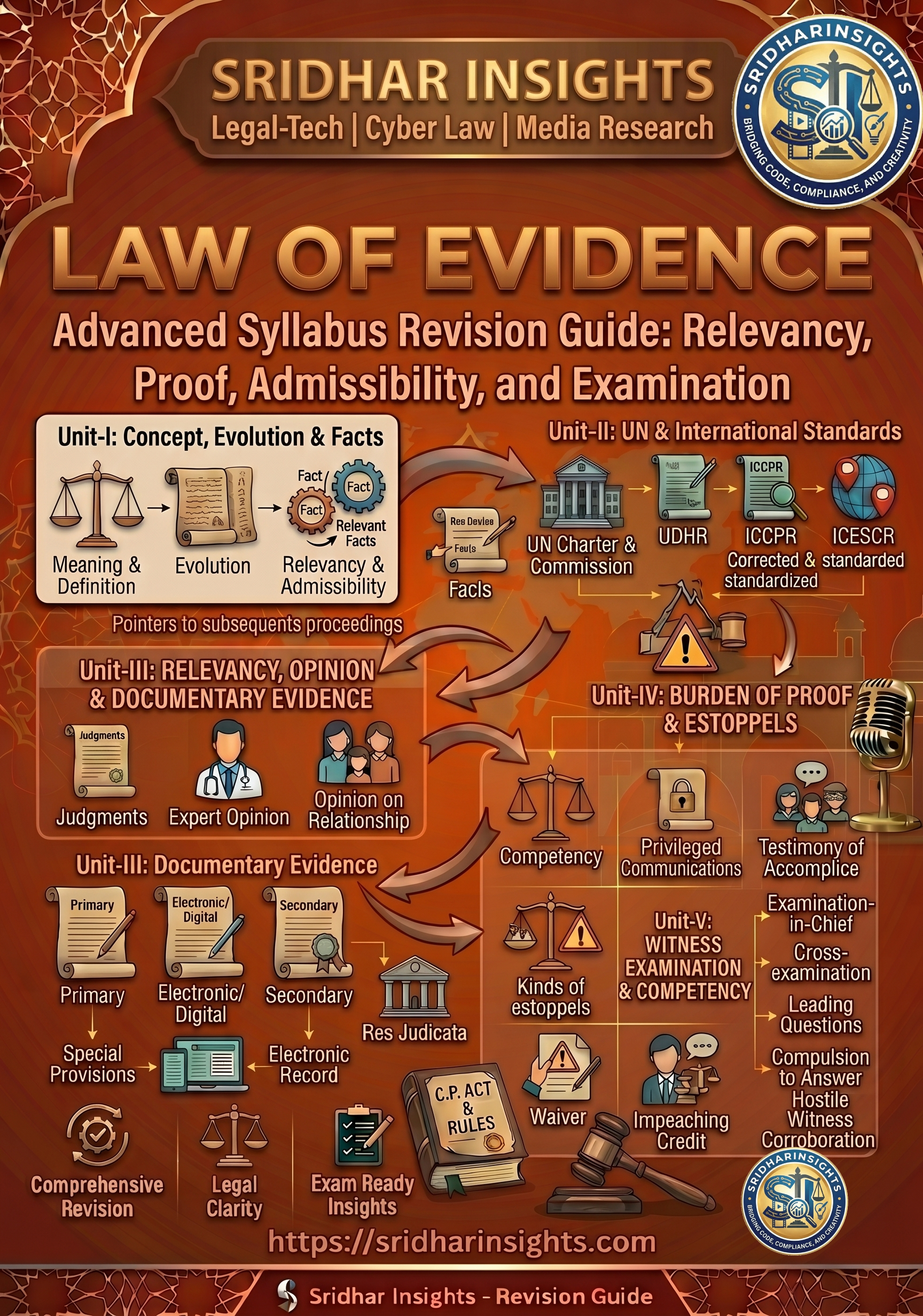
Master the intricate rules of proof and the strict procedural frameworks governing judicial trials. Based on the highly acclaimed infographic architecture of Sridhar Insights, this exam-oriented course translates dense statutory provisions, admissibility hurdles, and complex courtroom examination flows into clear, actionable, and linear text-based modules. Designed specifically for law students and legal professionals looking for a high-efficiency revision system, this course demystifies the rules of relevancy, documentary thresholds, and the mechanics of witness testimony.

Through structured breakdowns, milestone judicial precedents, and high-yield question banks, you will build a bulletproof understanding of legal proof from foundational concepts to advanced courtroom application.

What You Will Learn

  • Unit I: Concept, Evolution & Relevancy of Facts Explore the core meaning and foundational definitions of facts, tracking the precise legal distinctions between Relevancy (what is logically connected) and Admissibility (what the law allows in court). Master the territorial application of evidence laws and the evolutionary transition of proof rules.

  • Unit II: Admissions & Confessions Deep dive into statements that establish liability or guilt. Master the general principles governing Admissions and contrast them with Confessions. Evaluate the strict admissibility bars regarding Confessions made to the Police, the legal weight of Judicial vs. Extra-Judicial confessions, and the rules governing Co-Accused statements.

  • Unit III: Third-Party Opinions & Judgments Analyze when the opinions of outsiders become relevant in a trial. Study the strict criteria for introducing Expert Opinions (science, art, handwriting) and the rules regarding statements made by persons who cannot be called as witnesses (Dying Declarations). Learn when previous Judgments of a court are relevant to bar subsequent proceedings.

  • Unit IV: Oral, Documentary & Digital Evidence Deconstruct how physical and electronic statements are authenticated. Master the legal boundaries separating Primary and Secondary evidence, alongside the explicit statutory provisions regulating Digital and Electronic Records. Study the rules of Burden of Proof scales, presumptions of law, and the various kinds of Estoppels.

  • Unit V: Witness Competency & Examination Flow Step through the practical execution metrics of witness testimony. Understand witness competency, the evidentiary value of Accomplice testimony, and the protective boundaries of Privileged Communications. Master the three-stage structural trial flow: Examination-in-Chief, Cross-Examination, and Re-Examination—including rules on Leading Questions, Hostile Witnesses, and impeaching the credit of a witness.

Course Features & Study Aids Include:

  • Linear Text Mind Maps: Dense procedural evidence concepts translated into scannable visual flows for maximum memory retention.

  • Courtroom Examination Flows: Step-by-step structural breakdowns detailing the precise transitions from direct examination to cross-examination protocols.

  • Modern Statutory Parallelisms: Strategic integration of classic evidence rules alongside the modern Bharatiya Sakshya Adhiniyam (BSA) context to align your revision with the latest legal landscape.

Who is This Course For?

  • LL.B. & LL.M. Students seeking an accelerated, structurally clean visual companion to clear semester finals and comprehensive core law modules.

  • Judicial Services & Trial Advocacy Aspirants targeting high-yield statutory definitions, trial procedures, and witness examination rules.

  • Litigators, Trial Lawyers & Legal Researchers who need a practical, logically mapped visual overview bridging classic evidence frameworks with modern digital admissibility codes.

Show More

What Will You Learn?

  • Trace the foundational evolution, structural terminology, and historical jurisprudence of global and domestic evidence law.
  • Analyze the critical, precise legal boundaries separating logical Relevancy from statutory Admissibility during active trials.
  • Understand the operational limits of territorial and extra-territorial jurisdiction within evidence applications.
  • Master the general principles of Admissions and contrast them precisely with the high thresholds of criminal Confessions.
  • Evaluate the strict statutory bars and exclusionary rules regarding Confessions made directly to Police officers.
  • Distinguish between the unique evidentiary weights of Judicial confessions and out-of-court Extra-Judicial confessions.
  • Analyze the legal parameters, conditions, and collaborative liabilities surrounding Co-Accused Statements.
  • Unpack the strict requirements for introducing expert statements by missing witnesses via Dying Declarations.
  • Identify the strict criteria, evaluation standards, and fields of science or art open to Expert Opinions.
  • Evaluate when previous final court Judgments are legally relevant to bar subsequent legal proceedings via Res Judicata.
  • Understand the clear operational boundaries, rules of proof, and presentation parameters governing Oral Evidence.
  • Master the strict legal borders separating Primary documentary evidence from secondary documentary evidence.
  • Analyze the contemporary statutory rules, special provisions, and verification tracking required for Electronic Evidence.
  • Apply the authentication parameters and compliance thresholds required for the admissibility of Digital Records.
  • Master the shifting allocation scales, structural shifts, and legal definitions of the Burden of Proof.
  • Deconstruct Presumptions of Law and factual presumptions to understand how a legal proof level is constructed.
  • Evaluate the distinct categories, waiver elements, and equitable boundaries of the various Kinds of Estoppels.
  • Determine witness competency rules, child or disabled witness parameters, and the legal weight of Accomplice Testimony.
  • Navigate the protective legal

Course Content

Law of Evidence: High-Efficiency Revision Guide for LL.B. & LL.M.
Master the intricate rules of proof, admissibility hurdles, and the procedural mechanics governing judicial trials with this high-efficiency, exam-oriented revision course. Built upon the widely acclaimed infographic and structural blueprint of Sridhar Insights, this course translates dense statutory provisions, complex exclusionary rules, and courtroom testimony protocols into clear, highly scannable, linear text modules. Perfect for LL.B. and LL.M. students preparing for semester finals, as well as competitive judicial services aspirants and developing trial advocates, this course bridges abstract codifications with practical courtroom applications. By the end of this course, you will possess a bulletproof command over how legal facts are discovered, authenticated, and leveraged during an active trial. Key Frameworks Covered: The Jurisprudence of Proof: Mastering the precise legal boundaries that separate logical Relevancy from statutory Admissibility. Admissions & Confessions: Navigating the strict exclusionary rules regarding confessions made to police, contrasting judicial and extra-judicial statements, and evaluating co-accused liabilities. Third-Party Statements & Expert Opinions: Unpacking the strict evidentiary parameters for introducing specialized expert testimony and statements by missing witnesses (Dying Declarations). Oral, Documentary & Electronic Evidence: Breaking down primary vs. secondary evidence, understanding burden of proof scales, and mastering the modern authentication standards required for digital and electronic records. Witness Examination & Competency: Stepping through courtroom trial flows—from Examination-in-Chief to Cross-Examination and Re-Examination—including rules on leading questions, hostile witnesses, accomplice testimony, and privileged communications. The IPC-IEA to BSA Transition: Integrating classic trial proof principles alongside the modern Bharatiya Sakshya Adhiniyam (BSA) framework to keep your knowledge perfectly aligned with the latest legal updates.

  • High-Efficiency Revision Guide for LL.B. & LL.M.
error: Content is protected !!