About Course
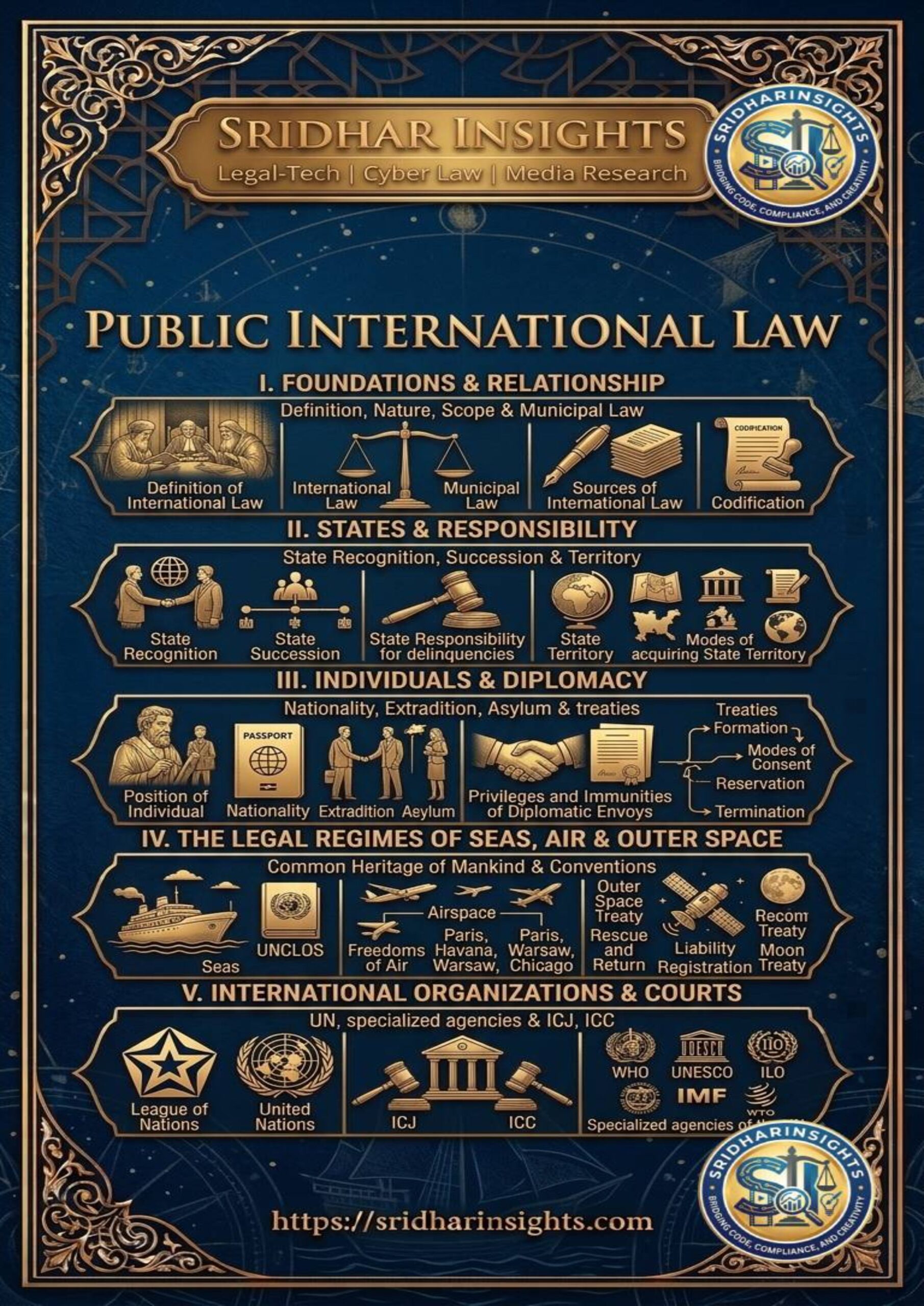
Course Overview This course provides a comprehensive, systematic study of Public International Law (PIL), centered on the foundational principles governing sovereign States, international organizations, and individuals on the global stage. Structured for academic excellence and competitive legal examinations, it explores the evolution of international legal theory, the law of treaties, state responsibility, diplomatic immunities, and the legal regimes governing global commons such as the seas, airspace, and outer space.
What You Will Learn
Unit I: Public International Law: Foundations, Sources, and Relation to Municipal Law
Evolution of the definition of International Law from the classic State-only era to the modern inclusion of international organizations and individuals.
Jurisprudential battle between Monism and Dualism regarding how international treaties enter domestic (Municipal) legal systems, highlighting the Indian Constitutional position.
Thorough analysis of the Sources of International Law codified in Article 38(1) of the ICJ Statute, including Treaties, International Custom (State Practice and Opinio Juris), and General Principles.
The process of Codification spearheaded by the UN General Assembly and the International Law Commission (ILC).
Unit II: Public International Law: Statehood, Responsibility, And Territory
State Recognition frameworks: Declaratory vs. Constitutive theories, and the differences between De Facto and De Jure recognition.
Mechanics of State Succession, including the “Clean Slate” doctrine for treaties and the transfer of public property and localized debts.
Responsibility of States for international delinquencies under the ILC Draft Articles 2001, focusing on Imputability and Reparation (Restitution, Compensation, Satisfaction).
The spatial architecture of State Territory and the traditional modes of acquiring title: Occupation (Terra Nullius), Prescription, Accretion, Cession, and Annexation (now illegal).
Unit III: Public International Law: The Individual, Diplomatic Immunity, and the Law of Treaties
The transformation of the individual from an “object” to a direct “subject” of international law, possessing human rights and direct criminal liability.
Acquisition of Nationality (Jus Soli, Jus Sanguinis, Naturalization) and the “Genuine Link” requirement established in the Nottebohm case.
Rules governing Extradition (Double Criminality, Specialty, Political Offense Exception) and Asylum (Territorial vs. Extra-Territorial).
Absolute privileges and immunities of diplomatic envoys under the Vienna Convention on Diplomatic Relations (VCDR) 1961, and the host state’s weapon of Persona Non Grata.
The lifecycle of Treaties under the VCLT 1969: formation, modes of consent, reservations, and termination doctrines like Material Breach, Rebus Sic Stantibus, and Jus Cogens.
Unit IV: The Legal Regime of the Seas, Airspace, and Outer Space
The evolution of the Law of the Sea and the codification of maritime zones under UNCLOS 1982: Territorial Sea, Contiguous Zone, EEZ, and the High Seas.
The Freedoms of the High Seas and the application of the Common Heritage of Mankind (CHM) doctrine to the deep seabed.
The Legal Regime of Airspace moving from the Paris Convention to the Chicago Convention 1944, outlining absolute sovereignty and the Five Freedoms of the Air.
The governance of Outer Space anchored by the Outer Space Treaty (1967), the Liability Convention, the Rescue Agreement, and UNISPACE principles.
Unit V: International Organizations, Courts, and Specialized Agencies
The structural evolution from the failed League of Nations to the United Nations, focusing on the absolute ban on force and the UNSC veto power.
Jurisdiction and composition of the International Court of Justice (ICJ), differentiating between Contentious (binding on States) and Advisory jurisdictions.
The International Criminal Court (ICC) under the Rome Statute, its jurisdiction over core international crimes, and the Principle of Complementarity.
The mandates and regulatory powers of UN Specialized Agencies, including the WHO, UNESCO, ILO (Tripartite structure), IMF, and the WTO (Marrakesh Agreement and Dispute Settlement Body).
Course Highlights & Materials
Contemporary Convergence: Critical analysis of cutting-edge intersections, including the codification of cyber warfare (Tallinn Manual), commercial spaceflight liability, blockchain “Smart Treaties,” cyber-asylum disputes, and WHO digital genomic surveillance.
Practice & Assessment: Unit-wise descriptive model questions, practical diplomatic drafting precedents (Notes Verbale, Treaty Reservations, Extradition Briefs), and a rigorous 50-question MCQ repository aligned with AIBE and CLAT-PG standards.
Course Content
Public International Law
Public International La