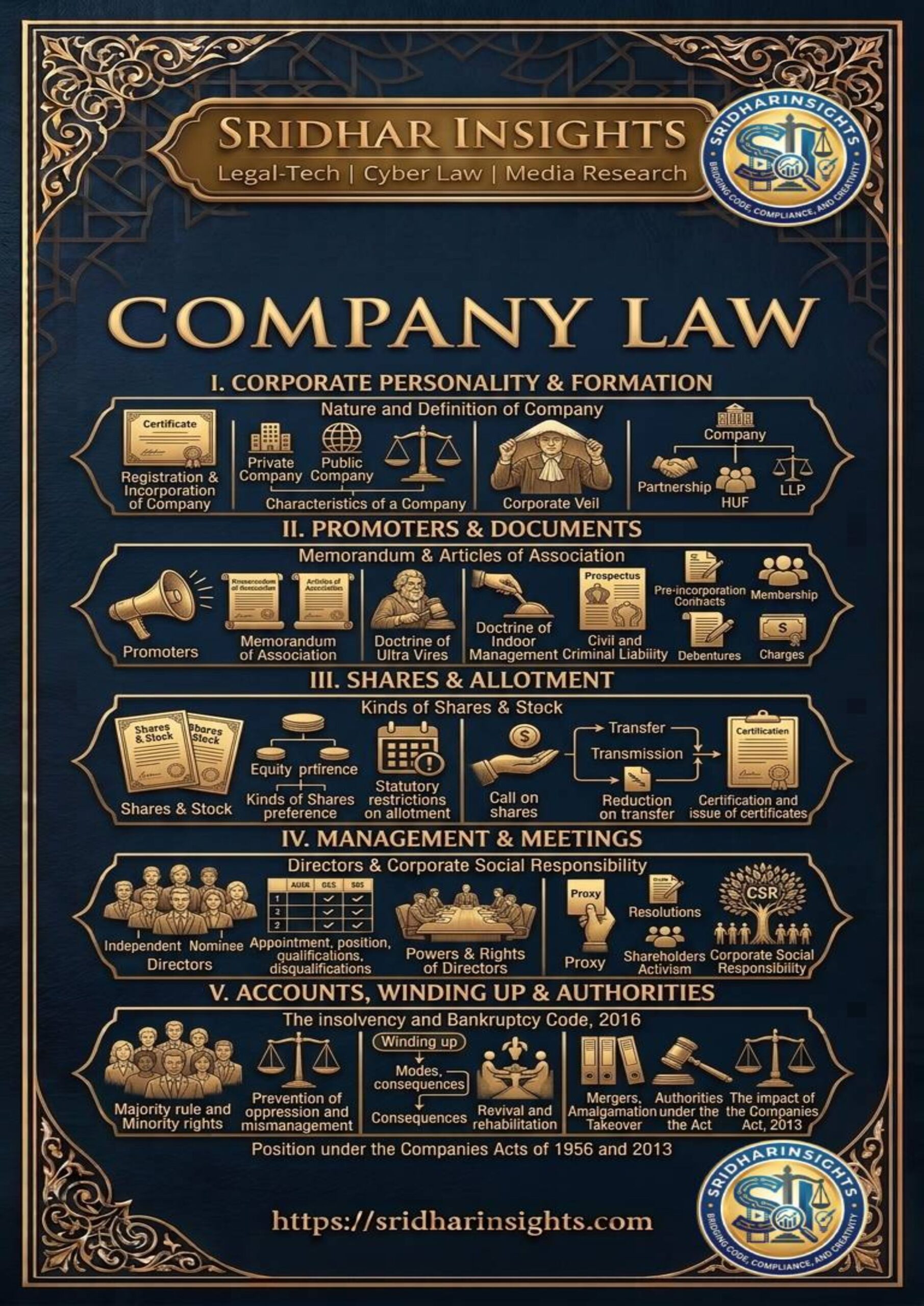
Company Law | Legal | Quiz
Promoters, charter documents,Capital raising, and borrowing powers | Company Law | MCQ Quiz with Answers | Test Your Legal Knowledge
Company Law MCQ Quiz (1–50)
(1). Who among the following is legally recognized as a Promoter under Section 2(69) of the Companies Act, 2013?
- [A]. An independent statutory auditor
- [B]. A person named as such in a prospectus or annual return
- [C]. A mere legal advisor drafting documents
- [D]. A court-appointed liquidator
(2). What is the legal status of a pre-incorporation contract executed by a promoter?
- [A]. Fully binding on the company from birth
- [B]. Not binding on the company, and the promoter is personally liable
- [C]. Voidable at the option of the third party
- [D]. Automatically transferred to the government
(3). Under the Specific Relief Act, 1963, a company can be bound by a pre-incorporation contract if:
- [A]. It ignores the contract
- [B]. The contract is warranted by the incorporation terms and the company expressly accepts it
- [C]. The promoter escapes the country
- [D]. It is signed in green ink
(4). The foundational English case establishing that promoters remain personally liable for pre-incorporation contracts is:
- [A]. Kelner v. Baxter
- [B]. Salomon v. Salomon
- [C]. Derry v. Peek
- [D]. Carlill v. Carbolic Smoke Ball
(5). The Memorandum of Association must contain a Name Clause, Object Clause, Capital Clause, Liability Clause, and:
- [A]. Sub-delegation Clause
- [B]. Registered Office (Situation) Clause
- [C]. Employee Salary Clause
- [D]. Arbitration Clause
(6). Any act done by a company which travels beyond the powers granted in its Object Clause is:
- [A]. Voidable at the option of the directors
- [B]. Valid if ratified by a special resolution of shareholders
- [C]. Ultra Vires and absolutely void ab initio
- [D]. Intra Vires but illegal
(7). The Doctrine of Ultra Vires was firmly established by the House of Lords in which landmark case?
- [A]. Royal British Bank v. Turquand
- [B]. Ashbury Railway Carriage and Iron Co. Ltd. v. Riche
- [C]. Foss v. Harbottle
- [D]. Lee v. Lee’s Air Farming
(8). Which document contains the internal rules and regulations for the management of the company?
- [A]. Memorandum of Association
- [B]. Prospectus
- [C]. Articles of Association
- [D]. Statutory Declaration
(9). The legal presumption that an outsider dealing with a company has read and understood the company’s MoA and AoA is called the Doctrine of:
- [A]. Constructive Notice
- [B]. Indoor Management
- [C]. Vicarious Liability
- [D]. Promissory Estoppel
(10). The Doctrine of Indoor Management mitigates the harshness of Constructive Notice by allowing outsiders to assume that:
- [A]. The company is highly profitable
- [B]. Internal proceedings (like board resolutions) required by the AoA have been duly and properly carried out
- [C]. The directors are immune from lawsuits
- [D]. The MoA can be ignored
(11). Which case birthed the Doctrine of Indoor Management?
- [A]. Royal British Bank v. Turquand
- [B]. Rylands v. Fletcher
- [C]. Donoghue v. Stevenson
- [D]. Gilford Motor Co. v. Horne
(12). An outsider CANNOT claim the protection of Turquand’s Rule (Indoor Management) if:
- [A]. They acted in good faith
- [B]. The transaction involved a forged document
- [C]. They paid full consideration
- [D]. They are a foreign citizen
(13). A document inviting the public to subscribe for shares or debentures of a company is a:
- [A]. Circular
- [B]. Prospectus
- [C]. Power of Attorney
- [D]. Trust Deed
(14). A prospectus must be drafted with absolute truthfulness and no material concealment. It is considered a contract of:
- [A]. Caveat Emptor (Let the buyer beware)
- [B]. Uberrimae Fidei (Utmost good faith)
- [C]. Quantum Meruit
- [D]. Res Ipsa Loquitur
(15). Under Section 35 of the 2013 Act, civil liability for a misstatement in a prospectus means that:
- [A]. Directors face the death penalty
- [B]. Promoters and directors must personally compensate defrauded subscribers for any loss sustained
- [C]. The company is dissolved immediately
- [D]. Shareholders must pay the government
(16). Criminal liability for authorizing a misleading prospectus under Section 34 attracts the severe penalties of Section:
- [A]. 302 IPC
- [B]. 447 of the Companies Act (Corporate Fraud)
- [C]. 144 CrPC
- [D]. 420 BNS
(17). In Rex v. Kylsant, the court held that a prospectus was legally false and fraudulent because:
- [A]. It contained forged signatures
- [B]. It told a deceptive half-truth by omitting the fact that dividends were paid from wartime reserves, not current profits
- [C]. It was printed in the wrong language
- [D]. It was issued by a minor
(18). The “Statement in lieu of Prospectus” was a feature of the 1956 Act used when a public company:
- [A]. Did not invite the public to subscribe to its shares
- [B]. Went bankrupt
- [C]. Merged with a foreign entity
- [D]. Refused to pay taxes
(19). Under the Companies Act 2013, the “Statement in lieu of Prospectus” has been:
- [A]. Made mandatory for all companies
- [B]. Replaced by the Red Herring Prospectus
- [C]. Completely abolished and removed
- [D]. Extended to 100 pages
(20). A person becomes a full “Member” of a company when:
- [A]. They verbally agree to buy shares
- [B]. They sign a pre-incorporation contract
- [C]. They agree in writing and their name is entered in the Register of Members
- [D]. They visit the registered office
(21). Can a person be a “Member” without holding any shares?
- [A]. No, impossible
- [B]. Yes, in a company limited by guarantee without share capital
- [C]. Only if they are a director
- [D]. Only if they are a minor
(22). The subscribers to the Memorandum of Association become members:
- [A]. Only after paying full share value
- [B]. Immediately upon the incorporation of the company
- [C]. After one year of operations
- [D]. Upon the first board meeting
(23). Under Section 180 of the 2013 Act, the Board of Directors can borrow money without shareholder approval up to:
- [A]. Unlimited amounts
- [B]. The aggregate of its paid-up share capital, free reserves, and securities premium
- [C]. Twice the net worth of the directors
- [D]. ₹10 Crores only
(24). An instrument issued by a company acknowledging a debt, typically secured by a charge on assets, is a:
- [A]. Share Certificate
- [B]. Dividend Warrant
- [C]. Debenture
- [D]. Promissory Note
(25). A charge created on specific, identifiable property (like a factory building) that the company cannot sell without the creditor’s consent is a:
- [A]. Floating Charge
- [B]. Fixed Charge
- [C]. Crystallized Charge
- [D]. Contingent Charge
(26). A charge that hovers over a fluctuating class of assets (like inventory) allowing the company to deal with them in the ordinary course of business is a:
- [A]. Fixed Charge
- [B]. Floating Charge
- [C]. Statutory Charge
- [D]. Void Charge
(27). The process by which a floating charge converts into a fixed charge upon a default or winding up is called:
- [A]. Subrogation
- [B]. Novation
- [C]. Crystallization
- [D]. Amalgamation
(28). Under Section 77 of the 2013 Act, a company must register a newly created charge with the ROC within:
- [A]. 7 days
- [B]. 15 days
- [C]. 30 days
- [D]. 90 days
(29). If a charge is not registered with the ROC, what is its status?
- [A]. It is perfectly valid and superior
- [B]. It is void against the liquidator and any other creditor of the company
- [C]. It becomes a government debt
- [D]. It transforms into equity shares
(30). Entrenchment provisions in the Articles of Association mean that:
- [A]. The company is buried
- [B]. Certain clauses can only be altered by a procedure more restrictive than a special resolution (e.g., a 90% or 100% vote)
- [C]. Directors can never be fired
- [D]. The government owns the shares
(31). The distinction between the 1956 Act and the 2013 Act regarding objects clauses is that the 1956 Act:
- [A]. Had no object clauses
- [B]. Divided objects into “Main”, “Ancillary”, and “Other” objects
- [C]. Permitted ultra vires acts
- [D]. Only allowed one object
(32). A prospectus issued that does not include complete particulars of the quantum or price of the securities included therein is called a:
- [A]. Shelf Prospectus
- [B]. Red Herring Prospectus
- [C]. Deemed Prospectus
- [D]. Abridged Prospectus
(33). If a company allots shares without issuing a prospectus, under the 2013 Act it must follow the strict rules of:
- [A]. Public Offer
- [B]. Private Placement (Section 42)
- [C]. Statement in Lieu
- [D]. Crowdfunding
(34). The rule that promoters cannot make secret profits is based on their:
- [A]. Executive power
- [B]. Fiduciary position towards the company
- [C]. Statutory immunity
- [D]. Labor rights
(35). In Erlanger v. New Sombrero Phosphate Co., the promoter was penalized for:
- [A]. Selling his own property to the company at a hidden profit
- [B]. Murder
- [C]. Failing to register a charge
- [D]. Issuing a forged debenture
(36). An act which is intra vires the company but ultra vires the directors:
- [A]. Is completely void
- [B]. Can be ratified by the shareholders in a general meeting
- [C]. Attracts the death penalty
- [D]. Dissolves the company
(37). A document containing the salient features of a prospectus as specified by SEBI is called an:
- [A]. Abridged Prospectus
- [B]. Initial Memorandum
- [C]. Draft Red Herring
- [D]. Index
(38). The legal remedy for an investor who was induced to buy shares by a fraudulent prospectus includes:
- [A]. Rescission of the contract and claiming damages
- [B]. Claiming the director’s personal house
- [C]. Becoming the CEO
- [D]. Forgiving the debt
(39). Which case established the exception to Indoor Management where the outsider was negligent and put on “inquiry” due to suspicious circumstances?
- [A]. Anand Bihari Lal v. Dinshaw & Co.
- [B]. Salomon v. Salomon
- [C]. Heydon’s Case
- [D]. Carlill v. Carbolic
(40). Shares held in electronic form in a depository (Demat) make the depository the registered owner, while the investor is the:
- [A]. Beneficial Owner (and recognized as a Member under Sec 2(55))
- [B]. Unsecured creditor
- [C]. Promoter
- [D]. Auditor
(41). A floating charge is generally recognized as an equitable charge on the assets of a:
- [A]. Going concern
- [B]. Liquidated company
- [C]. Sole proprietorship
- [D]. Insolvent estate
(42). If the Memorandum and the Articles of Association contradict each other:
- [A]. The Articles prevail
- [B]. The Memorandum prevails
- [C]. Both become void
- [D]. The court flips a coin
(43). The primary defense available to a director facing civil liability for a misstatement in a prospectus is to prove:
- [A]. That they didn’t read it
- [B]. That they had reasonable grounds to believe, and did believe up to the issue time, that the statement was true
- [C]. That they were out of the country
- [D]. That they bribed the auditor
(44). Section 447 of the Companies Act, 2013 is widely known as the master section penalizing:
- [A]. Late tax filing
- [B]. Corporate Fraud
- [C]. Insider trading exclusively
- [D]. Environmental violations
(45). A company creates a floating charge over its inventory. The next day, it sells 100 units of inventory to a retail buyer. Can the charge-holder seize those 100 units from the buyer?
- [A]. Yes, the charge applies to all inventory.
- [B]. No, until crystallization, the company has the right to deal with its assets in the ordinary course of business.
- [C]. Yes, if they file an FIR.
- [D]. Only if the buyer is a foreigner.
(46). A public company must have a minimum of 7 members. If membership falls to 5 and it carries on business for more than 6 months, the members aware of this fact become:
- [A]. Immune from debt
- [B]. Personally liable for the company’s debts contracted thereafter (Section 3A)
- [C]. Partners of an LLP
- [D]. Promoters again
(47). The “Name Clause” of a public limited company’s MoA must strictly end with the word:
- [A]. Private Limited
- [B]. Limited
- [C]. Corporation
- [D]. Inc.
(48). Who can file a petition to claim compensation for a false statement in a prospectus?
- [A]. Any citizen of India
- [B]. Only a person who subscribed for securities relying on the misleading prospectus and sustained a loss
- [C]. A competing company
- [D]. The Registrar of Companies
(49). The transition from the 1956 Act to the 2013 Act regarding capital raising was intended to:
- [A]. Loosen regulations and allow shadow funding
- [B]. Maximize transparency, protect retail investors, and impose stringent penal consequences for corporate fraud
- [C]. Abolish the stock market
- [D]. Encourage paper-based share certificates
(50). The synergy of Unit II demonstrates that MoAs, AoAs, Prospectuses, and Registration of Charges serve to:
- [A]. Confuse the public.
- [B]. Ensure that a company operates strictly within its legal mandate, respects internal democracy, deals transparently with investors, and secures creditor debt.
- [C]. Eliminate corporate profits.
- [D]. Make all business illegal.