Constitutional Law II
0% Completed
Mastering Constitutional Law-II: A Visual Revision Guide to the Indian Constitution
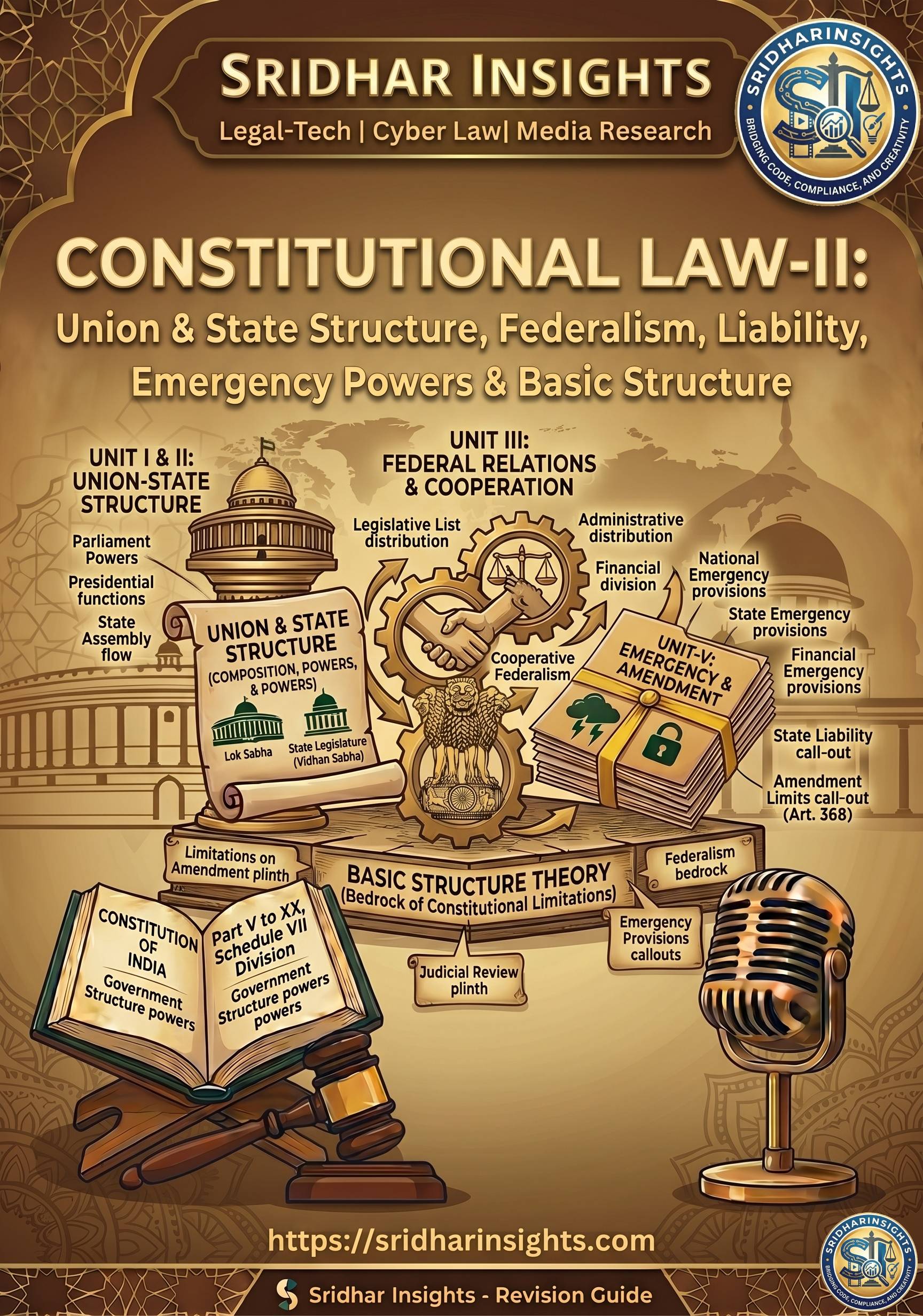
About This Course: Accelerate your legal studies and master the intricate machinery of the Indian Constitution. Based on the highly acclaimed infographic architecture of Sridhar Insights, this comprehensive, exam-oriented course translates heavy, complex theoretical concepts into clear, actionable, and linear frameworks. Designed specifically for law students and legal professionals looking for high-efficiency final revisions, this course demystifies the structural, relational, and emergency frameworks of the Constitution. Through structured breakdowns, milestone landmark cases, and high-yield question banks, you will build a rock-solid understanding of Parts V through XX and Schedule VII of the Constitution of India. What You Will Learn : Unit I: Legislature & Executive Explore the composition, powers, and functions of the Union and State Legislatures. Master parliamentary privileges (Articles 105 & 194) , the constitutional position of nominal heads vs. the real executive , the mechanics of collective responsibility , and the intricacies of the Anti-Defection Law (10th Schedule). Unit II: Judiciary Under the Constitution Trace the evolution of the Collegium System and the independence of the judiciary through landmark Judges Cases. Compare the wide writ jurisdictions of the Supreme Court (Article 32) and High Courts (Article 226) , alongside advisory, original, and supervisory powers. Unit III: Centre-State Relations Deconstruct the vertical split of Indian federalism across Legislative, Administrative, and Financial boundaries. Learn crucial interpretive judicial doctrines like Pith and Substance, Colorable Legislation, Harmonious Construction, and Repugnancy (Article 254). Unit IV: State Liability, Trade & Services Analyze government contract formalities under Article 299 and the judicial evolution from Sovereign Immunity to modern Constitutional Torts. Understand the constitutional parameters governing freedom of trade (Articles 301–307) and the procedural safeguards built for civil servants (Article 311). Unit V: Emergency Powers & Basic Structure Theory Deep dive into the operational mechanics, approval times, and impacts of National (Art. 352), State (Art. 356), and Financial (Art. 360) Emergencies. Trace the historic judicial battles from Shankari Prasad to Kesavananda Bharati that established the unamendable bedrock of the Basic Structure Theory. Course Features & Study Aids Include:Linear Text Mind Maps: Heavy legal theories translated into structured visual flows for crisp memory retention. Exam Prep Question Banks: Curated 10-Mark Essay and 4-Mark Short Note practice modules to match university and competitive testing patterns. Quick-Reference Comparison Tables: Immediate conceptual clarity on complex topics like President vs. Governor powers and Supreme Court vs. High Court parameters. Who is This Course For?LL.B. & LL.M. Students preparing for semester finals, midterms, or comprehensive revision blocks.Competitive Exam Aspirants mapping out high-yield constitutional law syllabus criteria for judicial services or public administration testing.Legal Professionals & Researchers seeking a swift, structurally accurate reference tool that bridges statutory frameworks and case logic.