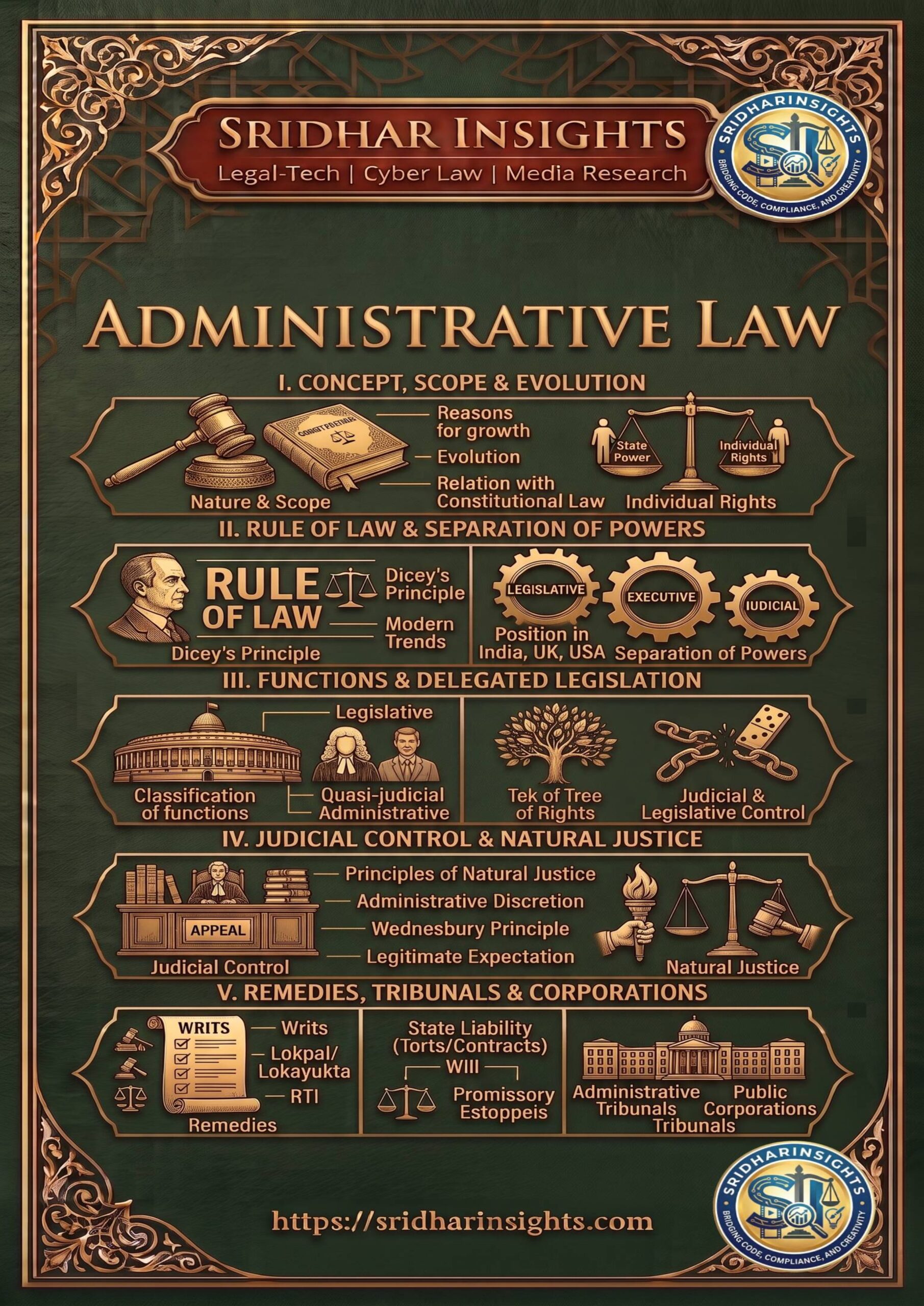
Rule of Law & Separation of Powers MCQ Quiz (1–50)
(1). [AIBE 2021] Who among the following is credited with originating the classical principles of the Rule of Law in the English legal system?
[A]. John Locke
[B]. A.V. Dicey
[C]. Montesquieu
[D]. Ivor Jennings
Correct Answer: [B]. A.V. Dicey
(2). Which of the following is NOT one of the three principles of the Rule of Law propounded by Dicey?
[A]. Supremacy of law
[B]. Equality before the law
[C]. Separation of legislative and executive personnel
[D]. Predominance of legal spirit
Correct Answer: [C]. Separation of legislative and executive personnel
(3). [CLAT-PG 2019] Dicey strongly criticized the French system of Droit Administratif because:
[A]. It had no courts
[B]. It exempted government officials from the jurisdiction of ordinary courts
[C]. It was too democratic
[D]. It violated international law
Correct Answer: [B]. It exempted government officials from the jurisdiction of ordinary courts
(4). The modern interpretation of the Rule of Law (as formulated by the International Commission of Jurists at Delhi, 1959) emphasizes:
[A]. Formal procedural rules only
[B]. The creation of social, economic, and cultural conditions for human dignity (Substantive Justice)
[C]. Absolute executive immunity
[D]. The abolition of administrative tribunals
Correct Answer: [B]. The creation of social, economic, and cultural conditions for human dignity (Substantive Justice)
(5). [AIBE 2023] In which landmark Indian case was the Rule of Law explicitly held to be a part of the “Basic Structure” of the Constitution?
[A]. Golaknath v. State of Punjab
[B]. Kesavananda Bharati v. State of Kerala
[C]. ADM Jabalpur v. Shivkant Shukla
[D]. Maneka Gandhi v. Union of India
Correct Answer: [B]. Kesavananda Bharati v. State of Kerala
(6). The theory of Separation of Powers was systematically propounded in 1748 by:
[A]. Dicey
[B]. Montesquieu
[C]. Austin
[D]. Bentham
Correct Answer: [B]. Montesquieu
(7). [CLAT-PG 2020] What is the primary purpose of the Separation of Powers?
[A]. To increase executive efficiency
[B]. To prevent the concentration of all governmental powers in a single organ and safeguard liberty
[C]. To abolish the legislature
[D]. To give supreme power to judges
Correct Answer: [B]. To prevent the concentration of all governmental powers in a single organ and safeguard liberty
(8). Which country is classically cited as having a rigid separation of powers?
[A]. United Kingdom
[B]. India
[C]. United States of America
[D]. New Zealand
Correct Answer: [C]. United States of America
(9). [AIBE 2018] In the United Kingdom, the system of government is characterized by:
[A]. Strict separation of powers
[B]. Fusion of powers (Executive forms part of the Legislature)
[C]. Absolute judicial supremacy
[D]. Presidential rule
Correct Answer: [B]. Fusion of powers (Executive forms part of the Legislature)
(10). How does the Indian Constitution treat the Separation of Powers?
[A]. Adopts a rigid separation like the USA
[B]. Adopts complete fusion like the UK
[C]. Adopts a flexible separation with checks and balances and judicial review
[D]. Rejects the doctrine entirely
Correct Answer: [C]. Adopts a flexible separation with checks and balances and judicial review
(11). [CLAT-PG 2022] In Indira Nehru Gandhi v. Raj Narain, the Supreme Court held that the adjudication of a specific election dispute by Parliament violated:
[A]. Fundamental duties
[B]. The Separation of Powers (usurping judicial function)
[C]. Tax laws
[D]. The Official Secrets Act
Correct Answer: [B]. The Separation of Powers (usurping judicial function)
(12). Which Article of the Indian Constitution directs the State to separate the judiciary from the executive?
[A]. Article 14
[B]. Article 21
[C]. Article 50
[D]. Article 356
Correct Answer: [C]. Article 50
(13). [AIBE 2019] The phrase “Equality before the law” (Article 14) is borrowed primarily from:
[A]. American Due Process
[B]. Dicey’s second principle of the Rule of Law
[C]. French Administrative Law
[D]. Soviet Constitution
Correct Answer: [B]. Dicey’s second principle of the Rule of Law
(14). Marbury v. Madison is a landmark American case that established:
[A]. Presidential immunity
[B]. The power of Judicial Review
[C]. The jury system
[D]. Tax exemption
Correct Answer: [B]. The power of Judicial Review
(15). [CLAT-PG 2021] Substantive Due Process under Indian Administrative and Constitutional Law was firmly cemented by:
[A]. A.K. Gopalan v. State of Madras
[B]. Maneka Gandhi v. Union of India
[C]. Champakam Dorairajan
[D]. Berubari Union
Correct Answer: [B]. Maneka Gandhi v. Union of India
(16). Which of the following represents an exception where the Legislature exercises judicial power in India?
[A]. Passing budget estimates
[B]. Impeachment of the President and punishing for breach of its privileges
[C]. Drafting police manuals
[D]. Issuing executive ordinances
Correct Answer: [B]. Impeachment of the President and punishing for breach of its privileges
(17). [AIBE 2022] Which of the following represents an exception where the Executive exercises legislative power?
[A]. Granting bail
[B]. Promulgating ordinances (Article 123/213) and framing delegated legislation
(18). The rule that “discretion must be exercised according to rules of reason and justice, not according to private opinion” is a safeguard against:
[A]. Separation of powers
[B]. Arbitrary executive power under the Rule of Law
[C]. Judicial independence
[D]. Parliamentary elections
Correct Answer: [B]. Arbitrary executive power under the Rule of Law
(19). [CLAT-PG 2018] A.V. Dicey’s concept of the “Predominance of Legal Spirit” implies that:
[A]. Lawyers should run the government
[B]. Constitutional rights are secured by judicial remedies and court enforcement rather than abstract declarations
[C]. Police have supreme authority
[D]. Statutes are superior to case law
Correct Answer: [B]. Constitutional rights are secured by judicial remedies and court enforcement rather than abstract declarations
(20). In a modern welfare state, why is absolute adherence to Dicey’s rejection of discretionary power impossible?
[A]. Because laws are unnecessary
[B]. Because the state must regulate complex economic and social sectors requiring flexible administrative discretion
[C]. Because judges want more holidays
[D]. Because parliaments no longer pass laws
Correct Answer: [B]. Because the state must regulate complex economic and social sectors requiring flexible administrative discretion
(21). [AIBE 2023] Which of the following best describes the Indian judiciary’s stance on the Separation of Powers?
[A]. It is a non-existent doctrine in India.
[B]. It is part of the basic structure, prohibiting any organ from usurping the essential core functions of another.
[C]. The judiciary can take over executive ministries whenever it desires.
[D]. The legislature can overturn any Supreme Court judgment effortlessly.
Correct Answer: [B]. It is part of the basic structure, prohibiting any organ from usurping the essential core functions of another.
(22). The concept of “Administrative Tribunalization” (setting up tribunals for taxation, labor, environment) challenges which strict traditional concept?
[A]. Separation of Powers (as tribunals combine administrative and adjudicatory functions)
[B]. Universal Adult Suffrage
[C]. Federalism
[D]. Bicameralism
Correct Answer: [A]. Separation of Powers (as tribunals combine administrative and adjudicatory functions)
(23). [CLAT-PG 2019] In Ram Jawaya Kapur v. State of Punjab, the Supreme Court examined the overlap between:
[A]. Judicial and Legislative powers
[B]. Executive and Legislative powers
[C]. Fundamental rights and Directive principles
[D]. Centre and State jurisdictions
Correct Answer: [B]. Executive and Legislative powers
(24). What is the primary distinction between “Formal” and “Substantive” Rule of Law?
[A]. Formal focuses only on legal procedures and publication; Substantive requires laws to be just, fair, and protect human rights.
[B]. Formal is used in India; Substantive is illegal.
[C]. Substantive applies only to criminal law.
[D]. There is no difference.
Correct Answer: [A]. Formal focuses only on legal procedures and publication; Substantive requires laws to be just, fair, and protect human rights.
(25). [AIBE 2020] Who famously observed that “power tends to corrupt, and absolute power corrupts absolutely,” underpinning the need for the Separation of Powers?
[A]. Lord Acton
[B]. Jeremy Bentham
[C]. John Austin
[D]. Max Weber
Correct Answer: [A]. Lord Acton
(26). The doctrine of checks and balances is most prominently visible in the constitutional design of:
[A]. The United Kingdom
[B]. The United States of America
[C]. Communist states
[D]. Absolute monarchies
Correct Answer: [B]. The United States of America
(27). [CLAT-PG 2022] Which of the following is an example of the Judiciary exercising administrative/legislative functions (an exception to strict separation)?
[A]. Framing rules for court procedure and appointments (Rule-making power of courts)
[B]. Passing a tax bill
[C]. Declaring war
[D]. Vetoing a bill
Correct Answer: [A]. Framing rules for court procedure and appointments (Rule-making power of courts)
(28). Under the UK Constitution, Parliamentary Sovereignty means:
[A]. Parliament can do anything except make a man a woman (traditionally speaking), and courts cannot strike down primary legislation.
[B]. Parliament is subordinate to the courts.
[C]. The King makes all laws.
[D]. There is no parliament.
Correct Answer: [A]. Parliament can do anything except make a man a woman (traditionally speaking), and courts cannot strike down primary legislation.
(29). [AIBE 2018] If an administrative authority issues an order without any statutory backing or authority, it violates:
[A]. The Rule of Law and the principle of Ultra Vires
[B]. The law of contract
[C]. The civil procedure code
[D]. International trade law
Correct Answer: [A]. The Rule of Law and the principle of Ultra Vires
(30). The evolution of Public Interest Litigation (PIL) in India represents:
[A]. A violation of separation of powers
[B]. Judicial activism ensuring access to justice for the marginalized under the Welfare Rule of Law
[C]. An executive usurpation of judicial power
[D]. The abolition of the Supreme Court
Correct Answer: [B]. Judicial activism ensuring access to justice for the marginalized under the Welfare Rule of Law
(31). [CLAT-PG 2021] Which jurist’s critique of Dicey highlighted that discretion is inevitable and necessary in modern administration?
[A]. W.A. Robson and K.C. Davis
[B]. Aristotle
[C]. Montesquieu
[D]. Plato
Correct Answer: [A]. W.A. Robson and K.C. Davis
(32). The absolute absence of arbitrary power on the part of the government is the core meaning of:
[A]. Rule of Law
[B]. Delegated legislation
[C]. Doctrine of Laches
[D]. Res Judicata
Correct Answer: [A]. Rule of Law
(33). [AIBE 2019] Can the Indian Parliament pass a law taking away the Supreme Court’s power of Judicial Review over constitutional amendments?
[A]. Yes, absolutely
[B]. No, because Judicial Review is an essential feature of the Rule of Law and Basic Structure (L. Chandra Kumar, Kesavananda)
[C]. Only during a financial emergency
[D]. Only with state consent
Correct Answer: [B]. No, because Judicial Review is an essential feature of the Rule of Law and Basic Structure (L. Chandra Kumar, Kesavananda)
(34). The phrase Lex pendens relates to Unit II. What is the core Latin maxims supporting the Rule of Law regarding retroactivity?
[A]. Lex prospicit, non respicit (Law looks forward, not backward)
[B]. Ignorantia juris non excusat
[C]. Delegatus non potest delegare
[D]. Actio personalis moritur cum persona
Correct Answer: [A]. Lex prospicit, non respicit (Law looks forward, not backward)
(35). [CLAT-PG 2023] The coexistence of administrative agencies acting as prosecutor, judge, and jury is mitigated in modern administrative law by:
[A]. Abolishing the agencies
[B]. Enforcing strict adherence to the Principles of Natural Justice and Judicial Review
[C]. Making agencies immune from courts
[D]. Allowing private citizens to judge cases
Correct Answer: [B]. Enforcing strict adherence to the Principles of Natural Justice and Judicial Review
(36). In the context of Separation of Powers, the Indian Supreme Court’s power under Article 142 (“Complete Justice”) is an instance of:
[A]. Legislative overreach
[B]. Judicial flexibility to ensure equity where strict laws fall short
[C]. Executive discretion
[D]. A violation of the basic structure
Correct Answer: [B]. Judicial flexibility to ensure equity where strict laws fall short
(37). [AIBE 2021] Which organ of the state is traditionally assigned the function of adjudicating disputes according to law?
[A]. Legislature
[B]. Executive
[C]. Judiciary
[D]. Press
Correct Answer: [C]. Judiciary
(38). The primary weakness of Dicey’s formulation of the Rule of Law during the 20th-century crises (such as wartime detentions) was:
[A]. It was too flexible
[B]. It assumed courts could always protect liberty even when Parliament granted sweeping emergency powers
[C]. It favored administrative tribunals too much
[D]. It abolished the monarchy
Correct Answer: [B]. It assumed courts could always protect liberty even when Parliament granted sweeping emergency powers
(39). [CLAT-PG 2020] The doctrine where no person shall be condemned unheard (Audi alteram partem) is a vital procedural component of:
[A]. Substantive Rule of Law and Natural Justice
[B]. Criminal procedure code only
[C]. Contract formation
[D]. Legislative drafting
Correct Answer: [A]. Substantive Rule of Law and Natural Justice
(40). The conceptual bridge linking Fundamental Rights (Part III) with Directive Principles (Part IV) under the Indian Constitution serves to advance:
[A]. Formal rule of law
[B]. Substantive welfare-oriented rule of law
[C]. Strict separation of powers
[D]. Executive supremacy
Correct Answer: [B]. Substantive welfare-oriented rule of law
(41). [AIBE 2017] If the executive issues a circular that contradicts an Act passed by Parliament, the circular is:
[A]. Valid because executive power is supreme
[B]. Void and ultra vires under the Rule of Law
[C]. Validable by the cabinet
[D]. Binding on courts
Correct Answer: [B]. Void and ultra vires under the Rule of Law
(42). Montesquieu’s theory was heavily influenced by his study of the constitutional system of:
[A]. France
[B]. England
[C]. Rome
[D]. Ancient Greece
Correct Answer: [B]. England
(43). [CLAT-PG 2019] In India, the President’s power to issue ordinances is an example of:
[A]. Pure judicial function
[B]. Executive exercising legislative power under constitutional checks
[C]. A violation of the separation of powers
[D]. Absolute monarchy
Correct Answer: [B]. Executive exercising legislative power under constitutional checks
(44). The principle that government actions must be proportionate to the objective sought to be achieved is a modern administrative law test derived from:
[A]. The Rule of Law and Judicial Review
[B]. Contractual default rules
[C]. Criminal sentencing guidelines
[D]. International trade treaties
Correct Answer: [A]. The Rule of Law and Judicial Review
(45). [AIBE 2022] Which of the following best captures the relationship between Rule of Law and Administrative Discretion?
[A]. Discretion is completely illegal.
[B]. Discretion is permitted, but it must be structured, guided, and subject to judicial review to prevent arbitrariness.
[C]. Discretion belongs solely to the judiciary.
[D]. Discretion replaces the law entirely.
Correct Answer: [B]. Discretion is permitted, but it must be structured, guided, and subject to judicial review to prevent arbitrariness.
(46). The concept of “Constitutionalism” differs from mere “Rule of Law” in that constitutionalism explicitly requires:
[A]. A written document only
[B]. Effective, legally enforceable limitations on the powers of all government organs
[C]. Dictatorial powers during crises
[D]. The elimination of parliament
Correct Answer: [B]. Effective, legally enforceable limitations on the powers of all government organs
(47). [CLAT-PG 2021] The landmark judgment where the Supreme Court established that arbitrary state action violates Article 14 under the rule of law is:
[A]. E.P. Royappa v. State of Tamil Nadu
[B]. Golaknath
[C]. Kesavananda Bharati
[D]. Maneka Gandhi
Correct Answer: [A]. E.P. Royappa v. State of Tamil Nadu
(48). Under the separation of powers, can the legislature delegate its essential legislative functions to the executive?
[A]. Yes, without any limits
[B]. No, the doctrine of anti-delegation of essential legislative functions prevents unguided wholesale surrender of power
[C]. Only during peacetime
[D]. Only via executive order
Correct Answer: [B]. No, the doctrine of anti-delegation of essential legislative functions prevents unguided wholesale surrender of power
(49). [AIBE 2023] The ultimate guardian of the Rule of Law in a democratic constitutional state is:
[A]. The Police force
[B]. An independent and impartial Judiciary
[C]. The ruling political party
[D]. Corporate entities
Correct Answer: [B]. An independent and impartial Judiciary
(50). In summary, Unit II’s core doctrines—Rule of Law and Separation of Powers—jointly ensure that:
[A]. The state has absolute power over citizens.
[B]. Public power is channeled through law, checked by separation, and held accountable by independent review.
[C]. The judiciary becomes the supreme lawmaker.
[D]. Administrative agencies operate without oversight.
Correct Answer: [B]. Public power is channeled through law, checked by separation, and held accountable by independent review.
Imagine preparing intensely for the Odisha Judicial Service (OJS) exams, only to find yourself legally disqualified by a simple calendar date. Recently, several ambitious lawyers faced this exact heartbreak. They quickly approached the Orissa High Court, seeking urgent relief against a strict cut-off date for calculating their legal practice experience. However, the Court just delivered…
Imagine doing your job accurately, reporting on a court judgment dictated in an open courtroom, only to face criminal contempt charges because the judge had not yet signed the physical document. This alarming situation recently unfolded involving some of India’s biggest media publications. However, the Punjab and Haryana High Court just issued a massive ruling…