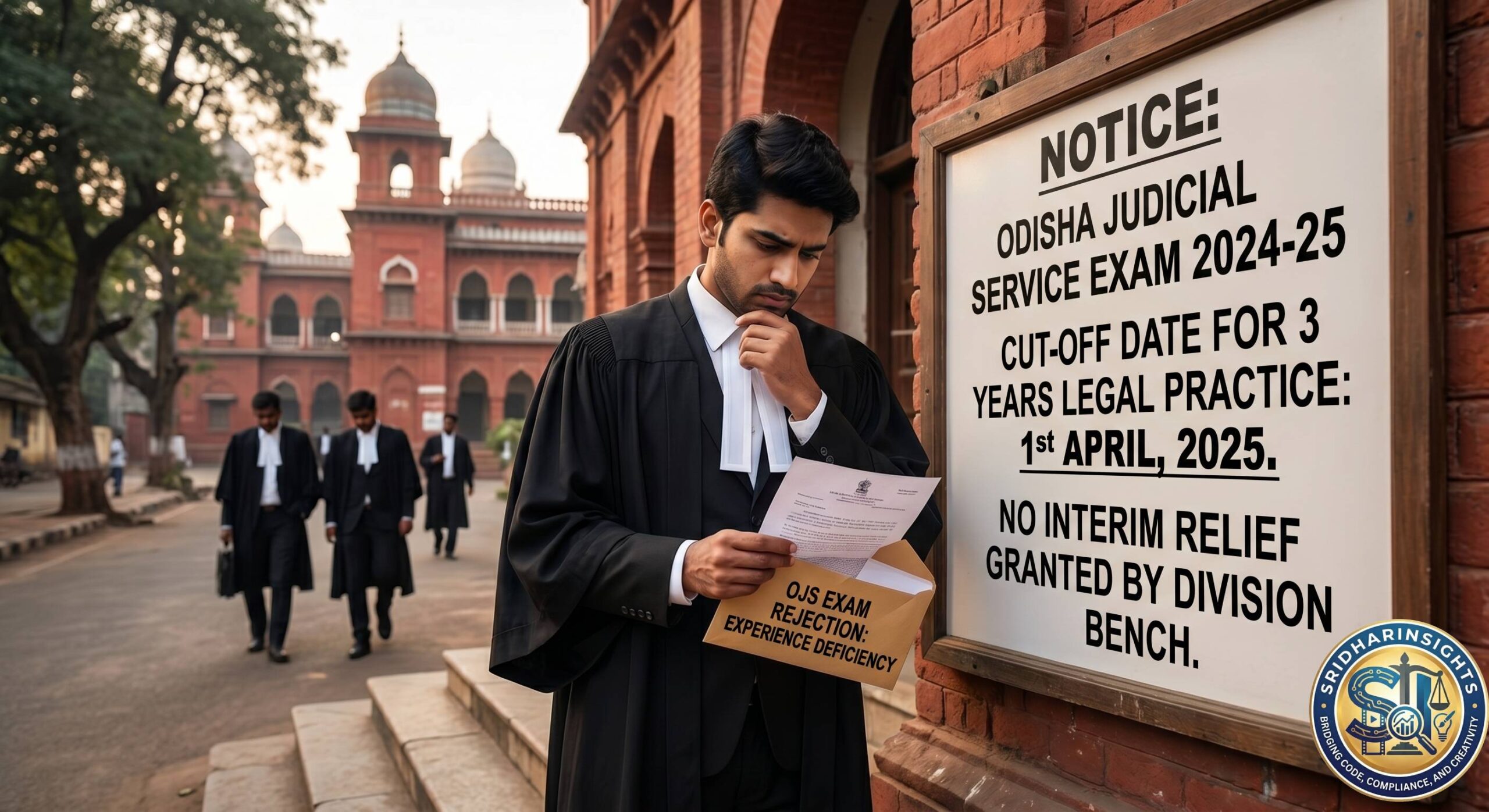
Big Update: HC Upholds 3-Year Practice Rule for OJS
Imagine preparing intensely for the Odisha Judicial Service (OJS) exams, only to find yourself legally disqualified by a simple calendar date. Recently, several ambitious lawyers faced this exact heartbreak. They quickly approached the Orissa High Court, seeking urgent relief against a strict cut-off date for calculating their legal practice experience.
However, the Court just delivered a massive blow to these hopeful candidates. The Division Bench officially refused to grant them any interim relief.
Let us dive deeply into this crucial legal battle and discover exactly why the High Court firmly supported the controversial April 1 deadline.
The Core Controversy: The April 1 Cut-Off Date
A Division Bench comprising Justice Manash Ranjan Pathak and Justice Sibo Sankar Mishra heard this critical petition. Several aggrieved law graduates filed the plea to aggressively challenge the newly amended recruitment rules.
Specifically, they questioned the strict requirement mandating a minimum of three years of active legal practice. The major problem arose because the state set a hard upper cut-off date of April 1, 2025. This meant candidates must have completed their three years of practice by that specific date to qualify for the 2024-25 vacancies.
Senior Advocates Budhadev Routray and Milan Kanungo fiercely represented the petitioners. They argued that fixing this specific cut-off date was entirely arbitrary and completely illegal. Because the recruitment notification itself was published much later on April 30, 2026, they firmly believed authorities should calculate eligibility from the date of the actual advertisement.
The Supreme Court Precedent and Amended Rules
To truly understand this ruling, we must look at a massive Supreme Court judgment from last year. In the landmark All India Judges Association v. Union of India case, the apex court officially restored the mandatory three-year practice rule. Consequently, anyone applying for the entry-level Civil Judge (Junior Division) role must now possess actual courtroom experience.
Following this supreme directive, the Odisha government quickly took action. State authorities formally consulted the High Court and heavily amended the Odisha Superior Judicial Service and Judicial Service Rules, 2007. Under the new Rule 18(1)(a), the State officially established the April 1 cut-off date for the recruitment year.
High Court’s Verdict: Executive Prerogative
During the intense hearing, Senior Advocate Gautam Mishra defended the High Court’s administrative decision. He successfully argued against granting any interim relief, warning that it would act as a final order in favor of unqualified candidates.
The Division Bench ultimately agreed with these strong arguments. The judges explicitly stated that fixing a cut-off date is strictly an “executive prerogative”. It falls completely under policy-making decisions, where courts rarely interfere.
The Court further clarified why the date makes logical sense. A standard recruitment year officially runs from April 1 to March 31 of the succeeding year. Therefore, setting the cut-off date as April 1 applies a uniform standard for all candidates. Furthermore, the judges highlighted an established legal principle: recruiting authorities absolutely cannot change eligibility rules mid-way through a selection process.
What Happens Next?
Because the petitioners simply did not possess the required three years of experience by the 2024 deadline, they cannot participate in the current OJS examination. The Court firmly dismissed their urgent application, effectively shutting them out of this specific recruitment cycle.
Ultimately, this huge ruling perfectly reinforces the state’s supreme power to strictly define eligibility deadlines. Future judicial aspirants must now carefully track their exact practice years before sending in their applications.