Calcutta High Court Quashes Bigamy Case Under BNS: Rules Section 82(2) Mandates Complaint Case Under BNSS
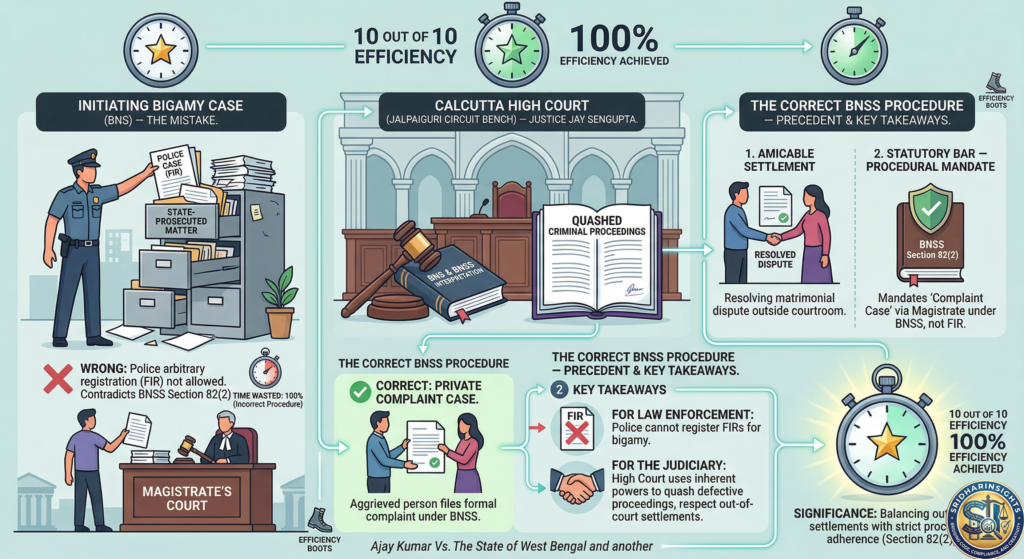
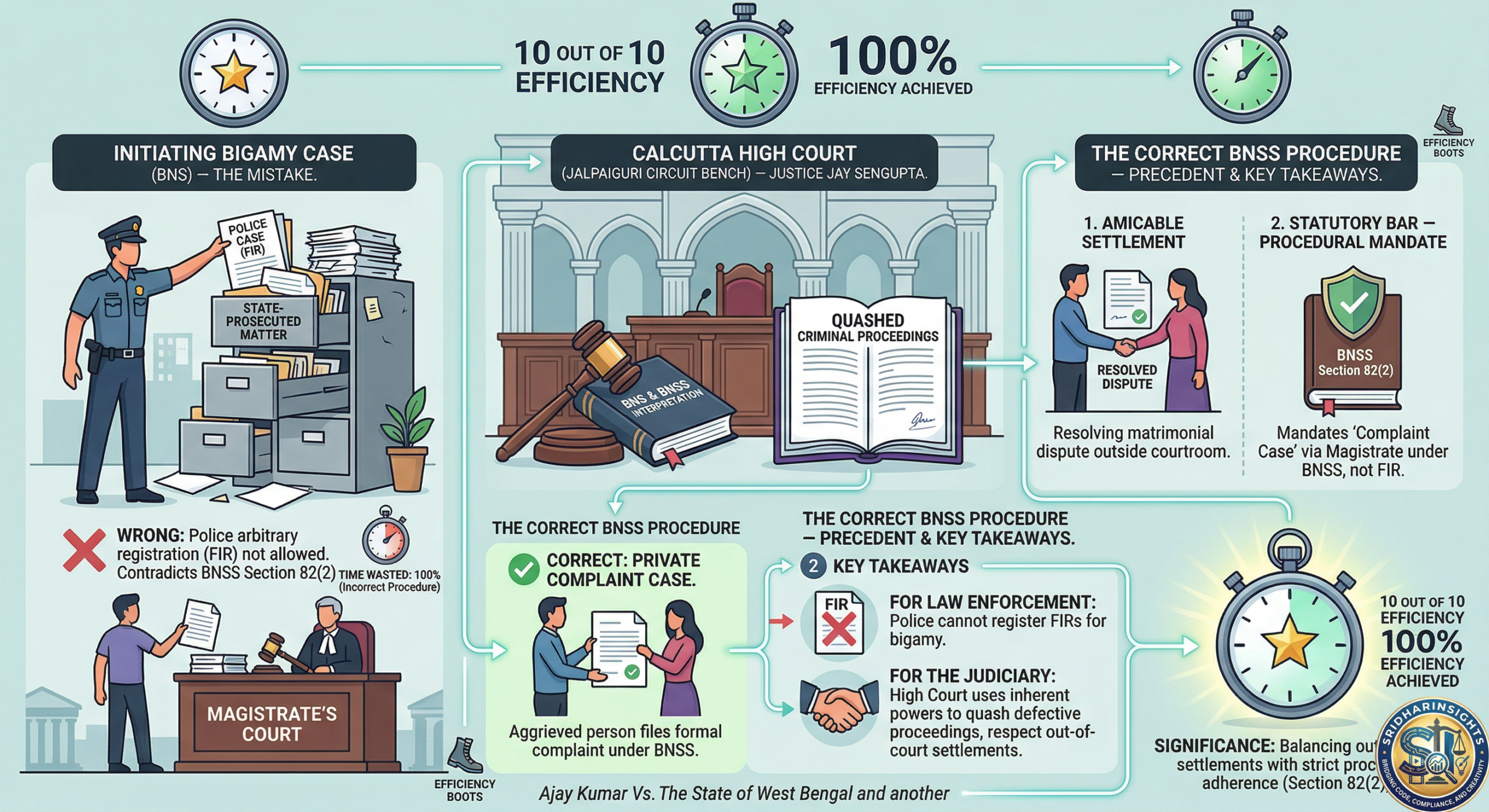
Introduction In a significant ruling interpreting the newly implemented criminal laws, the Calcutta High Court has quashed criminal proceedings related to a bigamy case filed under the Bharatiya Nyaya Sanhita (BNS). Sitting at the Jalpaiguri Circuit Bench, Justice Jay Sengupta highlighted a crucial procedural mandate: prosecuting bigamy under the BNS requires a formal complaint case under the Bharatiya Nagarik Suraksha Sanhita (BNSS), not a standard police FIR.
This judgment, delivered in the case of Ajay Kumar Vs. The State of West Bengal and another, sheds vital light on the procedural shifts from the old CrPC to the new BNSS, particularly concerning matrimonial offences.
Background of the Case: Amicable Settlement and Legal Flaws The legal battle originated from allegations of bigamy pressed against the accused under the newly enacted BNS. However, as the litigation progressed, both parties managed to reach a comprehensive and amicable settlement, resolving the underlying matrimonial dispute outside of the courtroom.
Seeking closure, a petition was moved before the Jalpaiguri Circuit Bench of the Calcutta High Court to quash the ongoing criminal proceedings. While the mutual settlement was a strong ground for quashing the case, Justice Jay Sengupta identified a glaring procedural defect in how the prosecution was initiated in the first place.
The Legal Crux: Bigamy Under BNS and Procedural Mandates of BNSS Under the old Indian Penal Code (IPC), bigamy was penalized under Section 494, and its procedural prosecution was strictly guided by Section 198 of the Criminal Procedure Code (CrPC), which restricted courts from taking cognizance of matrimonial offences except upon a formal complaint made by an aggrieved person.
With the overhaul of India’s criminal justice system:
- Substantive Law (BNS): Bigamy and related offences against marriage are now categorized under the Bharatiya Nyaya Sanhita (BNS).
- Procedural Law (BNSS): The procedural mechanism to prosecute these offences is governed by the Bharatiya Nagarik Suraksha Sanhita (BNSS).
Justice Sengupta pointed out that the invocation of the bigamy offence in this specific matter could not legally proceed through a standard police case (FIR). Emphasizing the text of the new laws, the Court noted that Section 82(2) contextually mandates that such offences must be pursued via a private “Complaint Case” instituted before a Magistrate under the BNSS. Because the police had wrongfully initiated the case as a regular state-prosecuted matter, the proceedings were procedurally void from the start.
The Court’s Verdict: Quashing the Proceedings Combining both the factual and legal realities of the case, Justice Jay Sengupta proceeded to quash the criminal proceedings. The High Court’s decision rested on two foundational pillars:
- Amicable Resolution: The core dispute between the estranged parties had been fully and finally settled. Continuing the criminal trial would serve no fruitful purpose and would only amount to an abuse of the judicial process.
- Statutory Bar: The initiation of the case via police machinery directly contravened the procedural requirements of the BNSS, which strictly requires a complaint case for offences of this nature.
Significance of the Judgment This ruling by the Calcutta High Court serves as an essential precedent for lawyers, police authorities, and litigants navigating the transition to the BNS and BNSS frameworks.
- For Law Enforcement: It acts as a strict reminder that police cannot arbitrarily register FIRs and investigate non-cognizable matrimonial offences that strictly require magisterial complaints.
- For the Judiciary: It reinforces the inherent powers of the High Court to quash defective criminal proceedings, thereby saving valuable judicial time and resources, especially when the warring parties have buried the hatchet.
Conclusion The Calcutta High Court’s decision in Ajay Kumar Vs. The State of West Bengal gracefully balances the scales of justice by respecting out-of-court matrimonial settlements while strictly enforcing statutory procedural laws. As Indian courts continue to interpret the nuances of the Bharatiya Nyaya Sanhita and the Bharatiya Nagarik Suraksha Sanhita, this judgment clearly establishes that procedural correctness—like the mandatory filing of a complaint case for bigamy—cannot be bypassed.