Claiming One Faith as the ‘Only True Religion’ Disparages Other Beliefs: Allahabad High Court Refuses to Quash Section 295A FIR
Introduction:
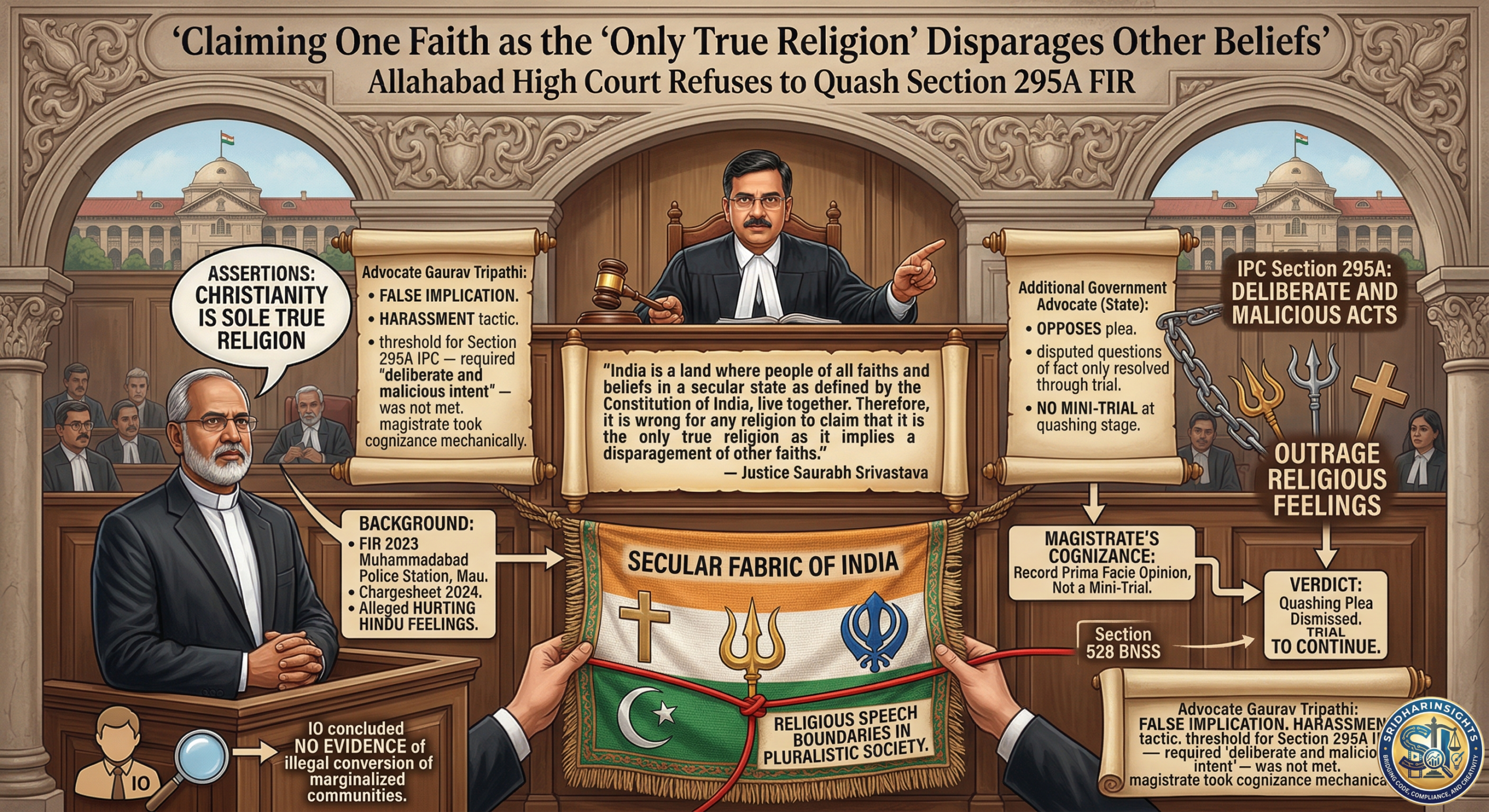
In a significant judgment reaffirming India’s secular fabric, the Allahabad High Court has ruled that claiming a particular religion is the “only true religion” is fundamentally wrong, as it inherently disparages other faiths. The Court observed that such assertions, when made publicly, prima facie attract the provisions of Section 295A of the Indian Penal Code (IPC), which penalizes deliberate and malicious acts intended to outrage religious feelings.
The ruling was delivered by a single-judge bench of Justice Saurabh Srivastava, who declined to quash ongoing criminal proceedings against a Christian priest accused of hurting the religious sentiments of the Hindu community during prayer meetings.
Background of the Case:
The legal dispute traces back to a First Information Report (FIR) registered in 2023 at the Muhammadabad Police Station in Mau district, Uttar Pradesh. The accused, Reverend Father Vineet Vincent Pereira, was booked for allegedly conducting prayer gatherings where he repeatedly asserted that Christianity was the sole true religion, thereby insulting and criticizing the Hindu faith.
During the initial police investigation, the Investigating Officer (IO) concluded that there was no evidence to suggest that the priest was involved in the illegal religious conversion of marginalized communities. However, the police proceeded to file a chargesheet in February 2024 based strictly on the allegations of making derogatory remarks against other religions. In May 2024, the local Judicial Magistrate took cognizance of the chargesheet, prompting the priest to approach the High Court under Section 528 of the Bharatiya Nagarik Suraksha Sanhita (BNSS) to have the proceedings quashed.
Arguments in the High Court:
The counsel representing the petitioner, Advocate Gaurav Tripathi, argued that the priest was being falsely implicated as a harassment tactic. The defense highlighted that since the police investigation had already ruled out any illegal conversions, the threshold for Section 295A IPC—which requires “deliberate and malicious intent”—was not met. Furthermore, the defense contended that the magistrate had taken cognizance of the chargesheet mechanically, without applying proper judicial mind or scrutinizing the lack of evidence.
Conversely, the Additional Government Advocate representing the State strongly opposed the quashing plea. The State argued that the contentions raised by the defense involved disputed questions of fact that could only be resolved through the appreciation of evidence during a full trial, not at the preliminary High Court stage.
Allahabad High Court’s Crucial Observations:
Justice Saurabh Srivastava carefully evaluated the FIR’s narrations and the scope of Section 295A of the IPC. The Court placed immense emphasis on the constitutional ethos of the country, noting:
“India is a land where people of all faiths and beliefs in a secular state as defined by the Constitution of India, live together. Therefore, it is wrong for any religion to claim that it is the only true religion as it implies a disparagement of other faiths.”
The bench observed that the opening lines of Section 295A explicitly deal with deliberate and malicious intentions to outrage the feelings of any class of citizens by insulting their religion. Based on the allegations in the FIR, the Court held that the petitioner’s actions fell squarely within the ambit of this section. Therefore, it could not be concluded that no prima facie case existed against the accused.
The Verdict on Legal Procedure:
Addressing the defense’s claim that the local court had acted mechanically, the High Court clarified the procedural boundaries of a magistrate taking cognizance. Justice Srivastava noted that at the stage of issuing summons or taking cognizance, a magistrate is only required to record a prima facie opinion based on the available material. The magistrate is not expected to conduct a “mini-trial” or heavily examine the defense’s evidence at such an initial juncture.
Because the arguments put forth by the priest’s counsel relied heavily on disputed facts, the High Court determined that it could not adjudicate these matters under its inherent powers. Consequently, the application to quash the criminal proceedings was dismissed as devoid of merit, paving the way for the trial to continue.
Significance of the Ruling:
This judgment from the Allahabad High Court draws a distinct line between the fundamental right to practice and propagate religion and the boundaries of religious speech in a pluralistic society. It serves as a crucial legal precedent underscoring that while individuals are free to practice their faith, public proclamations of religious supremacy that explicitly demean or invalidate the beliefs of other communities can invite strict legal scrutiny under India’s hate speech and public harmony laws.