(1). [AIBE 2021] Which of the following is the most accurate description of Administrative Law?
[A]. Law relating to the legislature
[B]. Law relating to the administration and its powers
[C]. Law relating to private contracts
[D]. Law relating to international treaties
Correct Answer: [B]. Law relating to the administration and its powers
(2). Who among the following jurists defined Administrative Law as “the law concerning the powers and procedures of administrative agencies, including especially the law governing judicial review of administrative action”?
[A]. Ivor Jennings
[B]. A.V. Dicey
[C]. K.C. Davis
[D]. Wade
Correct Answer: [C]. K.C. Davis
(3). [CLAT-PG 2019] Why did A.V. Dicey initially deny the existence of Administrative Law in England?
[A]. Because there was no Constitution in England
[B]. Because he believed it violated the principle of the “Rule of Law” by giving special privileges to the State
[C]. Because the Parliament passed a resolution against it
[D]. Because he favored the separation of powers
Correct Answer: [B]. Because he believed it violated the principle of the “Rule of Law” by giving special privileges to the State
(4). The French system of Droit Administratif is characterized by:
[A]. The absence of any courts
[B]. A separate system of administrative courts for disputes between citizens and the administration
[C]. The King acting as the sole judge
[D]. Absolute parliamentary sovereignty
Correct Answer: [B]. A separate system of administrative courts for disputes between citizens and the administration
(5). [AIBE 2023] The fundamental transformation that led to the phenomenal growth of Administrative Law was the shift from a:
[A]. Welfare State to a Police State
[B]. Police State (Laissez-Faire) to a Welfare State
[C]. Monarchy to a Republic
[D]. Capitalist State to a Communist State
Correct Answer: [B]. Police State (Laissez-Faire) to a Welfare State
(6). Which of the following is NOT a traditional function of a Laissez-Faire (Police) State?
[A]. Defense of the country
[B]. Maintenance of law and order
[C]. Providing free healthcare and education
[D]. Collection of taxes
Correct Answer: [C]. Providing free healthcare and education
(7). [CLAT-PG 2020] One of the primary reasons for the growth of Administrative Law is the inadequacy of the traditional judicial system because:
[A]. Courts are too fast and hasty
[B]. Courts are overburdened, highly technical, and expensive
[C]. Judges lack knowledge of the Constitution
[D]. Courts refuse to hear citizen grievances
Correct Answer: [B]. Courts are overburdened, highly technical, and expensive
(8). The legislative process is inadequate to deal with complex modern socio-economic problems because:
[A]. Parliament has too much time
[B]. Parliament lacks the time and technical expertise to legislate on every granular detail
[C]. Members of Parliament are not legally trained
[D]. The President controls the legislation
Correct Answer: [B]. Parliament lacks the time and technical expertise to legislate on every granular detail
(9). [AIBE 2018] Administrative authorities are preferred for taking preventive action. A traditional court generally provides:
[A]. Preventive measures only
[B]. Remedial/post-facto measures (e.g., damages) after the harm is done
[C]. Legislative measures
[D]. International remedies
Correct Answer: [B]. Remedial/post-facto measures (e.g., damages) after the harm is done
(10). Which of the following falls strictly within the scope of Administrative Law?
[A]. The procedure for passing a Constitutional Amendment
[B]. The rules framed by the Executive under a delegated statute
[C]. A contract between two private companies
[D]. The law of inheritance
Correct Answer: [B]. The rules framed by the Executive under a delegated statute
(11). [CLAT-PG 2022] “Constitutional law deals with the structure, whereas Administrative law deals with the function.” This distinction implies that:
[A]. Constitutional law is dynamic, Administrative law is static
[B]. Constitutional law is the anatomy, Administrative law is the physiology
[C]. Constitutional law is inferior to Administrative law
[D]. They are completely unrelated
Correct Answer: [B]. Constitutional law is the anatomy, Administrative law is the physiology
(12). If a conflict arises between Constitutional Law and a rule of Administrative Law:
[A]. The Administrative rule prevails because it is more specific
[B]. The Constitutional Law prevails because it is the supreme law
[C]. Both are struck down
[D]. The matter is referred to the UN
Correct Answer: [B]. The Constitutional Law prevails because it is the supreme law
(13). [AIBE 2019] In India, Administrative Law is largely:
[A]. Codified in a single “Administrative Procedure Act”
[B]. Uncodified and judge-made (developed through case laws and writs)
[C]. Imported directly from French law
[D]. Part of the Indian Penal Code
Correct Answer: [B]. Uncodified and judge-made (developed through case laws and writs)
(14). In Ram Jawaya Kapur v. State of Punjab, the Supreme Court held that the executive power of the State:
[A]. Is strictly confined to executing the laws passed by the legislature
[B]. Includes all residuary sovereign powers not vested in the legislature or judiciary
[C]. Cannot formulate policies
[D]. Is superior to the judiciary
Correct Answer: [B]. Includes all residuary sovereign powers not vested in the legislature or judiciary
(15). [CLAT-PG 2021] Which Article of the Indian Constitution is considered the most potent weapon in Administrative Law to strike down arbitrary executive action?
[A]. Article 14
[B]. Article 370
[C]. Article 44
[D]. Article 356
Correct Answer: [A]. Article 14
(16). The concept of the “Welfare State” in the Indian Constitution is primarily enshrined in:
[A]. The Preamble and Directive Principles of State Policy (Part IV)
[B]. The Fundamental Duties
[C]. The Emergency Provisions
[D]. The Citizenship Act
Correct Answer: [A]. The Preamble and Directive Principles of State Policy (Part IV)
(17). [AIBE 2022] Administrative Law regulates:
[A]. The relationship between individuals
[B]. The relationship between the State and its citizens
[C]. The relationship between two sovereign nations
[D]. Corporate mergers
Correct Answer: [B]. The relationship between the State and its citizens
(18). Which of the following is a key component of Administrative Law?
[A]. Delegated Legislation
[B]. Administrative Adjudication (Tribunals)
[C]. Judicial Review of Administrative Action
[D]. All of the above
Correct Answer: [D]. All of the above
(19). [CLAT-PG 2018] The establishment of bodies like SEBI, the Competition Commission, and the National Green Tribunal represents:
[A]. The failure of the legislature
[B]. The growth of specialized administrative adjudicatory bodies due to modern complexities
[C]. The collapse of the Supreme Court
[D]. A return to the Police State
Correct Answer: [B]. The growth of specialized administrative adjudicatory bodies due to modern complexities
(20). A law that determines the organization, powers, and duties of administrative authorities is the definition given by:
[A]. Griffith and Street
[B]. Ivor Jennings
[C]. Dicey
[D]. Salmond
Correct Answer: [B]. Ivor Jennings
(21). [AIBE 2023] Does the scope of Administrative Law cover the pure legislative acts of Parliament?
[A]. Yes
[B]. No, it covers the executive and administrative actions, not pure legislative functions
[C]. Only money bills
[D]. Only Constitutional amendments
Correct Answer: [B]. No, it covers the executive and administrative actions, not pure legislative functions
(22). Administrative authorities can exercise discretionary powers. Who checks if this discretion is misused?
[A]. The Police
[B]. The Judiciary through Judicial Review
[C]. The Media
[D]. The President alone
Correct Answer: [B]. The Judiciary through Judicial Review
(23). [CLAT-PG 2019] In Asif Hameed v. State of J&K, the Supreme Court stated that:
[A]. The judiciary can take over the functions of the executive if the executive fails
[B]. Courts cannot usurp the administrative role; they only review the legality of the action
[C]. The executive is not answerable to the courts
[D]. Tribunals are unconstitutional
Correct Answer: [B]. Courts cannot usurp the administrative role; they only review the legality of the action
(24). The primary remedy available to a citizen against wrongful administrative action in India is:
[A]. Filing a suit for specific performance
[B]. Filing a Writ Petition under Articles 32 or 226
[C]. Appealing to the Prime Minister
[D]. Filing an FIR
Correct Answer: [B]. Filing a Writ Petition under Articles 32 or 226
(25). [AIBE 2020] “Administrative Law is the law concerning the powers and procedures of administrative agencies…” Which jurist focuses heavily on ‘procedures’ in his definition?
[A]. Ivor Jennings
[B]. K.C. Davis
[C]. Maitland
[D]. Austin
Correct Answer: [B]. K.C. Davis
(26). The transition of the State from merely protecting borders to providing utilities, running railways, and managing telecom led to the expansion of:
[A]. Property Law
[B]. Personal Law
[C]. Administrative Law
[D]. International Law
Correct Answer: [C]. Administrative Law
(27). [CLAT-PG 2022] Which of the following internal documents falls under the study of Administrative Law but does NOT generally have the force of statutory law?
[A]. A Constitutional Amendment
[B]. An Act of Parliament
[C]. Departmental circulars and administrative guidelines
[D]. A Supreme Court judgment
Correct Answer: [C]. Departmental circulars and administrative guidelines
(28). The doctrine that prevents the legislature from delegating its “essential legislative functions” to the executive is part of:
[A]. Contract Law
[B]. Administrative and Constitutional Law
[C]. Tort Law
[D]. Criminal Law
Correct Answer: [B]. Administrative and Constitutional Law
(29). [AIBE 2018] What is the relationship between Administrative Law and the Rule of Law?
[A]. Administrative law seeks to establish the Rule of Law in the welfare state
[B]. Administrative law destroys the Rule of Law
[C]. They are totally disconnected concepts
[D]. Rule of law only applies to the judiciary
Correct Answer: [A]. Administrative law seeks to establish the Rule of Law in the welfare state
(30). In E.P. Royappa v. State of T.N., Justice Bhagwati famously linked which Article to administrative arbitrariness?
[A]. Article 19
[B]. Article 21
[C]. Article 14
[D]. Article 25
Correct Answer: [C]. Article 14
(31). [CLAT-PG 2021] Maitland’s statement regarding Constitutional and Administrative law implies that:
[A]. Constitutional law is the genus, and administrative law is a species
[B]. They are enemies
[C]. Administrative law is the genus
[D]. Constitutional law deals only with the Prime Minister
Correct Answer: [A]. Constitutional law is the genus, and administrative law is a species
(32). Administrative tribunals are established to provide:
[A]. Complicated legal procedures
[B]. Speedy, cheap, and specialized justice
[C]. Protection to the rich
[D]. A substitute for Parliament
Correct Answer: [B]. Speedy, cheap, and specialized justice
(33). [AIBE 2019] The Indian Constitution permits the creation of Administrative Tribunals under:
[A]. Article 32
[B]. Article 226
[C]. Article 323A and 323B
[D]. Article 136
Correct Answer: [C]. Article 323A and 323B
(34). Which of the following statements is true?
[A]. Administrative law is totally independent of Constitutional law.
[B]. Administrative law draws its basic life and breath from Constitutional law.
[C]. Administrative law overrides Constitutional law in an emergency.
[D]. Administrative law is applicable only to civil servants.
Correct Answer: [B]. Administrative law draws its basic life and breath from Constitutional law.
(35). [CLAT-PG 2023] The concept of Laissez-Faire advocates for:
[A]. Maximum state control over business
[B]. Minimum state interference in economic activities
[C]. Absolute monarchy
[D]. Judicial dictatorship
Correct Answer: [B]. Minimum state interference in economic activities
(36). Administrative law deals with the pathology of power. This means it aims to prevent:
[A]. The use of power
[B]. The abuse and misuse of power by authorities
[C]. Elections
[D]. The passing of laws
Correct Answer: [B]. The abuse and misuse of power by authorities
(37). [AIBE 2021] Does the scope of Administrative Law include the internal administrative workings of a purely private company?
[A]. Yes
[B]. No, it deals with public/state authorities
[C]. Yes, if the company is profitable
[D]. Only if the company has foreign investors
Correct Answer: [B]. No, it deals with public/state authorities
(38). The necessity of ‘Delegated Legislation’ arose because:
[A]. Parliament is too lazy
[B]. Parliament lacks time and technical expertise
[C]. The President wanted more power
[D]. The Supreme Court ordered it
Correct Answer: [B]. Parliament lacks time and technical expertise
(39). [CLAT-PG 2020] In a Welfare State, the functions of the government are:
[A]. Diminishing
[B]. Static
[C]. Multiplying and permeating every aspect of citizen life
[D]. Confined to defense
Correct Answer: [C]. Multiplying and permeating every aspect of citizen life
(40). Who said that Administrative law is a branch of public law which deals with the organization, powers, duties, and functions of the administrative authorities?
[A]. K.C. Davis
[B]. Ivor Jennings
[C]. Jain & Jain
[D]. Upendra Baxi
Correct Answer: [B]. Ivor Jennings
(41). [AIBE 2017] According to the modern view, what happens where Constitutional law ends?
[A]. The State collapses
[B]. Administrative law begins
[C]. International law takes over
[D]. Anarchy ensues
Correct Answer: [B]. Administrative law begins
(42). Droit Administratif was strongly criticized by Dicey because it:
[A]. Followed the common law
[B]. Subjected government officials to ordinary courts
[C]. Shielded government officials from ordinary courts and placed them under special administrative courts
[D]. Abolished the French Parliament
Correct Answer: [C]. Shielded government officials from ordinary courts and placed them under special administrative courts
(43). [CLAT-PG 2019] The growth of Administrative Law in India gained immense momentum after:
[A]. The Revolt of 1857
[B]. The adoption of the Constitution in 1950 and the push for a socialist, welfare state
[C]. The passing of the IPC in 1860
[D]. The year 2000
Correct Answer: [B]. The adoption of the Constitution in 1950 and the push for a socialist, welfare state
(44). Under Administrative Law, if an officer exercises discretionary power in bad faith (mala fide), the action is:
[A]. Valid because it is discretionary
[B]. Void/Ultra vires and liable to be struck down
[C]. Protected by sovereign immunity
[D]. Justified in a welfare state
Correct Answer: [B]. Void/Ultra vires and liable to be struck down
(45). [AIBE 2022] Which of the following represents ‘Adjudicatory’ functions in Administrative Law?
[A]. Passing a budget in Parliament
[B]. A minister making a speech
[C]. The Income Tax Appellate Tribunal deciding a tax dispute
[D]. The police arresting a suspect
Correct Answer: [C]. The Income Tax Appellate Tribunal deciding a tax dispute
(46). According to the Supreme Court in Minerva Mills, the creature of the Constitution (Administrative authorities) cannot:
[A]. Function at all
[B]. Exercise power that is ultra vires (beyond) the Constitution
[C]. Use computers
[D]. Advise the legislature
Correct Answer: [B]. Exercise power that is ultra vires (beyond) the Constitution
(47). [CLAT-PG 2021] The scope of Administrative Law is vast, but it is ultimately limited by the doctrine of:
[A]. Laches
[B]. Ultra Vires
[C]. Caveat Emptor
[D]. Res Judicata
Correct Answer: [B]. Ultra Vires
(48). While Constitutional law provides the general principles of state organization, Administrative law provides the:
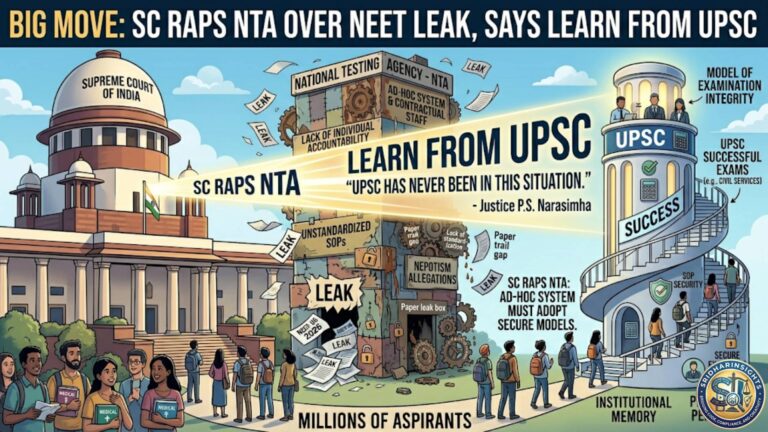
Imagine preparing for years to clear India’s toughest medical entrance exam, only to see it canceled because of a massive paper leak. Millions of students are currently facing this exact nightmare. Because of repeated failures, the Supreme Court of India has finally stepped in with severe criticism for the National Testing Agency (NTA). Recently, the…
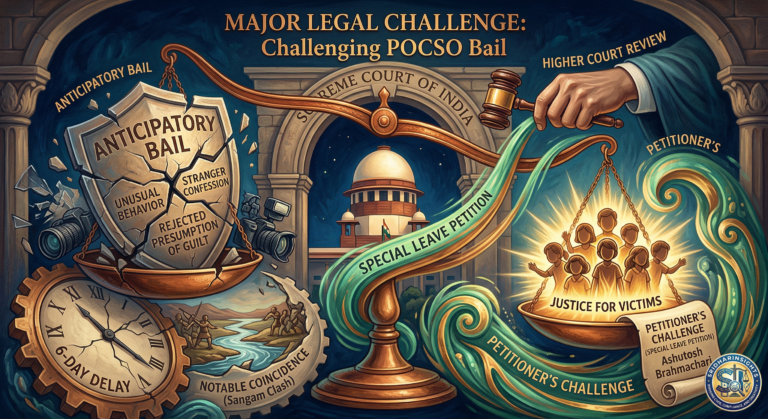
A major legal battle has reached the Supreme Court of India. Recently, a petitioner filed a Special Leave Petition (SLP) challenging a crucial Allahabad High Court order. This previous order granted anticipatory bail to Swami Avimukteshwaranand Saraswati in a highly sensitive Prayagraj POCSO case. Ashutosh Brahmachari, the first informant in the case, filed this new…
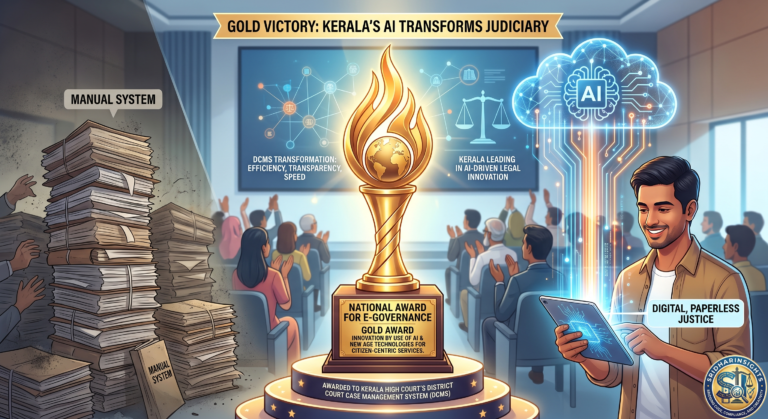
Imagine a judicial system completely free of massive, dusty paper files and endless administrative delays. For decades, Indian courts have struggled with towering mountains of physical paperwork. However, the Kerala High Court is rapidly changing this outdated reality through cutting-edge technology. Recently, the High Court achieved a massive national milestone. Its ambitious District Court Case…