Major Challenge: Supreme Court Hears Plea Against Bail for Swami Avimukteshwaranand in POCSO Case
A major legal battle has reached the Supreme Court of India. Recently, a petitioner filed a Special Leave Petition (SLP) challenging a crucial Allahabad High Court order. This previous order granted anticipatory bail to Swami Avimukteshwaranand Saraswati in a highly sensitive Prayagraj POCSO case.
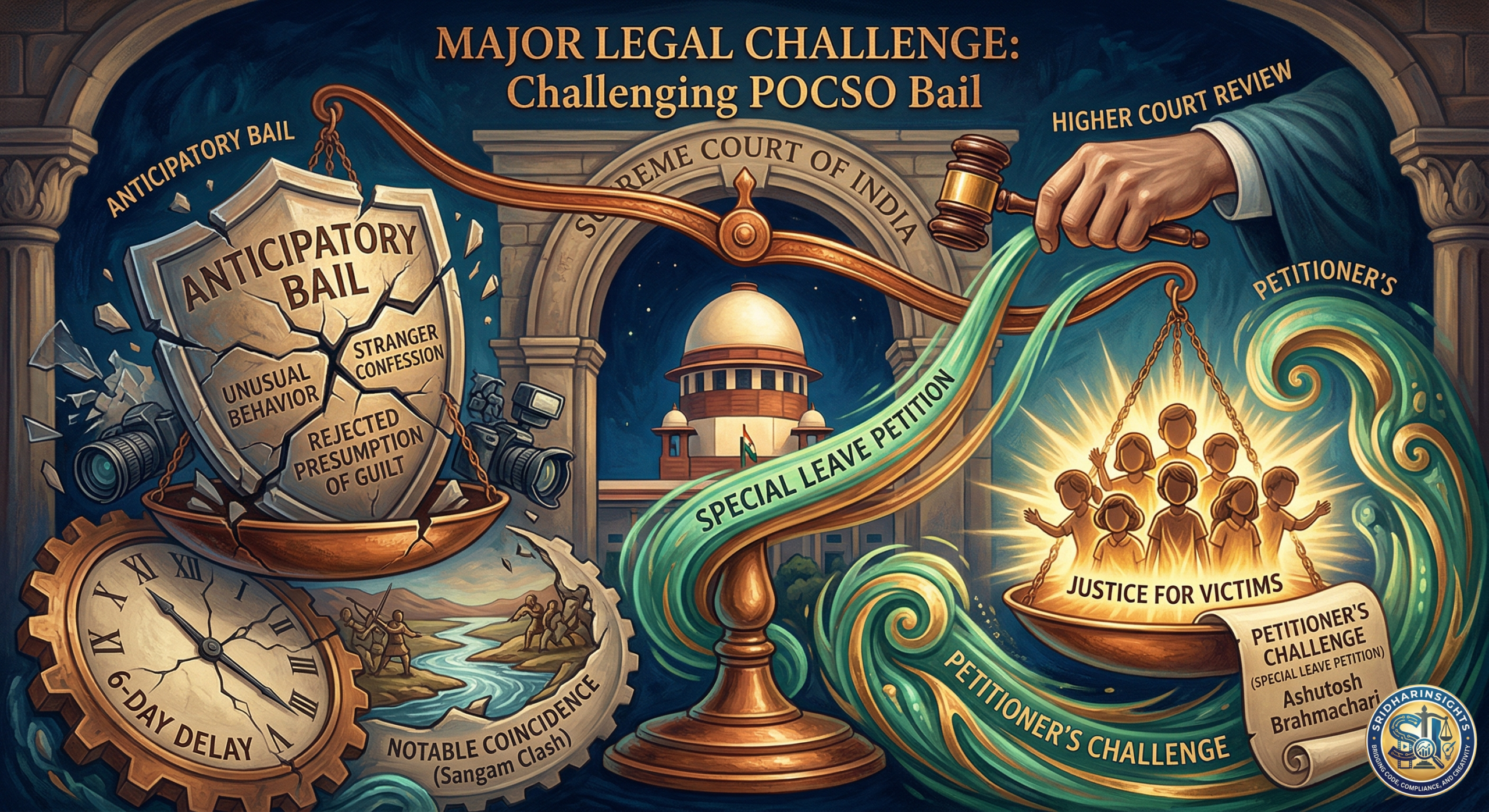
Ashutosh Brahmachari, the first informant in the case, filed this new petition. He submitted the plea through Advocate-on-Record (AOR) Saurabh Ajay Gupta. Primarily, the petitioner argues that the High Court completely ignored the severe nature of the child abuse allegations.
Why Did the High Court Grant Bail?
On March 25, the Allahabad High Court granted relief to the Shankaracharya of the Jyotir Math. The judges provided several strong reasons for their decision.
First, the High Court noticed “unusual” behavior from the minor victims. Strangely, the children chose to confess the alleged abuse to a complete stranger (the informant). They did not tell their own parents or natural guardians.
Second, the State argued that the court must presume the accused is guilty under Section 29 of the POCSO Act. However, the High Court firmly rejected this argument. The bench clarified a vital legal rule. Courts cannot use this presumption of guilt during the pre-arrest stage before police actually frame the formal charges.
Huge Delays and Strange Coincidences
Furthermore, the High Court highlighted a suspicious six-day delay in police reporting. Supposedly, the victims told Brahmachari about the crime on January 18, 2026. Yet, he waited until January 24 to contact the police. He claimed a “Pooja/Yagya” kept him too busy to file the report.
However, the Court found a glaring contradiction. Despite his busy excuse, Brahmachari actually filed a completely different legal application on January 21 regarding another incident.
Additionally, the judges pointed out a “notable coincidence” that required extreme caution. The exact day the informant allegedly discovered the abuse (January 18) was the same day a massive public dispute happened. On that day, the accused and local authorities clashed over bathing rights at the Sangam during the holy Mauni Amavasya.
Media Violations Condemned
Finally, the High Court strongly condemned the local media’s reckless behavior. After police registered the FIR, several Hindi news channels illegally interviewed the minor victims on camera. The Court called this a direct and severe violation of strict privacy rules under both the POCSO Act and the Juvenile Justice Act.
Now, the Supreme Court will decide if these High Court observations justify protecting the accused from arrest. Legal experts across the country are watching this high-profile case very closely.