(1). [AIBE 2021] Which of the following was NOT among the three heads of judicial review formulated by Lord Diplock in the GCHQ Case (1984)?
[A]. Illegality
[B]. Irrationality
[C]. Political Expediency
[D]. Procedural Impropriety
Correct Answer: [C]. Political Expediency
(2). The principle that “no person shall be condemned unheard” is known as:
[A]. Nemo judex in causa sua
[B]. Audi alteram partem
[C]. Res ipsa loquitur
[D]. Delegatus non potest delegare
Correct Answer: [B]. Audi alteram partem
(3). [CLAT-PG 2019] If a member of an administrative tribunal adjudicating a dispute owns shares in one of the litigant companies, it constitutes:
[A]. Pecuniary bias
[B]. Personal bias
[C]. Subject-matter bias
[D]. Ministerial duty
Correct Answer: [A]. Pecuniary bias
(4). The requirement that an administrative authority must provide reasons for its decision (a “speaking order”) forms an essential part of:
[A]. Delegated legislation
[B]. Principles of Natural Justice
[C]. Contract law
[D]. Criminal sentencing
Correct Answer: [B]. Principles of Natural Justice
(5). [AIBE 2023] In A.K. Kraipak v. Union of India, the Supreme Court held that Principles of Natural Justice apply to:
[A]. Judicial proceedings only
[B]. Administrative actions as well as quasi-judicial proceedings
[C]. Legislative enactments only
[D]. International treaties
Correct Answer: [B]. Administrative actions as well as quasi-judicial proceedings
(6). Which of the following is an instance of an “Abuse of Administrative Discretion”?
[A]. Exercising power for an improper purpose
[B]. Taking into account relevant statutory factors
[C]. Following mandatory statutory guidelines
[D]. Granting a hearing
Correct Answer: [A]. Exercising power for an improper purpose
(7). [CLAT-PG 2020] The Wednesbury unreasonableness test requires a decision to be:
[A]. Slightly incorrect
[B]. So absurd and outrageous that no sensible authority could ever have made it
[C]. Approved by Parliament
[D]. Involving foreign currency
Correct Answer: [B]. So absurd and outrageous that no sensible authority could ever have made it
(8). The primary distinction between Wednesbury Unreasonableness and the Doctrine of Proportionality is that Proportionality:
[A]. Is less rigorous
[B]. Involves a structured 4-step balancing test, whereas Wednesbury sets an extremely high threshold of absurdity
[C]. Applies only to criminal law
[D]. Rejects judicial review entirely
Correct Answer: [B]. Involves a structured 4-step balancing test, whereas Wednesbury sets an extremely high threshold of absurdity
(9). [AIBE 2018] The Doctrine of Legitimate Expectation is primarily invoked to protect:
[A]. Absolute property ownership
[B]. Reasonable procedural or substantive expectations created by past public representations or practices
[C]. Criminal offenders
[D]. Legislative immunity
Correct Answer: [B]. Reasonable procedural or substantive expectations created by past public representations or practices
(10). Can a Legitimate Expectation override an express statutory provision or overriding public interest?
[A]. Yes, always
[B]. No, express statute and overriding public interest always prevail over a legitimate expectation
[C]. Only during national elections
[D]. Only with cabinet approval
Correct Answer: [B]. No, express statute and overriding public interest always prevail over a legitimate expectation
(11). [CLAT-PG 2022] In Om Kumar v. Union of India, the Supreme Court examined the transition and application of:
[A]. Company law rules
[B]. The Doctrine of Proportionality in administrative law
[C]. Tax exemptions
[D]. Environmental civil liability
Correct Answer: [B]. The Doctrine of Proportionality in administrative law
(12). What is the legal consequence if an administrative authority acts mala fide (in bad faith)?
[A]. The action is perfectly valid.
[B]. The action is vitiated, illegal, and void ab initio.
[C]. The authority receives a bonus.
[D]. The case is transferred to the police.
Correct Answer: [B]. The action is vitiated, illegal, and void ab initio.
(13). [AIBE 2019] The rule against bias is founded on the maxim:
[A]. Nemo judex in causa sua (No person shall be a judge in their own cause)
[B]. Caveat emptor
[C]. Pendente lite nihil innovetur
[D]. Ignorantia juris non excusat
Correct Answer: [A]. Nemo judex in causa sua (No person shall be a judge in their own cause)
(14). When an administrative authority blindly follows a rigid internal departmental policy without exercising independent discretion on the merits of a specific case, it is guilty of:
[A]. Fettering or surrendering discretion
[B]. Sub-delegation
[C]. Following the rule of law
[D]. Ministerial compliance
Correct Answer: [A]. Fettering or surrendering discretion
(15). [CLAT-PG 2021] In Maneka Gandhi v. Union of India, the Supreme Court linked procedural fairness and natural justice directly to:
[A]. Article 14 and Article 21
[B]. Article 370
[C]. Article 356
[D]. Article 50
Correct Answer: [A]. Article 14 and Article 21
(16). Which landmark case established the modern application of the Doctrine of Legitimate Expectation in India regarding government contracts and tenders?
[A]. FCI v. Kamdhenu Cattle Feed Industries
[B]. Kesavananda Bharati
[C]. Maneka Gandhi
[D]. GCHQ Case
Correct Answer: [A]. FCI v. Kamdhenu Cattle Feed Industries
(17). [AIBE 2022] If an authority omits to consider a vital, mandatory statutory factor while making a decision, the administrative action is vitiated on the ground of:
[A]. Considering irrelevant factors
[B]. Omitting relevant considerations / Failure to consider relevant material
[C]. Perfect compliance
[D]. Ministerial duty
Correct Answer: [B]. Omitting relevant considerations / Failure to consider relevant material
(18). The doctrine that requires a penalty or administrative restriction to be no more severe than necessary to achieve the stated goal is:
[A]. Proportionality
[B]. Wednesbury unreasonableness
[C]. Res judicata
[D]. Laches
Correct Answer: [A]. Proportionality
(19). [CLAT-PG 2018] In Mohinder Singh Gill v. CEC, Justice Krishna Iyer noted that natural justice is:
[A]. A technical rule of English courts
[B]. A prime-val constitutional requirement and an unwritten baseline of fairness
[C]. Optional for election commissioners
[D]. Unconstitutional in India
Correct Answer: [B]. A prime-val constitutional requirement and an unwritten baseline of fairness
(20). Can the Principles of Natural Justice be excluded entirely by a statute?
[A]. No, they are absolute.
[B]. Yes, if the legislature explicitly and unambiguously expresses an intent to exclude them (subject to constitutional validity under Art 14/21).
[C]. Only during peacetime.
[D]. Only by Supreme Court order.
Correct Answer: [B]. Yes, if the legislature explicitly and unambiguously expresses an intent to exclude them (subject to constitutional validity under Art 14/21).
(21). [AIBE 2023] Which of the following is an exception to the Rule Against Bias?
[A]. Direct financial interest
[B]. Doctrine of Necessity (where no other judge or authority is legally competent to act)
[C]. Personal enmity
[D]. Political bias
Correct Answer: [B]. Doctrine of Necessity (where no other judge or authority is legally competent to act)
(22). The standard of review known as “Wednesbury Unreasonableness” was established in which year?
[A]. 1948
[B]. 1950
[C]. 1984
[D]. 1973
Correct Answer: [A]. 1948
(23). [CLAT-PG 2019] If an executive policy change overrides a citizen’s legitimate expectation, what is the deciding factor for courts?
[A]. Whether the citizen is rich
[B]. Whether there is an overriding public interest justifying the policy shift
[C]. Whether the prime minister signed it
[D]. Whether the media supports it
Correct Answer: [B]. Whether there is an overriding public interest justifying the policy shift
(24). The primary objective of Judicial Review of administrative action is to check:
[A]. Bureaucratic efficiency
[B]. Abuse, excess, or arbitrariness of public power
[C]. Parliamentary elections
[D]. Judicial appointments
Correct Answer: [B]. Abuse, excess, or arbitrariness of public power
(25). [AIBE 2020] When a court issues a writ of Certiorari, it is exercising:
[A]. Original legislative power
[B]. Judicial control to quash an illegal or ultra vires administrative order
[C]. Executive control over police
[D]. Tax collection
Correct Answer: [B]. Judicial control to quash an illegal or ultra vires administrative order
(26). The phrase “Justice should not only be done, but manifestly and undoubtedly be seen to be done” relates to:
[A]. Substantive criminal law
[B]. The Rule Against Bias and public confidence in fair adjudication
[C]. Contract formation
[D]. Property registration
Correct Answer: [B]. The Rule Against Bias and public confidence in fair adjudication
(27). [CLAT-PG 2022] Which of the following actions constitutes Procedural Impropriety under Diplock’s classification?
[A]. Failing to give a fair hearing before passing an adverse order
[B]. Levying an unauthorized tax
[C]. Passing a law in Parliament
[D]. Signing an international treaty
Correct Answer: [A]. Failing to give a fair hearing before passing an adverse order
(28). Discretionary power given to an official without any statutory guidelines, standards, or boundaries is referred to as:
[A]. Structured discretion
[B]. Uncanalized and unguided discretion (violating Article 14)
[C]. Ministerial duty
[D]. Delegated legislation
Correct Answer: [B]. Uncanalized and unguided discretion (violating Article 14)
(29). [AIBE 2018] In State of Jharkhand v. Brahmputra Metallics Ltd., the Supreme Court emphasized that public accountability requires the state to honor:
[A]. Secret verbal agreements
[B]. Promissory estoppel and legitimate expectations arising from its policies
[C]. Arbitrary tax hikes
[D]. Unregistered contracts
Correct Answer: [B]. Promissory estoppel and legitimate expectations arising from its policies
(30). The 4-step test of Proportionality evaluates:
[A]. Legitimate aim, Suitability, Necessity, and Balancing
[B]. Speed, cost, profit, and loss
[C]. Age, gender, caste, and religion
[D]. Majority votes in Parliament
Correct Answer: [A]. Legitimate aim, Suitability, Necessity, and Balancing
(31). [CLAT-PG 2021] Can a writ of Mandamus be issued to compel a public official to perform a discretionary duty in a specific manner?
[A]. Yes, always
[B]. No, Mandamus can compel the authority to exercise its discretion, but cannot dictate how that discretion must be exercised
[C]. Yes, if the applicant is a lawyer
[D]. Never
Correct Answer: [B]. No, Mandamus can compel the authority to exercise its discretion, but cannot dictate how that discretion must be exercised
(32). The doctrine of Legitimate Expectation was first prominently imported into English administrative law by Lord Denning in:
[A]. Breen v. Amalgamated Engineering Union
[B]. GCHQ Case
[C]. Wednesbury Case
[D]. Anisminic Case
Correct Answer: [A]. Breen v. Amalgamated Engineering Union
(33). [AIBE 2019] Which type of bias arises when an adjudicator has a close personal relationship or enmity with one of the parties?
[A]. Pecuniary bias
[B]. Personal bias
[C]. Policy bias
[D]. Institutional bias
Correct Answer: [B]. Personal bias
(34). If an administrative order is passed with “Malice in Law,” it means:
[A]. The official acted with personal hatred.
[B]. The official did something prohibited by law without lawful excuse, even if there was no personal ill-will.
[C]. The official consulted a lawyer.
[D]. The order was written in Latin.
Correct Answer: [B]. The official did something prohibited by law without lawful excuse, even if there was no personal ill-will.
(35). [CLAT-PG 2023] In Anuradha Bhasin v. Union of India, the Supreme Court utilized the Doctrine of Proportionality to review:
[A]. Corporate mergers
[B]. Executive internet suspension orders
[C]. Criminal sentencing guidelines
[D]. Tax assessment rules
Correct Answer: [B]. Executive internet suspension orders
(36). The requirement of providing a “fair hearing” includes:
[A]. Giving notice of allegations, disclosing material evidence, and allowing representation
[B]. Taking the accused to dinner
[C]. Letting the judge decide without evidence
[D]. Banning lawyers completely
Correct Answer: [A]. Giving notice of allegations, disclosing material evidence, and allowing representation
(37). [AIBE 2021] Which of the following is a remedy against an administrative body exceeding its jurisdiction or acting without jurisdiction?
[A]. Writ of Prohibition or Certiorari
[B]. Filing an income tax return
[C]. Passing a vote of no confidence
[D]. Filing a civil defamation suit
Correct Answer: [A]. Writ of Prohibition or Certiorari
(38). The doctrine of “Doctrine of Necessity” allows a biased or legally interested authority to adjudicate a case only when:
[A]. The authority wants to make money.
[B]. No other competent authority exists by law to decide the matter, and refusing to act would cause a complete failure of justice.
[C]. The Prime Minister approves.
[D]. The litigants agree in writing.
Correct Answer: [B]. No other competent authority exists by law to decide the matter, and refusing to act would cause a complete failure of justice.
(39). [CLAT-PG 2020] Under Indian administrative law, when a fundamental right is restricted by administrative action, the standard of review shifts from traditional Wednesbury unreasonableness to:
[A]. Strict immunity
[B]. Proportionality
[C]. Judicial abdication
[D]. Automatic approval
Correct Answer: [B]. Proportionality
(40). The phrase “Justice is rooted in confidence” underscores the absolute importance of eliminating:
[A]. Judges
[B]. Bias from judicial and quasi-judicial proceedings
[C]. Lawyers
[D]. Written records
Correct Answer: [B]. Bias from judicial and quasi-judicial proceedings
(41). [AIBE 2017] When an administrative authority exercises its discretion based on rumors, political pressure, or external dictation from a minister without independent judgment, the action is void because:
[A]. It represents dictation / surrender of discretion
[B]. It is too fast
[C]. It is economical
[D]. It is constitutional
Correct Answer: [A]. It represents dictation / surrender of discretion
(42). The Wednesbury test is often criticized by modern jurists because:
[A]. It sets an exceptionally high, deferential threshold that makes it difficult to strike down unreasonable executive decisions.
[B]. It is too easy to satisfy.
[C]. It abolishes Parliament.
[D]. It requires juries.
Correct Answer: [A]. It sets an exceptionally high, deferential threshold that makes it difficult to strike down unreasonable executive decisions.
(43). [CLAT-PG 2019] The right to cross-examine witnesses in an administrative inquiry is part of:
[A]. Criminal procedure only
[B]. Audi Alteram Partem (Natural Justice) where the circumstances of the case demand it
[C]. Legislative debate
[D]. Tax auditing
Correct Answer: [B]. Audi Alteram Partem (Natural Justice) where the circumstances of the case demand it
(44). If an administrative authority fails to disclose adverse material or reports used against an individual before punishing them, it violates:
[A]. The right to a fair hearing (disclosure component of natural justice)
[B]. Contract law
[C]. Copyright law
[D]. Civil procedure code
Correct Answer: [A]. The right to a fair hearing (disclosure component of natural justice)
(45). [AIBE 2022] Which of the following writs is issued to command a public body or lower tribunal to perform a public duty imposed upon it by law?
[A]. Habeas Corpus
[B]. Mandamus
[C]. Quo-Warranto
[D]. Certiorari
Correct Answer: [B]. Mandamus
(46). In summary, the multifaceted controls of administrative action—ranging from Natural Justice to Proportionality—collectively ensure that:
[A]. Public power is exercised reasonably, fairly, transparently, and strictly within constitutional boundaries.
[B]. Bureaucrats become absolute rulers.
[C]. Courts manage government ministries.
[D]. Laws are never enforced.
Correct Answer: [A]. Public power is exercised reasonably, fairly, transparently, and strictly within constitutional boundaries.
(47). [CLAT-PG 2021] The Doctrine of Legitimate Expectation primarily provides protection against:
[A]. Sudden, unfair, and unannounced revocation of established public benefits or procedures without procedural fairness.
[B]. Natural disasters.
[C]. Private debt defaults.
[D]. Criminal prosecution.
Correct Answer: [A]. Sudden, unfair, and unannounced revocation of established public benefits or procedures without procedural fairness.
(48). Under the principles of natural justice, an administrative order affecting civil rights passed without giving reasons is vulnerable to being struck down as:
[A]. Arbitrary and opaque (violating Article 14 and natural justice)
[B]. Perfectly valid
[C]. A speaking order
[D]. Privileged communication
Correct Answer: [A]. Arbitrary and opaque (violating Article 14 and natural justice)
(49). [AIBE 2023] The ultimate constitutional touchstone for testing the validity of all administrative actions in India is:
[A]. The absolute discretion of the executive
[B]. The Constitution of India (incorporating Rule of Law, Fundamental Rights, and Judicial Review)
[C]. The executive manifesto
[D]. International trade treaties
Correct Answer: [B]. The Constitution of India (incorporating Rule of Law, Fundamental Rights, and Judicial Review)
(50). The synergy between Wednesbury, Proportionality, Natural Justice, and Discretion Control demonstrates that modern Administrative Law functions to:
[A]. Eliminate all government action.
[B]. Balance administrative efficiency with robust protection of individual liberty against state overreach.
[C]. Give judges absolute executive control.
[D]. Replace statutes with judicial decrees.
Correct Answer: [B]. Balance administrative efficiency with robust protection of individual liberty against state overreach.
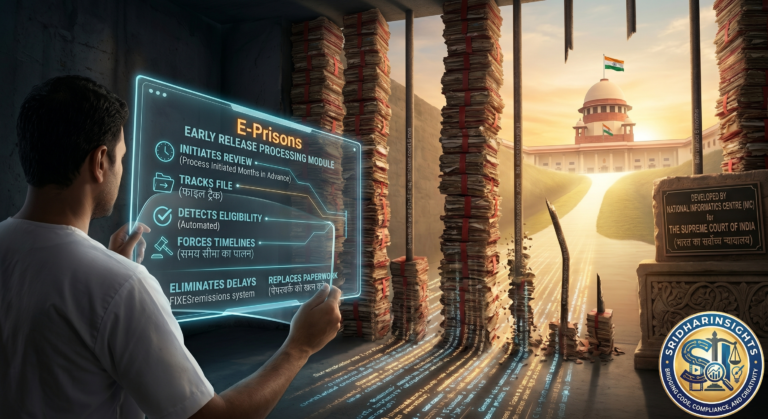
The Supreme Court of India is bringing a massive technological upgrade to the country’s prison system. Recently, the apex court directed all States and Union Territories to consider adopting a specialized digital software. This software will automatically process the premature release of eligible prisoners. Consequently, this landmark move aims to eliminate severe administrative delays. It…
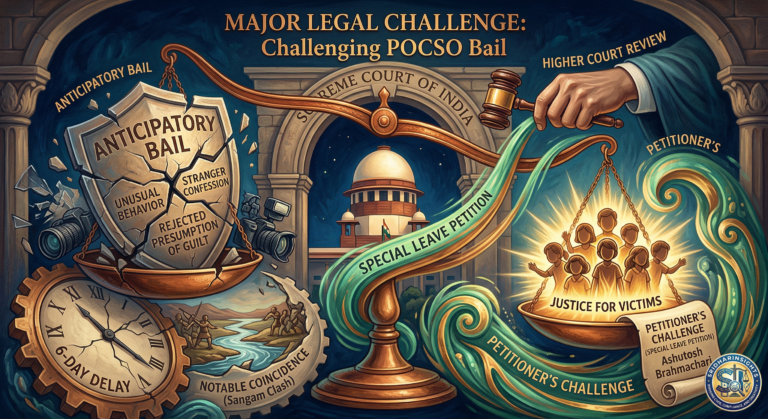
A major legal battle has reached the Supreme Court of India. Recently, a petitioner filed a Special Leave Petition (SLP) challenging a crucial Allahabad High Court order. This previous order granted anticipatory bail to Swami Avimukteshwaranand Saraswati in a highly sensitive Prayagraj POCSO case. Ashutosh Brahmachari, the first informant in the case, filed this new…