Kerala High Court: 1 Big Electronic Evidence Judgment
When a brutal crime occurs in broad daylight, one usually expects human witnesses to step forward. But what happens when the very people who watched the crime unfold suddenly lose their memory in the courtroom?
This was the chilling reality in the infamous Madhu lynching case. A few years ago, the lynching of Madhu—a mentally challenged tribal youth—shocked Kerala’s collective conscience. However, during the trial, local residents, shopkeepers, and roadside traders turned completely hostile. Even when confronted with CCTV footage in open court, they brazenly pleaded ignorance.
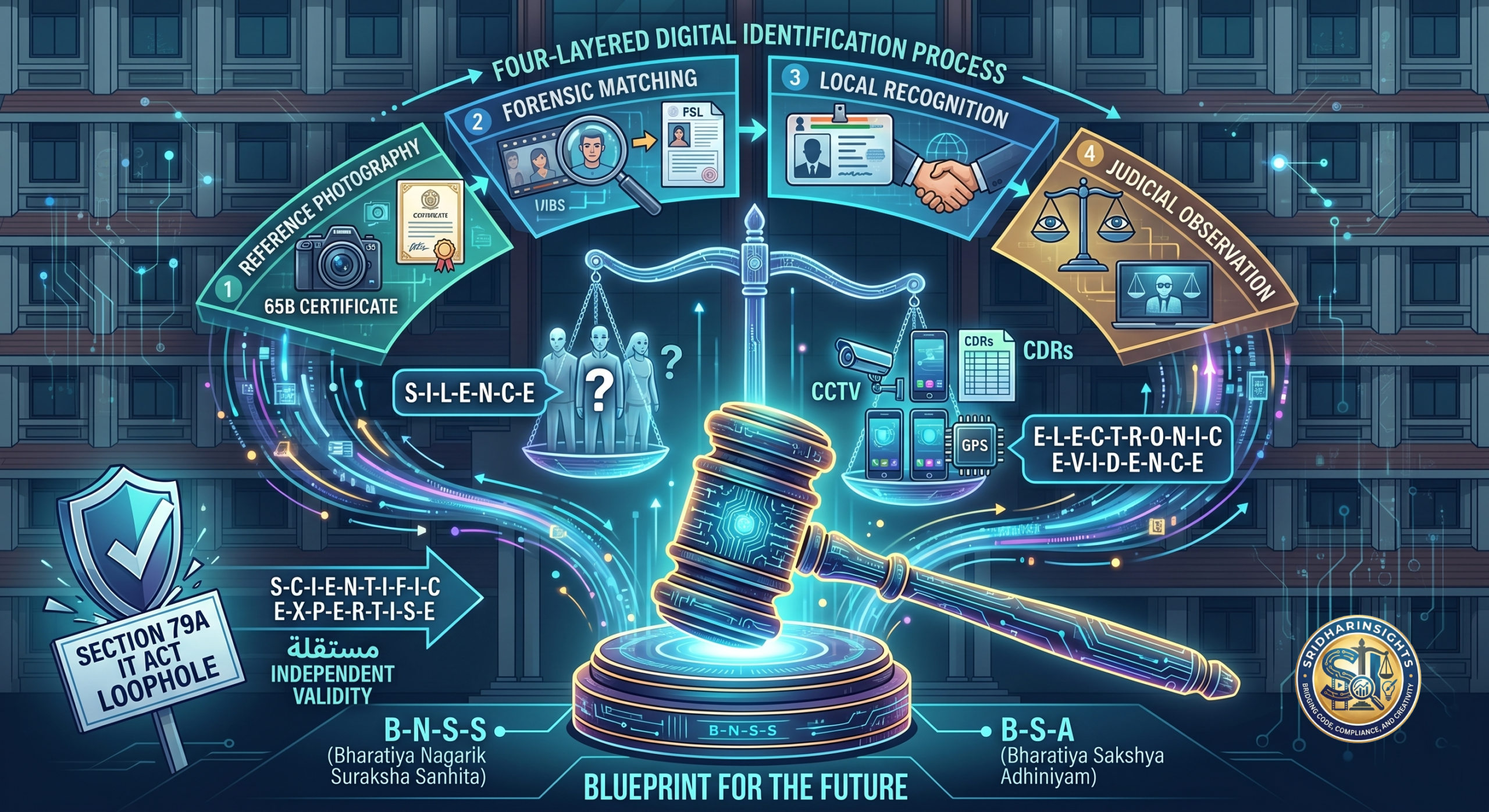
If human testimony was the only pillar of this case, the perpetrators would have walked free. Instead, the Kerala High Court recently delivered a landmark judgment that relied heavily on digital footprints. Three CCTV cameras, six mobile phones, a GPS chip, and Call Data Records (CDRs) became the ultimate truth-tellers.
Here is a detailed breakdown of how the Kerala High Court utilized electronic evidence to secure a conviction, setting a massive legal precedent for future criminal trials.
Debunking the Section 79A IT Act Loophole
The defense team played what they thought was their trump card. They argued that the electronic evidence was completely inadmissible. Why? Because the State Forensic Science Laboratory (FSL) in Thiruvananthapuram, which analyzed the devices, was not officially notified as an “Examiner of Electronic Evidence” under Section 79A of the Information Technology (IT) Act, 2000.
The Kerala High Court brilliantly dismantled this defense. The Court ruled that Section 79A merely empowers the Central Government to create an additional statutory mechanism for expert opinions. However, neither the IT Act nor the Indian Evidence Act states that failing to have this specific notification makes a government lab’s report inadmissible.
Furthermore, the Court pointed out that Section 293 of the CrPC independently recognizes reports issued by Directors and Assistant Directors of State Forensic Labs as valid evidence. The absence of a Section 79A notification does not magically erase the validity of competent scientific expertise.
The Four-Layered Digital Identification Process
Another major defense argument was that simply showing a video in court does not legally establish the identity of the accused, especially since human witnesses refused to identify them.
To overcome this, the prosecution and the Court utilized a foolproof, four-layered identification framework:
- Reference Photography: A photographer took high-quality photos of the accused immediately after their arrest. These were admitted into evidence with a proper Section 65B certificate.
- Forensic Matching: The FSL expert extracted the CCTV and mobile footage, meticulously comparing the faces in the videos with the official arrest photographs, mapping exact timestamps.
- Local Recognition: During the trial, one local resident who had known the accused for years identified them by name from the video footage, grounding the digital evidence in real-world familiarity.
- Judicial Observation: The trial court performed its own visual assessment, comparing the individuals standing in the courtroom with the footage on the screen.
The High Court noted that these four layers created a web of evidence so tight that no alternative explanation was legally tenable.
Videos and Call Records Speak for Themselves
Can a video be accepted in court if the person who recorded it doesn’t orally narrate what is happening? The defense argued that digital footage and Call Data Records (CDRs) require a witness or a Nodal Officer to orally depose the contents in the witness box.
The Kerala High Court, relying on Supreme Court precedents, shut this down. The Court clarified that once the requirements of Section 65B of the Evidence Act are met, an electronic record acts just like a physical document. It speaks for itself. Similarly, regarding CDRs, the Court invoked Section 22A of the Evidence Act. The role of a telecom Nodal Officer is strictly to prove the authenticity of the CDR document, not to stand in court and read out thousands of call entries. Once the CDR is proven genuine, the scientific data is treated as conclusive evidence.
A Blueprint for the Future of Criminal Law
The Madhu lynching judgment is a masterclass in modern jurisprudence. It proves that when human morality falters, technology can bridge the gap in the pursuit of justice.
As India transitions into a new era of criminal law with the Bharatiya Nagarik Suraksha Sanhita (BNSS) and the Bharatiya Sakshya Adhiniyam (BSA)—both of which heavily prioritize digital investigations and electronic records—this judgment serves as essential reading. The days of relying purely on the fading, easily manipulated memory of human witnesses are officially ending. In the modern courtroom, data does not lie.