Major Win: Delhi HC Slams Arbitrary Passport Seizures
Recently, a Division Bench of the Delhi High Court set aside a Single Judge’s earlier order. This previous order had refused to entertain a writ petition against a passport impounding. Therefore, this new ruling is a major victory for fundamental rights.
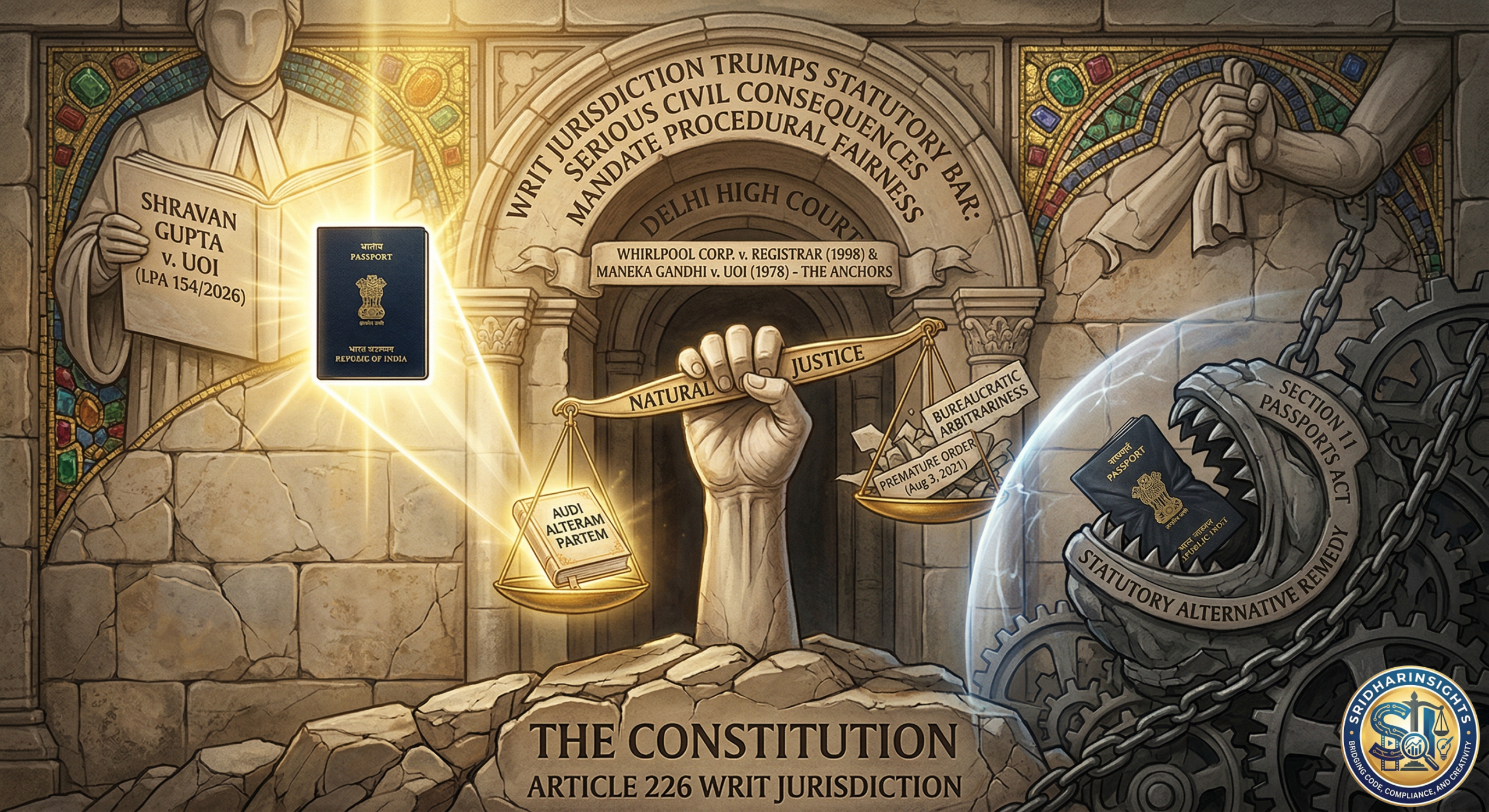
Moreover, the case of Shravan Gupta v. Union of India gives us a crucial legal reminder. Statutory remedies certainly exist. However, they do not completely block a citizen’s right to file a writ petition under Article 226 of the Constitution. This rule especially applies when government actions break the rules of natural justice and cause serious civil consequences.
The Facts: A Rushed Passport Impounding Order
First, we must look at how this dispute started. On July 28, 2021, authorities issued a show-cause notice to the petitioner regarding his passport. They gave him until August 4, 2021, to submit his official reply.
However, the passport officer jumped the gun. The officer executed the final order to impound the passport on August 3, 2021. Consequently, this severe action happened a full day before the official deadline actually expired.
Naturally, the petitioner approached the Delhi High Court to fight this arbitrary decision. Initially, a Single Judge dismissed the writ petition on February 13. The judge told the petitioner to use the alternative statutory remedy instead. Specifically, he suggested filing an appeal under Section 11 of the Passports Act, 1967. As a result, the petitioner filed this current intra-court appeal.
Article 226 vs. Section 11 of the Passports Act
The core legal question came before Chief Justice Devendra Kumar Upadhyaya and Justice Tejas Karia. Specifically, they had to answer one thing. Must a High Court reject an extraordinary writ petition just because an alternative statutory appeal exists?
Often, the State argues that citizens must exhaust all statutory remedies before approaching Constitutional Courts. Yet, the Division Bench strongly disagreed with the Single Judge’s mechanical approach to this rule.
Furthermore, the Court noted a major procedural flaw. The impounding order completely ignored the petitioner’s earlier replies. It also destroyed his legal right to respond to the notice. Thus, the government’s action blatantly violated the fundamental right to be heard.cores a vital democratic safeguard: High Courts will not allow legal technicalities to overshadow the principles of natural justice. Actions bearing severe civil consequences—such as the seizure of a passport—will always be scrutinized with the highest standard of constitutional fairness.
Key Supreme Court Precedents
The Bench based its legal analysis on two landmark Supreme Court judgments. Indeed, these famous cases form the bedrock of Indian constitutional law.
1. Whirlpool Corporation v. Registrar of Trade Marks (1998)
The Court relied heavily on this historic judgment. It proves that an alternative remedy does not absolutely bar a writ petition. Furthermore, the Supreme Court created clear exceptions for this rule. One major exception applies when an order violates the principles of natural justice. Because the passport authorities acted prematurely, the High Court decided the Single Judge made a mistake. He should not have declined jurisdiction.
2. Maneka Gandhi v. Union of India (1978)
Next, the Bench invoked this famous case to highlight the gravity of the State’s action. The Court clearly stated that impounding a passport is not just a minor administrative issue. Instead, it causes serious civil consequences because it stops the fundamental right to travel abroad. Therefore, authorities must strictly follow procedural fairness.
Why This Ruling Matters
This Delhi High Court judgment pushes back powerfully against bureaucratic overreach. Here are the main takeaways for citizens and lawyers:
- First, when an authority issues a show-cause notice, it creates a legitimate expectation. Citizens expect the government to wait for their response and read it carefully.
- Second, issuing an order before the deadline expires ruins the entire process. It turns the important notice-and-reply mechanism into a hollow formality.
- Finally, this case clarifies the true limits of alternative remedies. Laws like Section 11 of the Passports Act exist to ease the burden on courts. They definitely do not exist to protect unconstitutional administrative actions from quick judicial review.
Conclusion
Ultimately, the Division Bench set aside the Single Judge’s order. They also sent the matter back for a fresh hearing on its merits. For legal professionals and citizens alike, this case remains highly reassuring. In conclusion, the ruling proves a vital democratic safeguard. High Courts will never let legal technicalities hide clear violations of natural justice. Authorities must always treat actions that cause severe civil consequences with the absolute highest standard of constitutional fairness.