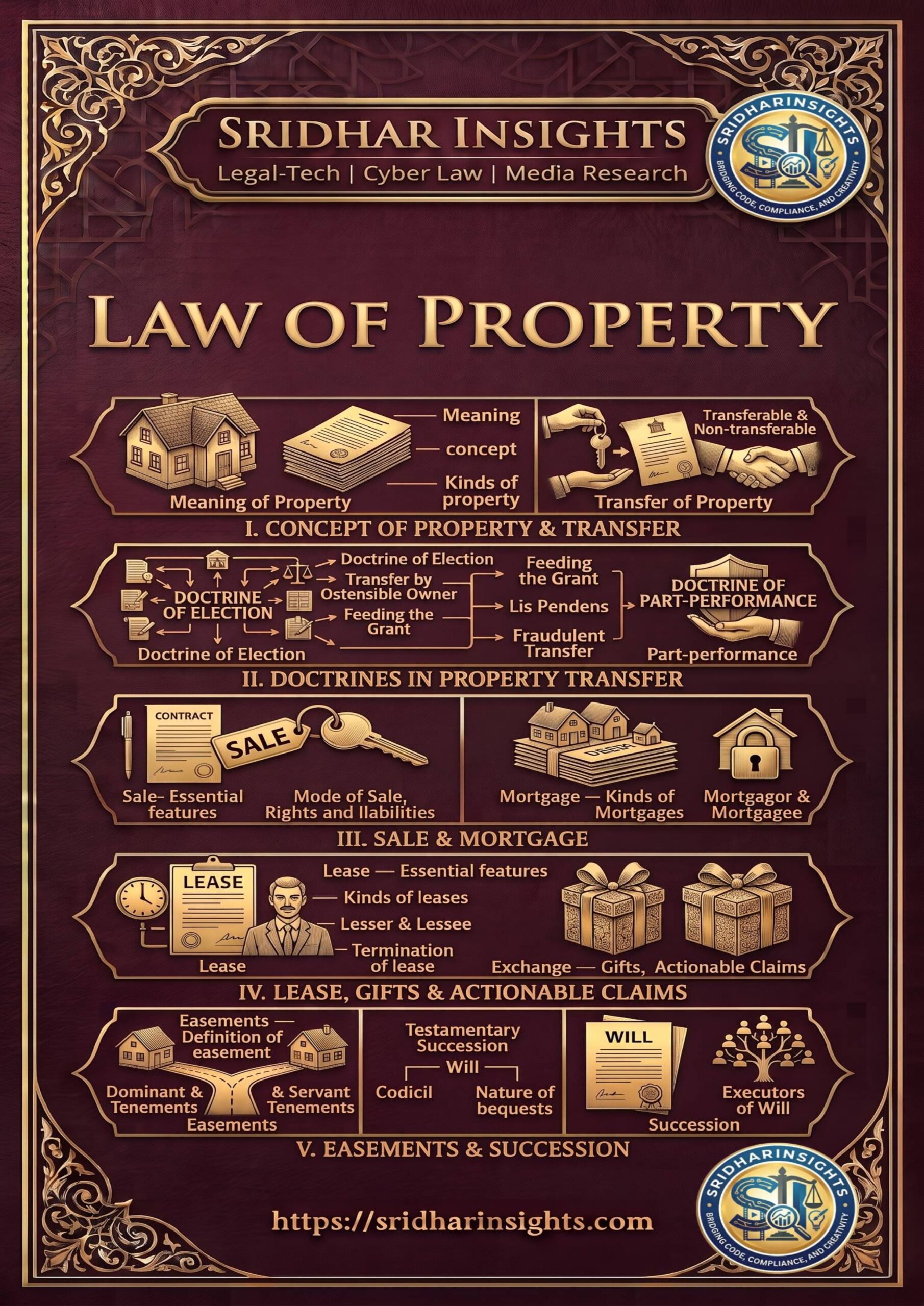
Law of Property | Legal | Quiz
Sale & Mortgage | Law of Property | MCQ Quiz with Answers | Test Your Legal Knowledge
TPA — Sale & Mortgage MCQ Quiz (1–50)
(1). [AIBE 2021] Which section of the TPA defines ‘Sale’?
- [A]. Section 52
- [B]. Section 54
- [C]. Section 55
- [D]. Section 58
(2). [CLAT-PG 2019] An agreement to sell (Contract for sale) of immovable property:
- [A]. Creates an immediate interest in the property
- [B]. Creates a charge on the property
- [C]. Does not, of itself, create any interest in or charge on such property
- [D]. Transfers absolute ownership
(3). For a valid sale under TPA, the consideration must be:
- [A]. Love and affection
- [B]. Price (money)
- [C]. Another property (barter)
- [D]. Past services
(4). According to Section 54, delivery of tangible immovable property takes place when:
- [A]. The agreement is signed
- [B]. The seller places the buyer in possession of the property
- [C]. The earnest money is paid
- [D]. The keys are shown
(5). [AIBE 2023] Under Section 55, before completion of the sale, the seller is bound to:
- [A]. Disclose any material defect in the property of which he is aware
- [B]. Pay all public charges and rent accrued due
- [C]. Take care of the property as an owner of ordinary prudence
- [D]. All of the above
(6). If the seller fails to disclose a material latent defect in the property, it amounts to:
- [A]. Fraud
- [B]. Breach of contract only
- [C]. Negligence
- [D]. Nothing, caveat emptor applies
(7). [CLAT-PG 2022] How many types of mortgages are defined under Section 58 of the TPA?
- [A]. 4
- [B]. 5
- [C]. 6
- [D]. 7
(8). In which type of mortgage is there NO delivery of possession, but the mortgagor binds himself personally to pay the debt?
- [A]. Simple Mortgage
- [B]. Usufructuary Mortgage
- [C]. English Mortgage
- [D]. Anomalous Mortgage
(9). Bare Act Illustration: A transfers his property to B with a condition that if A repays the loan on a certain date, the sale shall become void. This is a:
- [A]. English Mortgage
- [B]. Mortgage by Conditional Sale
- [C]. Usufructuary Mortgage
- [D]. Anomalous Mortgage
(10). [AIBE 2020] In a Mortgage by Conditional Sale, the condition must be embodied in:
- [A]. A separate registered agreement
- [B]. An oral agreement
- [C]. The same document which effects or purports to effect the sale
- [D]. A promissory note
(11). The defining feature of a Usufructuary Mortgage is:
- [A]. Personal liability of the mortgagor
- [B]. Delivery of possession and enjoyment of rents/profits by the mortgagee
- [C]. Absolute transfer of title
- [D]. Deposit of title deeds
(12). In an English Mortgage, the transfer of property is:
- [A]. Absolute, with a proviso for re-transfer upon payment
- [B]. Ostensible
- [C]. Partial
- [D]. Voidable
(13). [CLAT-PG 2018] A mortgage by deposit of title deeds is also known as:
- [A]. Anomalous mortgage
- [B]. Equitable mortgage
- [C]. Usufructuary mortgage
- [D]. Simple mortgage
(14). To create a valid equitable mortgage, the title deeds must be deposited:
- [A]. Anywhere in India
- [B]. Only in the towns specified in the TPA or notified by the State Government
- [C]. Only in the capital of India
- [D]. At the Sub-Registrar’s office
(15). [AIBE 2019] Does a mortgage by deposit of title deeds require a registered instrument?
- [A]. Yes, compulsorily
- [B]. No, the mere delivery of deeds with intent to create security is sufficient
- [C]. Yes, if the loan exceeds ₹1,00,000
- [D]. Only if the bank demands it
(16). Section 59 requires that all mortgages (other than by deposit of title deeds) securing ₹100 or more must be:
- [A]. Oral
- [B]. Written, signed, and attested by at least two witnesses, and registered
- [C]. Written and notarized
- [D]. Written and attested by one witness
(17). [CLAT-PG 2021] The right of the mortgagor to get back the property on payment of the debt is called the right of:
- [A]. Foreclosure
- [B]. Subrogation
- [C]. Redemption
- [D]. Marshalling
(18). The right of redemption is a:
- [A]. Statutory and inherent right under Section 60
- [B]. Contractual right only
- [C]. Right granted at the court’s discretion
- [D]. Fundamental right under the Constitution
(19). [AIBE 2022] “Once a mortgage, always a mortgage” implies that:
- [A]. The loan can never be repaid
- [B]. The property can never be sold
- [C]. Any condition that prevents redemption is void as a clog
- [D]. Mortgages are perpetual
(20). A condition in a mortgage deed stating that “if the loan is not repaid within 5 years, the mortgage shall be deemed an absolute sale” is:
- [A]. Valid and enforceable
- [B]. Void as a clog on redemption
- [C]. Voidable by the mortgagee
- [D]. A valid conditional sale
(21). The mortgagor’s right of redemption can be extinguished by:
- [A]. Act of parties
- [B]. Decree of a court
- [C]. Both (a) and (b)
- [D]. It can never be extinguished
(22). [CLAT-PG 2023] The corresponding right of the mortgagee to recover the debt is the right to:
- [A]. Redemption
- [B]. Foreclosure or Sale (Section 67)
- [C]. Contribution
- [D]. Subrogation
(23). A suit for foreclosure is essentially a suit to:
- [A]. Sell the property
- [B]. Deprive the mortgagor absolutely of his right to redeem the property
- [C]. Claim mesne profits
- [D]. Register the property
(24). Which mortgagee CANNOT sue for foreclosure?
- [A]. Mortgagee by conditional sale
- [B]. Simple mortgagee (can only sue for sale)
- [C]. English mortgagee
- [D]. Anomalous mortgagee
(25). [AIBE 2018] Can a Usufructuary Mortgagee sue for foreclosure or sale?
- [A]. Yes, for sale
- [B]. Yes, for foreclosure
- [C]. No, he can only retain possession until the debt is recovered from profits
- [D]. Yes, with court permission
(26). The doctrine of Marshalling is covered under which section?
- [A]. Section 60
- [B]. Section 81
- [C]. Section 82
- [D]. Section 92
(27). [CLAT-PG 2020] Under Section 81 (Marshalling), a subsequent mortgagee can compel the prior mortgagee to satisfy his debt out of:
- [A]. The property NOT mortgaged to the subsequent mortgagee
- [B]. The property mortgaged to the subsequent mortgagee
- [C]. The personal assets of the mortgagor
- [D]. The government treasury
(28). Marshalling cannot be exercised if it prejudices the rights of:
- [A]. The mortgagor
- [B]. The prior mortgagee or any other person who has acquired an interest for consideration
- [C]. Unsecured creditors
- [D]. The state
(29). [AIBE 2021] The doctrine of Contribution is dealt with under Section:
- [A]. 81
- [B]. 82
- [C]. 91
- [D]. 92
(30). Under Section 82, when two properties subject to a common debt belong to different owners, how is the debt shared?
- [A]. Equally
- [B]. Rateably, in proportion to the value of the properties
- [C]. The owner of the larger property pays all
- [D]. The court decides arbitrarily
(31). A Charge is defined under which section of the TPA?
- [A]. Section 54
- [B]. Section 58
- [C]. Section 100
- [D]. Section 105
(32). [CLAT-PG 2019] The fundamental difference between a Mortgage and a Charge is that:
- [A]. A charge involves a transfer of interest, a mortgage does not
- [B]. A mortgage involves a transfer of interest, a charge does not
- [C]. A charge requires no consideration
- [D]. A mortgage is only by operation of law
(33). A Charge can be created by:
- [A]. Act of parties only
- [B]. Operation of law only
- [C]. Both act of parties and operation of law
- [D]. Neither
(34). [AIBE 2023] Does a charge bind a bona fide purchaser for value without notice?
- [A]. Yes
- [B]. No, Section 100 explicitly protects such purchasers
- [C]. Only if created by court decree
- [D]. Only if registered
(35). A seller’s charge on the property for unpaid purchase money under Section 55(4)(b) is an example of a charge created by:
- [A]. Operation of law
- [B]. Act of parties
- [C]. Will
- [D]. Custom
(36). In an English mortgage, if the mortgagor repays the debt on the specified date, the mortgagee must:
- [A]. File a suit
- [B]. Pay damages
- [C]. Re-transfer the property to the mortgagor
- [D]. Retain 10% of the property
(37). [CLAT-PG 2022] Hypothetical: A mortgages his property to B. The deed states B will take possession and adjust the principal and interest from the rent. This is a:
- [A]. Simple Mortgage
- [B]. Usufructuary Mortgage
- [C]. English Mortgage
- [D]. Equitable Mortgage
(38). Which mortgagee has a right to sell the property without court intervention under Section 69 (in specific cases)?
- [A]. Usufructuary Mortgagee
- [B]. English Mortgagee (where neither party is a Hindu, Muslim, Buddhist)
- [C]. Simple Mortgagee
- [D]. Mortgagee by Conditional Sale
(39). [AIBE 2020] Subrogation (Section 92) means:
- [A]. Cancelling the mortgage
- [B]. Substitution of a person in place of the creditor (mortgagee) after paying off the prior debt
- [C]. Selling the property
- [D]. Merging two properties
(40). The limitation period for filing a suit for redemption of a mortgage is:
- [A]. 3 years
- [B]. 12 years
- [C]. 30 years
- [D]. 60 years
(41). A mortgage deed contains a clause: “If the interest is not paid for 6 months, the mortgagee can enter possession.” This clause is:
- [A]. A clog on redemption
- [B]. Valid, creating an anomalous mortgage
- [C]. Void ab initio
- [D]. Illegal
(42). [CLAT-PG 2018] Suraj Lamp & Industries case severely restricted property sales via:
- [A]. Registered Sale Deeds
- [B]. General Power of Attorney (GPA) and Wills
- [C]. Oral agreements
- [D]. Court decrees
(43). Under Section 55(1)(d), the seller is bound to execute a proper conveyance of the property when:
- [A]. The buyer pays the amount due in respect of the price
- [B]. The contract is signed
- [C]. The broker demands it
- [D]. The court orders it
(44). [AIBE 2019] If the buyer discovers a defect in the seller’s title after the sale is completed, the buyer can rely on the seller’s implied covenant for title under:
- [A]. Section 55(1)(a)
- [B]. Section 55(2)
- [C]. Section 55(3)
- [D]. Section 55(4)
(45). Under Marshalling (Sec 81), the subsequent mortgagee’s right is subject to:
- [A]. The prior mortgagee not being prejudiced
- [B]. The mortgagor’s consent
- [C]. The court’s discretion
- [D]. The Registration Act
(46). A co-mortgagor who pays off the entire mortgage debt steps into the shoes of the mortgagee. This is called:
- [A]. Marshalling
- [B]. Contribution
- [C]. Subrogation
- [D]. Novation
(47). [CLAT-PG 2021] Which type of mortgage is most commonly used by banks for housing loans in metropolitan cities to avoid heavy stamp duty?
- [A]. English Mortgage
- [B]. Usufructuary Mortgage
- [C]. Mortgage by Deposit of Title Deeds (Equitable)
- [D]. Conditional Sale
(48). The rule of Contribution (Sec 82) is subject to a contract to the contrary.
- [A]. True
- [B]. False
- [C]. True only for movable property
- [D]. False, it is absolute
(49). [AIBE 2022] In a simple mortgage, the remedy of the mortgagee is:
- [A]. Foreclosure
- [B]. To take possession
- [C]. To sue for sale of the property
- [D]. To keep the property
(50). A transfer of property made to secure the payment of an existing or future debt is the statutory definition of:
- [A]. Sale
- [B]. Mortgage
- [C]. Exchange
- [D]. Gift