Huge Change: SC Slams Weak Fines for Adulterated Food
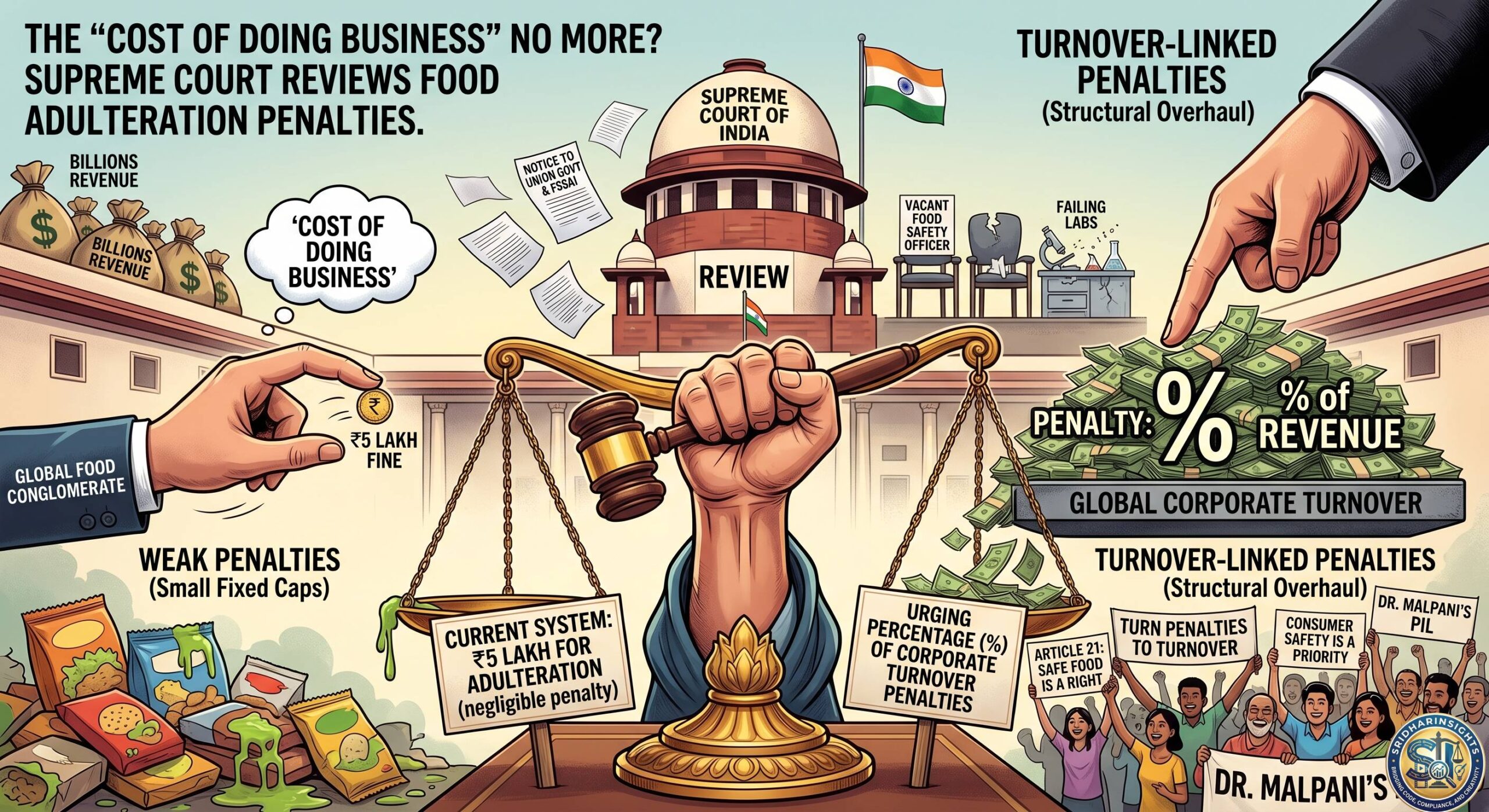
When a massive multinational food corporation gets caught selling sub-standard or adulterated products in India, the maximum penalty is often just a few lakh rupees. For companies raking in billions, these fines are barely a slap on the wrist. In fact, many corporate giants simply write off these negligible penalties as a routine “cost of doing business.”
However, this deeply flawed system might finally face a complete overhaul.
Recently, the Supreme Court of India issued formal notices to the Union Government and the Food Safety and Standards Authority of India (FSSAI). The Court is demanding answers on why the current penal framework remains so incredibly weak.
Here is a detailed breakdown of a crucial Public Interest Litigation (PIL) that could forever change how India punishes food adulteration.
The Petition: Targeting Corporate Turnover
A division bench comprising Justice Vikram Nath and Justice Sandeep Mehta issued the notices while hearing a compelling PIL. Dr. Aniruddha Narayan Malpani, a Mumbai-based IVF specialist and public health advocate, filed this crucial petition.
Dr. Malpani’s core argument is brilliantly simple. The current Food Safety and Standards Act (2006) prescribes fixed, static penalties. For instance, the law caps fines at just ₹5 lakh for selling sub-standard food and a mere ₹3 lakh for misbranding.
For a local street vendor, ₹5 lakh is a devastating penalty. But for a global food conglomerate, it is absolute pocket change. Therefore, the PIL urges the Supreme Court to mandate turnover-linked penalties. Instead of a fixed fine, violating companies should pay a harsh percentage of their total corporate revenue. This structural shift would instantly force massive food business operators (FBOs) to take consumer safety seriously.
Ignoring the Law and Violating Article 21
The petition highlights that these fixed caps actually contradict the spirit of the law itself. Section 49 of the FSS Act clearly mandates that authorities must consider the “unfair financial gains” a company makes when calculating punishments. Yet, the current penalty structure completely ignores this rule.
Furthermore, the plea strongly asserts that weak enforcement directly violates Article 21 of the Constitution. Under the Right to Life, every Indian citizen inherently deserves access to safe, wholesome, and non-toxic food. Citing the landmark Centre for Public Interest Litigation v. Union of India judgment, the petitioner reminded the Court that toxic food threatens human survival itself.
A Broken Infrastructure: Missing Officers and Failing Labs
Beyond financial penalties, the PIL exposed a severe infrastructural crisis crippling India’s food safety network.
Citing official data presented to the Rajya Sabha, the petition revealed a shocking human resource deficit. India currently operates with only 2,997 Food Safety Officers (FSOs) nationwide. Consequently, nearly 28% of the sanctioned positions (4,208) remain entirely vacant.
Moreover, the petitioner referenced a damning 2017 Comptroller and Auditor General (CAG) report. This performance audit proved that numerous state testing laboratories lack basic technical capacity. Many public labs cannot even detect heavy metals, dangerous pesticide residues, or severe microbiological contamination.
What the Supreme Court Notice Means for the Future
To fix these systemic failures, the PIL asks the Supreme Court to issue three major directives:
- Variable Penalties: Replace fixed fines with severe penalties tied directly to a company’s total financial turnover.
- Infrastructure Upgrades: Force the immediate recruitment of Food Safety Officers and modernize all state testing laboratories.
- Public Transparency: Create a centralized digital platform where citizens can track corporate food safety violations and immediate product recalls.
As the Union Government and the FSSAI prepare their official responses, the food industry is watching closely. If the Supreme Court ultimately agrees with this petition, the days of giant corporations buying their way out of food safety violations will finally come to a permanent end.