P&H High Court Drops Contempt Case Against Media
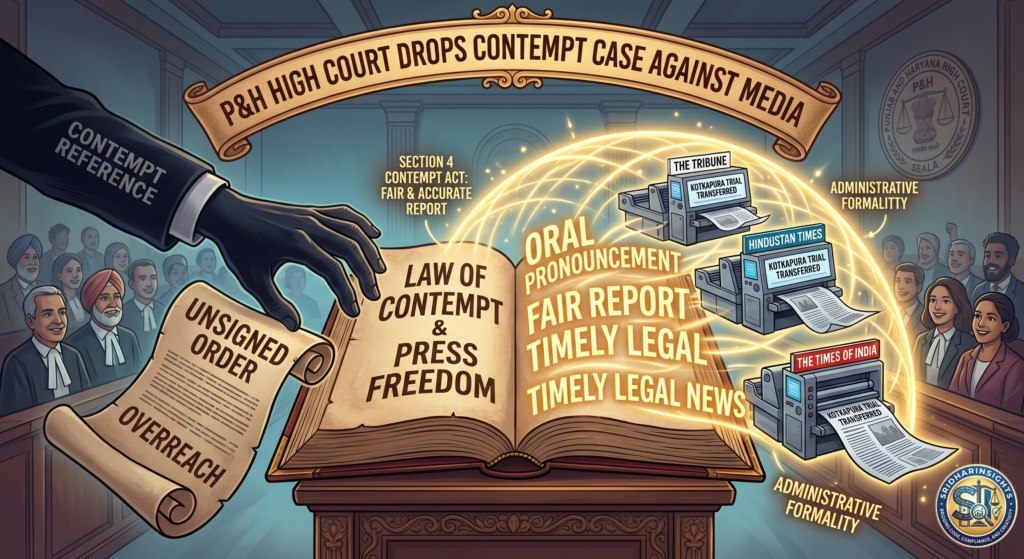
Imagine doing your job accurately, reporting on a court judgment dictated in an open courtroom, only to face criminal contempt charges because the judge had not yet signed the physical document. This alarming situation recently unfolded involving some of India’s biggest media publications.
However, the Punjab and Haryana High Court just issued a massive ruling safeguarding press freedom. The Court officially dropped the suo motu criminal contempt proceedings against several prominent journalists and editors.
Let us dive into this crucial legal battle to understand why reporting an orally dictated court order is completely legal and fair.
The Core Controversy: The Unsigned Judgment
This high-stakes controversy began in April 2026. A Single Judge Bench, presided over by Justice Tribhuvan Dahiya, was handling a major case related to the highly sensitive Kotkapura firing incidents.
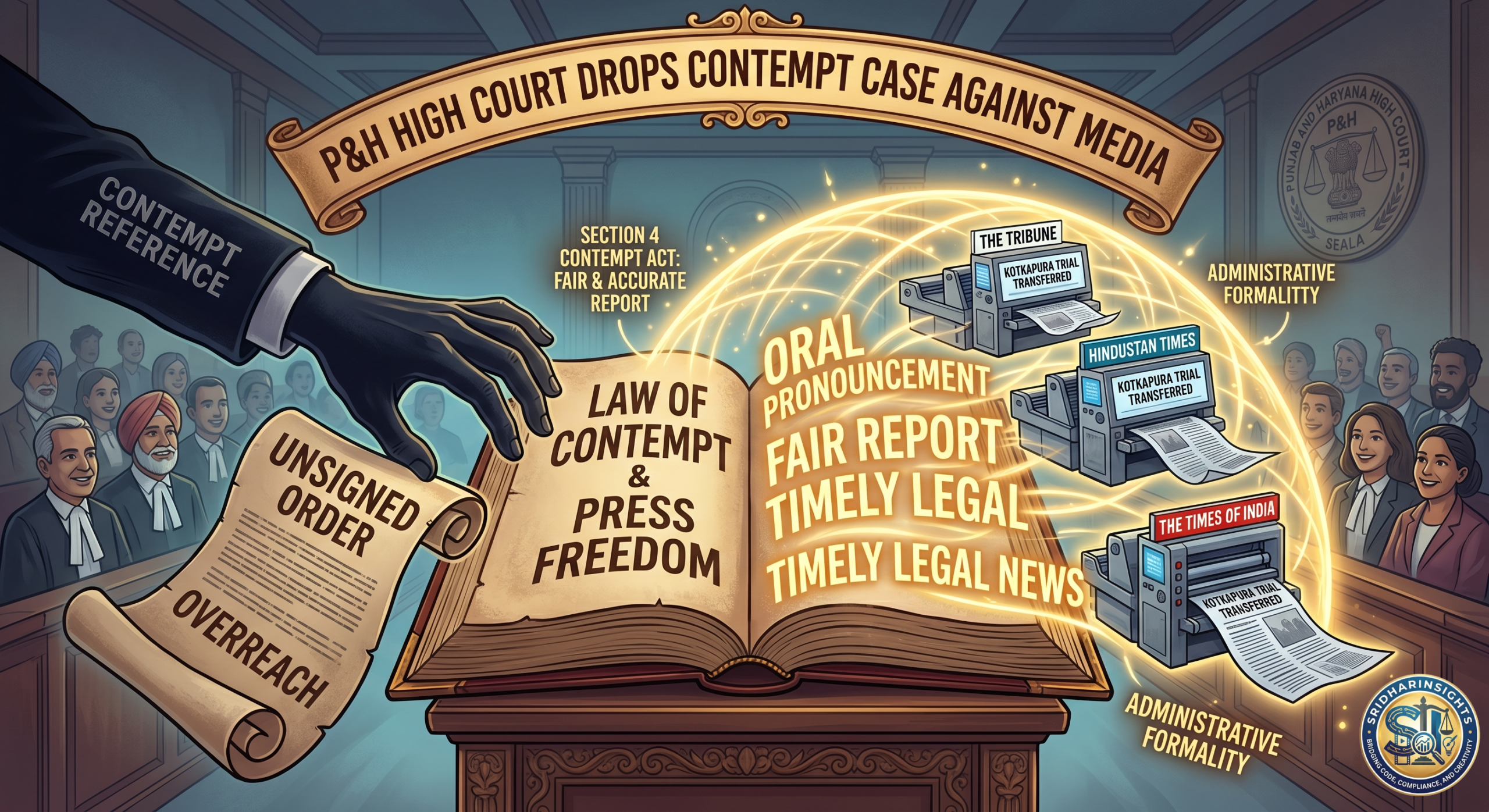
On April 9, 2026, the judge openly dictated an order in the courtroom. The dictated order explicitly directed the transfer of the trial involving former Punjab police officers from Faridkot to Chandigarh.
Prominent newspapers, including The Tribune, Hindustan Times, and The Times of India, quickly covered this major development. They published detailed reports on April 10, accurately stating that the High Court had transferred the trials.
However, there was a technical catch. The judge had not yet formally signed the typed order. Consequently, on April 11, the Single Judge took serious offense. Viewing the media reports as an attempt to “overreach the court and interfere with the administration of justice,” the judge immediately initiated suo motu criminal contempt proceedings. The court issued notices to editors-in-chief, including Jyoti Malhotra of The Tribune, and several reporters.
The High Court’s Landmark Verdict
A Division Bench comprising Justice Jasgurpreet Singh Puri and Justice Amarjot Bhatti took up this critical contempt reference in the case titled Court on Its Own Motion v. Jyoti Malhotra and Others.
The Bench carefully examined two main issues: whether the news reports were factually false, and whether reporting an unsigned, orally dictated order legally constitutes contempt.
During the hearings, the Division Bench made powerful observations defending press freedom. The judges noted that the newspapers had reported the facts entirely correctly. The Single Judge had indeed dictated the transfer order in open court. The contents of the newspaper publications were not false; they were completely accurate.
Why Oral Dictation Counts as a Pronouncement
To resolve the legal technicality, the Division Bench relied heavily on established Supreme Court precedents and Section 4 of the Contempt of Courts Act, 1971.
Section 4 clearly states that a person cannot be held guilty of contempt for publishing a “fair and accurate report of a judicial proceeding”. The Bench emphasized that an open-court dictation is exactly that—a public judicial proceeding.
Furthermore, the judges highlighted a crucial legal principle: once a judge formally pronounces a judgment in an open court, it immediately becomes a valid, operative judgment. The physical signature is merely an administrative formality. Therefore, reporting on that valid oral pronouncement cannot ever be termed as criminal contempt.
Because the journalists acted fairly, accurately, and based on a valid judicial pronouncement, the Court firmly dismissed the criminal contempt petition.
A Massive Win for Court Reporting
This ruling serves as a vital shield for legal journalists across India. Reporters sit in courtrooms precisely to deliver timely updates to the public. If journalists were forced to wait days or weeks for a judge’s physical signature, the entire concept of real-time legal news would collapse.
Ultimately, this judgment strongly reaffirms that fair, accurate, and truthful reporting of open-court proceedings is a protected democratic right, not a crime.