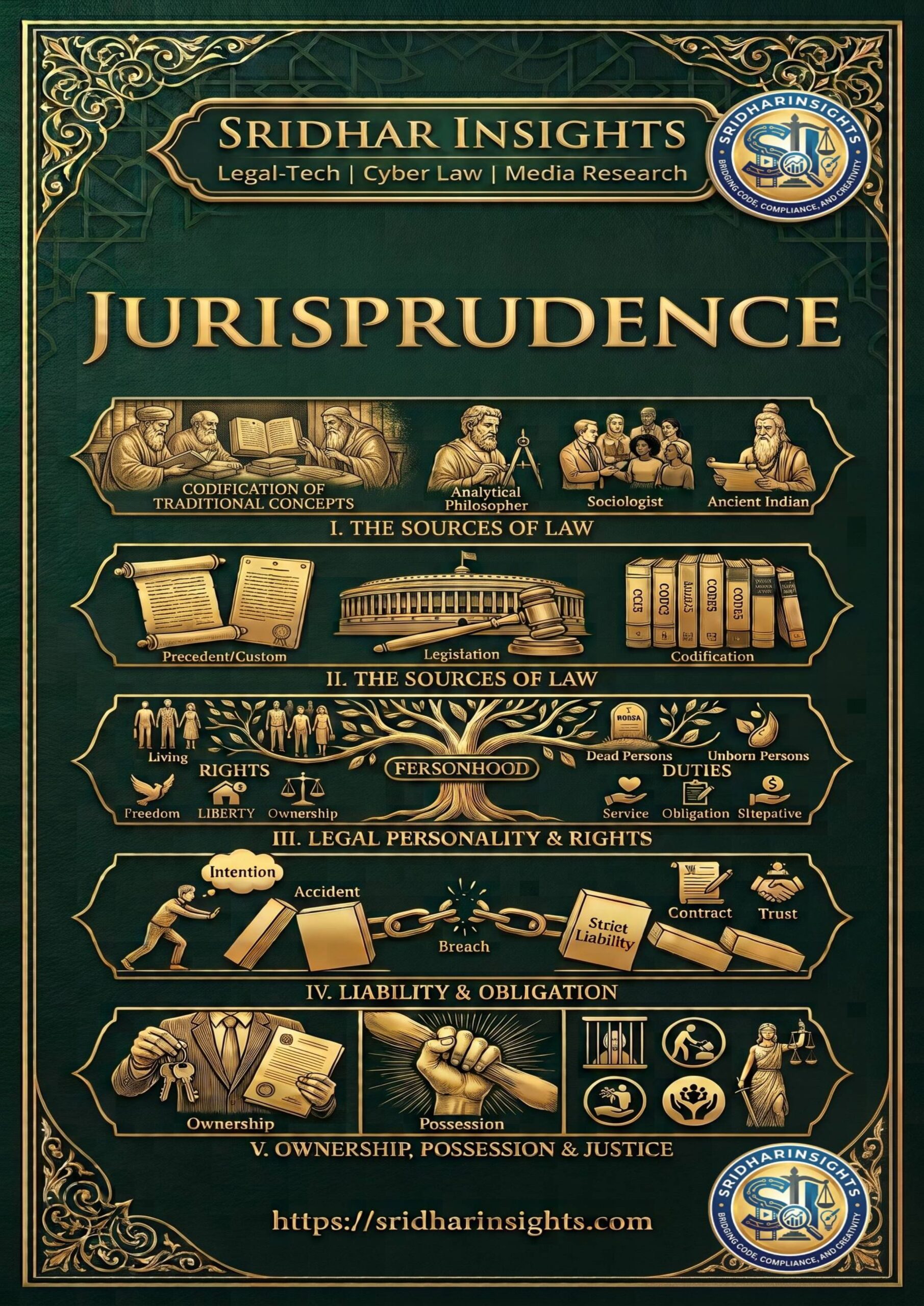
Jurisprudence | Legal | Quiz
Ownership, Possession, Property & Justice | Jurisprudence | MCQ Quiz with Answers | Test Your Legal Knowledge
Ownership, Possession, Property & Justice MCQ Quiz (1–50)
(1). [AIBE 2021] Who defined ownership as “a relation between a person and a right that is vested in him”?
- [A]. John Austin
- [B]. John Salmond
- [C]. Roscoe Pound
- [D]. H.L.A. Hart
(2). Ownership is best described in legal theory as:
- [A]. A physical object
- [B]. A bundle of rights, liberties, powers, and immunities vested in a person regarding a thing
- [C]. Pure physical possession
- [D]. A temporary contract
(3). [CLAT-PG 2019] The two indispensable elements required to constitute legal possession are:
- [A]. Title deed and registration
- [B]. Corpus possessionis (physical control) and Animus possidendi (mental intention)
- [C]. Purchase price and sales tax
- [D]. Witness attestation and notarization
(4). The maxim “Possession is nine points of the law” implies that:
- [A]. Possession is a strong presumptive title protected against everyone except the true owner.
- [B]. Possession is illegal without ownership.
- [C]. Owners never possess property.
- [D]. Thieves acquire absolute ownership.
(5). [AIBE 2023] A summary suit under Section 6 of the Specific Relief Act, 1963 can be instituted by a person dispossessed without consent:
- [A]. Within 12 years based on title
- [B]. Within 6 months based strictly on prior settled possession
- [C]. Only in the Supreme Court
- [D]. After paying a penalty
(6). Which of the following is classified as Incorporeal Property?
- [A]. A residential building
- [B]. Copyrights, patents, and trademarks
- [C]. Agricultural land
- [D]. Gold coins
(7). [CLAT-PG 2020] According to John Salmond, which of the following is NOT a recognized primary mode of acquiring property?
- [A]. Prescription
- [B]. Agreement
- [C]. Inheritance
- [D]. Confiscation by mob violence
(8). A legal sanction backed by the state to enforce compliance with the law is classified primarily into:
- [A]. Moral and religious sanctions
- [B]. Civil sanctions and Criminal sanctions
- [C]. International treaties
- [D]. Customary taboos
(9). [AIBE 2018] The administration of Civil Justice is primarily concerned with:
- [A]. Punishing criminals with death
- [B]. Redressing private wrongs, enforcing rights, and awarding compensatory damages
- [C]. Waging foreign wars
- [D]. Levying income tax
(10). Which theory of punishment aims to strike terror into potential criminals by making an infamous example of the offender?
- [A]. Reformative Theory
- [B]. Deterrent (Exemplary) Theory
- [C]. Preventive Theory
- [D]. Restorative Theory
(11). [CLAT-PG 2022] The motto “Hate the sin, not the sinner” forms the philosophical foundation of which theory of punishment?
- [A]. Retributive Theory
- [B]. Reformative (Rehabilitative) Theory
- [C]. Deterrent Theory
- [D]. Preventive Theory
(12). Aristotelian Justice is classically divided into:
- [A]. Civil and Criminal Justice
- [B]. Distributive Justice and Corrective Justice
- [C]. Formal and Substantive Justice
- [D]. National and International Justice
(13). [AIBE 2019] The Retributive Theory of punishment is based on the ethical principle that:
- [A]. Criminals should be rewarded.
- [B]. An offender deserves to suffer in proportion to the moral wickedness of the crime (“Just Deserts”).
- [C]. Crime is a disease to be cured.
- [D]. Punishment is useless.
(14). Mediate possession refers to a situation where:
- [A]. A person possesses property through an agent, tenant, or bailee.
- [B]. Possession is illegal.
- [C]. No one owns the property.
- [D]. Possession is shared equally with the state.
(15). [CLAT-PG 2021] The Latin maxim Lex talionis relates to:
- [A]. The law of retaliation (Retributive theory)
- [B]. The law of contract
- [C]. The rule against bias
- [D]. The doctrine of basic structure
(16). Property in jurisprudence encompasses:
- [A]. Only tangible physical land
- [B]. The legal bundle of rights, interests, and economic expectations a person holds over a thing
- [C]. Cash money alone
- [D]. Government buildings
(17). [AIBE 2022] Which of the following is a possessory remedy under Indian law that allows summary recovery of land without proving ownership title?
- [A]. Section 6 of the Specific Relief Act, 1963
- [B]. Section 302 of the IPC
- [C]. Article 368 of the Constitution
- [D]. Section 13 of the TPA
(18). The Preventive Theory of punishment seeks to protect society primarily by:
- [A]. Executing all offenders
- [B]. Incapacitating or physically disabling the offender from committing future crimes (e.g., imprisonment)
- [C]. Educating the public via newspapers
- [D]. Forgiving all debts
(19). [CLAT-PG 2018] In the landmark case of Nair Service Society v. K.C. Alexander, the Supreme Court affirmed that:
- [A]. Settled physical possession is a substantive legal right protected against unlawful ouster.
- [B]. Possession gives no rights whatsoever.
- [C]. Trespassers have absolute ownership.
- [D]. Owners can use unlimited violence to evict tenants.
(20). John Austin defined a legal sanction as:
- [A]. A moral blessing
- [B]. The evil or penalty threatened by the sovereign for disobedience of a command
- [C]. A voluntary contract clause
- [D]. An international treaty
(21). [AIBE 2023] The distinction between Ownership (De Jure) and Possession (De Facto) is that:
- [A]. Ownership is the legal right, whereas possession is the factual physical control.
- [B]. They are identical in every legal system.
- [C]. Possession is always superior to ownership.
- [D]. Ownership requires no mental element.
(22). Which theory of punishment views crime as a social and psychological malady that requires therapeutic rehabilitation?
- [A]. Deterrent Theory
- [B]. Reformative Theory
- [C]. Retributive Theory
- [D]. Preventive Theory
(23). [CLAT-PG 2019] John Rawls’ theory of justice famously introduced the philosophical concepts of the “Original Position” and the:
- [A]. Veil of Ignorance
- [B]. Grundnorm
- [C]. Volksgeist
- [D]. Social Contract Leviathan
(24). The acquisition of property through continuous, long-standing adverse enjoyment over a statutory period is known as:
- [A]. Agreement
- [B]. Prescription
- [C]. Inheritance
- [D]. Gift
(25). [AIBE 2020] Can a person have corpus (physical control) without animus (mental intention to possess)?
- [A]. Yes, e.g., a servant holding their master’s coat or a postman delivering mail holds physical custody, not legal possession.
- [B]. No, possession is impossible without both.
- [C]. Only in criminal cases.
- [D]. Only under corporate law.
(26). The administration of Criminal Justice aims primarily to:
- [A]. Resolve private contract disputes
- [B]. Punish public wrongs, maintain social order, and deter offenses against the State
- [C]. Maximize commercial profits
- [D]. Distribute ancestral lands
(27). [CLAT-PG 2022] Which of the following modes of property acquisition involves the transfer of rights inter vivos through a voluntary contract?
- [A]. Prescription
- [B]. Agreement (Sale, Gift, Lease)
- [C]. Inheritance
- [D]. Escheat
(28). The “rarest of rare cases” sentencing principle balancing deterrence and reformative human rights was established by the Supreme Court in:
- [A]. Kesavananda Bharati
- [B]. Bachan Singh v. State of Punjab
- [C]. M.C. Mehta
- [D]. Maneka Gandhi
(29). [AIBE 2018] A contingent ownership becomes a vested ownership when:
- [A]. The uncertain future event happens or conditions are fulfilled.
- [B]. The owner dies.
- [C]. The court issues a warning.
- [D]. Taxes are paid in advance.
(30). In the context of legal sanctions, civil sanctions are designed to be:
- [A]. Compensatory and remedial (restitutio in integrum)
- [B]. Brutally deterrent and capital
- [C]. Confiscatory without trial
- [D]. Secretive
(31). [CLAT-PG 2021] The juristic concept that links a wrongdoer with the coercive penal or remedial consequences of the law is known as:
- [A]. Ownership
- [B]. Liability
- [C]. Possession
- [D]. Custom
(32). Can an owner recover property from a possessor who acquired it in good faith and for value without notice?
- [A]. Yes, true ownership generally prevails, subject to specific statutory exceptions (like Ostensible Owner under Section 41 TPA or Market Overt).
- [B]. Never under any circumstances.
- [C]. Only if the police approve.
- [D]. Only after 30 years.
(33). [AIBE 2019] The maxim Ex turpi causa non oritur actio means:
- [A]. No action arises from a base, illegal, or immoral cause.
- [B]. To every wrong there is a remedy.
- [C]. Possession is nine points of the law.
- [D]. Equity follows the law.
(34). The primary strength of the Deterrent Theory of punishment is that it:
- [A]. Reforms every criminal instantly.
- [B]. Instills fear of severe consequences, theoretically discouraging potential offenders from committing crimes.
- [C]. Costs zero money to maintain prisons.
- [D]. Eliminates the need for courts.
(35). [CLAT-PG 2023] In the administration of justice, if a dispute involves a claim for unliquidated damages arising from a civil wrong, it falls under:
- [A]. Criminal prosecution
- [B]. Civil Justice (Law of Torts)
- [C]. Constitutional writ jurisdiction
- [D]. International maritime law
(36). The concept of “Distributive Justice” deals specifically with:
- [A]. Punishing murderers
- [B]. Fair and equitable allocation of goods, wealth, resources, and honors among members of society
- [C]. Enforcing private contracts
- [D]. Resolving property boundary disputes
(37). [AIBE 2021] Which of the following jurists is most famously associated with the comprehensive definition of possession and ownership in English jurisprudence?
- [A]. John Austin
- [B]. John Salmond
- [C]. H.L.A. Hart
- [D]. Roscoe Pound
(38). The legal status of a tenant who occupies a landlord’s building is that the tenant holds:
- [A]. Immediate physical possession, while the landlord holds mediate possession and ownership.
- [B]. Absolute ownership.
- [C]. No legal rights whatsoever.
- [D]. Corporation sole status.
(39). [CLAT-PG 2020] The primary limitation of the Retributive Theory of punishment is that:
- [A]. It is too lenient.
- [B]. It relies purely on moral intuition and vengeance (“eye for an eye”), offering little empirical proof of social utility or rehabilitation.
- [C]. It abolishes prisons.
- [D]. It requires no judges.
(40). The rule that a person cannot take advantage of their own wrong is a fundamental maxim of:
- [A]. Equity and jurisprudence
- [B]. Criminal conspiracy only
- [C]. Corporate bankruptcy
- [D]. International trade
(41). [AIBE 2017] When property passes upon the death of an owner to his legal heirs, the mode of acquisition is classified as:
- [A]. Prescription
- [B]. Inheritance (Succession)
- [C]. Agreement
- [D]. Adverse possession
(42). The overarching purpose of combining multiple theories of punishment (deterrence, reform, prevention) in modern penal codes is to achieve:
- [A]. Total confusion in courts
- [B]. A balanced, pluralistic approach that protects public safety while upholding human dignity and justice
- [C]. Permanent incarceration for all citizens
- [D]. Absolute state autocracy
(43). [CLAT-PG 2019] If a person finds a lost item on public land, their possessory right against everyone except the true owner is:
- [A]. Non-existent
- [B]. Valid and enforceable (Armory v. Delamirie rule: finder keeps it against all but the true owner)
- [C]. Forfeited to the finder’s employer
- [D]. A criminal offense
(44). The legal term for ownership where the legal title is separated from the beneficial enjoyment is:
- [A]. Sole ownership
- [B]. Trust ownership
- [C]. Corporeal ownership
- [D]. Contingent ownership
(45). [AIBE 2022] In summary, Unit V’s analysis of Ownership, Possession, Property, Sanctions, and Justice demonstrates that jurisprudence unites these concepts to:
- [A]. Provide a comprehensive institutional framework for wealth distribution, dispute resolution, and state-backed social order.
- [B]. Abolish private property entirely.
- [C]. Give judges absolute executive power.
- [D]. Eliminate all laws.
(46). Which landmark Supreme Court case affirmed the protection of settled possession against forcible ouster?
- [A]. Rame Gowda v. M. Varadappa Naidu
- [B]. Rylands v. Fletcher
- [C]. Salomon v. Salomon
- [D]. Donoghue v. Stevenson
(47). [CLAT-PG 2021] Can criminal jurisdiction be invoked for a purely private breach of contract where no dishonest intention (mens rea of cheating ab initio) existed?
- [A]. Yes, all contract breaches are crimes.
- [B]. No, a mere breach of contract without fraudulent intent does not constitute a criminal offense (such as cheating under IPC/BNS).
- [C]. Only if approved by the Prime Minister.
- [D]. Only for real estate contracts.
(48). The term De Jure ownership translates literally to:
- [A]. Ownership in fact
- [B]. Ownership by law (legal right)
- [C]. Temporary possession
- [D]. Void ownership
(49). [AIBE 2023] The ultimate jurisprudential objective of the entire legal ecosystem—from sources and rights to sanctions and justice—is to ensure:
- [A]. The realization of an ordered, equitable, and just human society governed by the Rule of Law.
- [B]. Endless litigation.
- [C]. Absolute executive tyranny.
- [D]. The collapse of civil institutions.
(50). The synergy across Unit V confirms that property rights, possessory remedies, coercive legal sanctions, and criminal punishment theories work in harmony to maintain:
- [A]. Social equilibrium and the administration of justice.
- [B]. Absolute chaos.
- [C]. Purely private revenge.
- [D]. Feudal autocracy.