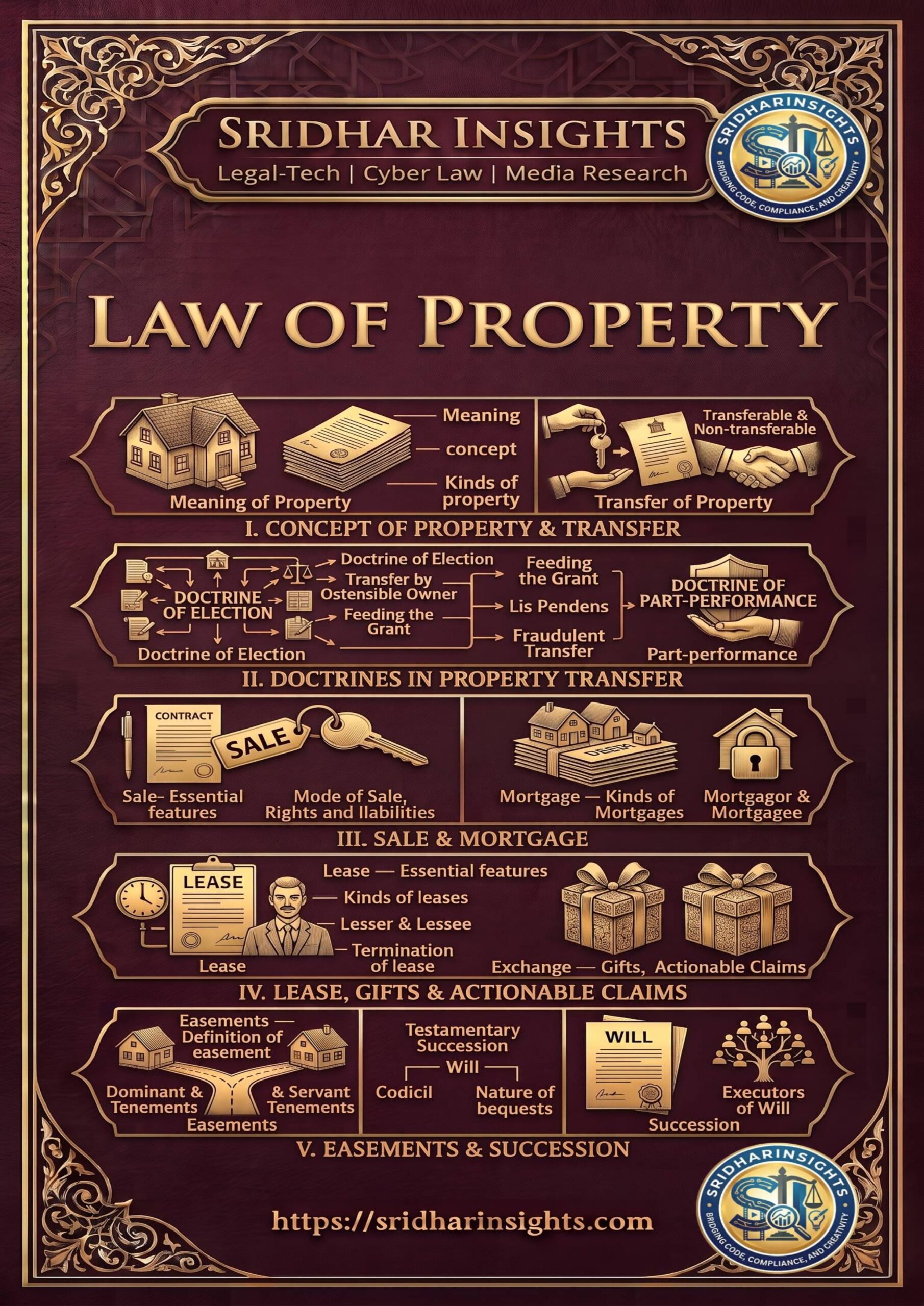
Law of Property | Legal | Quiz
Election, Covenants, Ostensible Owner & Fraud | Law of Property | MCQ Quiz with Answers | Test Your Legal Knowledge
TPA — Election, Covenants, Ostensible Owner & Fraud MCQ Quiz (1–50)
(1). [AIBE 2021] A transfers B’s estate to C, and as part of the same transaction, gives ₹5,000 to B. B chooses to retain his estate. Under Section 35, what happens to the ₹5,000?
- [A]. B keeps it as a penalty from A
- [B]. C gets the ₹5,000 directly
- [C]. B must relinquish it, and it reverts to A or his representatives
- [D]. It is forfeited to the State
(2). In the scenario above, if B retains his estate and relinquishes the ₹5,000, and A is still alive, who compensates C (the disappointed transferee)?
- [A]. B must compensate C
- [B]. A must compensate C out of the relinquished ₹5,000
- [C]. C has no right to compensation
- [D]. The court dictates compensation from B’s estate
(3). [CLAT-PG 2019] The time limit provided under Section 35 for the true owner to make an election after being required to do so by the transferor is:
- [A]. 6 months
- [B]. 1 year
- [C]. A reasonable time (if he fails, his silence is deemed acceptance)
- [D]. 3 years
(4). A person who takes a benefit indirectly under a transaction:
- [A]. Must elect
- [B]. Need not elect
- [C]. Must surrender the property
- [D]. Gets double compensation
(5). Cooper v. Cooper established that the Doctrine of Election applies to:
- [A]. Only immovable property
- [B]. Only wills and testamentary documents
- [C]. Every instrument and every type of property
- [D]. Only Hindu Joint Family properties
(6). [AIBE 2023] A sells land to B with a covenant that B will not build a factory on it. B sells the land to C. C builds a factory. Can A enforce the covenant against C?
- [A]. No, there is no privity of contract
- [B]. Yes, if C had notice of the restrictive covenant
- [C]. Yes, irrespective of notice
- [D]. No, because it is a positive covenant
(7). Which landmark case established that restrictive covenants run with the land in equity and bind subsequent purchasers with notice?
- [A]. Carlill v. Carbolic Smoke Ball Co.
- [B]. Tulk v. Moxhay
- [C]. Salomon v. Salomon
- [D]. Balfour v. Balfour
(8). A covenant compelling a purchaser to spend money to repair a boundary wall is a:
- [A]. Restrictive covenant and binds all future buyers
- [B]. Positive covenant and does NOT bind a subsequent purchaser
- [C]. Illegal covenant
- [D]. Voidable condition
(9). [CLAT-PG 2022] A buys a house in the name of his wife, B. B later sells the house to C without A’s knowledge. C pays market value and acted in good faith after reasonable inquiry. Can A recover the house from C?
- [A]. Yes, because A is the real owner
- [B]. No, because B was the ostensible owner with A’s implied consent, and C is a bona fide purchaser
- [C]. Yes, because a wife cannot sell property without husband’s consent
- [D]. No, because all benami transactions are perfectly valid
(10). The defense under Section 41 (Ostensible Owner) is available only when the transfer is:
- [A]. A gift
- [B]. For consideration
- [C]. By operation of law
- [D]. An exchange of equal values
(11). The standard of “reasonable care” required by the transferee under Section 41 is that of:
- [A]. A forensic investigator
- [B]. An ordinary prudent man of business
- [C]. A legal expert
- [D]. The Registrar of Assurances
(12). [AIBE 2019] Which Privy Council case laid down the foundation for Section 41?
- [A]. Bellamy v. Sabine
- [B]. Ramcoomar Koondoo v. McQueen
- [C]. Maddison v. Alderson
- [D]. Gokuldas v. Puranmal
(13). Section 41 of TPA is heavily impacted and restricted in modern India by which legislation?
- [A]. The Registration Act, 1908
- [B]. The Benami Transactions (Prohibition) Act, 1988
- [C]. The Specific Relief Act, 1963
- [D]. The Indian Contract Act, 1872
(14). [CLAT-PG 2021] Bare Act Illustration: A, a Hindu, separated from his father B, sells field Z to C, representing he is authorized to do so. Z actually belongs to B. Later, B dies, and A inherits Z. C has not rescinded the contract. What is C’s right?
- [A]. C can claim damages only
- [B]. C can require A to deliver field Z to him
- [C]. C’s contract is void ab initio
- [D]. C must pay A again for field Z
(15). Section 43 (Feeding the Grant) applies when the transferor’s initial representation was:
- [A]. Fraudulent only
- [B]. Erroneous only
- [C]. Either fraudulent or erroneous
- [D]. Made in a court of law
(16). [AIBE 2017] Section 43 does NOT apply to:
- [A]. Sales
- [B]. Mortgages
- [C]. Leases
- [D]. Gratuitous transfers (Gifts)
(17). If the transferor acquires the title, but before the first transferee claims it, the transferor sells it to a second bona fide purchaser for value without notice. Who gets the property?
- [A]. The first transferee
- [B]. The second bona fide purchaser
- [C]. The property reverts to the State
- [D]. They take it as joint tenants
(18). The Supreme Court in Jumma Masjid v. Kodimaniandra Deviah ruled that Section 43 applies even if the transferor’s initial interest was merely:
- [A]. A leasehold
- [B]. A Spes Successionis (expectancy)
- [C]. A mortgage
- [D]. A vested remainder
(19). [CLAT-PG 2018] What is the primary difference between Sec 41 and Sec 43 regarding the transferor’s status at the time of transfer?
- [A]. In Sec 41, he has no consent; in Sec 43 he has consent.
- [B]. In Sec 41, he has the real owner’s consent; in Sec 43, he has no title and no consent.
- [C]. Sec 41 applies to gifts; Sec 43 applies to sales.
- [D]. There is no difference.
(20). A sues B for specific performance of a contract to sell a house. While the suit is pending, B sells the house to C. The court decrees specific performance in favor of A. What is C’s legal position?
- [A]. C retains the house if he bought it without notice of the suit
- [B]. C’s purchase is subservient to the decree, and C must surrender the house to A
- [C]. The court’s decree is void against C
- [D]. C becomes a co-owner with A
(21). [AIBE 2022] The doctrine of Lis Pendens applies to which types of suits?
- [A]. Only suits for money recovery
- [B]. Only criminal proceedings
- [C]. Suits where a right to specific immovable property is directly in question
- [D]. Suits for defamation
(22). For Section 52 to apply, the suit must NOT be:
- [A]. Filed in a lower court
- [B]. Defended vigorously
- [C]. Collusive (a sham proceeding)
- [D]. Based on documentary evidence
(23). Pendente lite nihil innovetur means:
- [A]. Let the buyer beware
- [B]. Equity acts in personam
- [C]. During litigation, nothing new should be introduced
- [D]. Justice delayed is justice denied
(24). [CLAT-PG 2020] According to Turner L.J. in Bellamy v. Sabine, the doctrine of Lis Pendens is based on:
- [A]. The doctrine of constructive notice
- [B]. Strict public policy and necessity
- [C]. Fraud
- [D]. Mutual mistake
(25). Does Lis Pendens apply to involuntary sales, such as a court-ordered auction during the pendency of another suit regarding the same property?
- [A]. No, court auctions are exempt
- [B]. Yes, it applies to court execution sales as well
- [C]. Only if the auction purchaser consents
- [D]. Only if the President approves
(26). The pendency of a suit under Section 52 is deemed to commence from:
- [A]. The date the defendant receives the summons
- [B]. The date of presenting the plaint in a court of competent jurisdiction
- [C]. The date the trial begins
- [D]. The date of the first hearing
(27). [AIBE 2023] A, heavily in debt, transfers his only immovable property to his brother B for a nominal sum, intending to keep it out of the reach of his creditors. This transfer is:
- [A]. Void ab initio
- [B]. Voidable at the option of any defeated creditor
- [C]. Valid, as A is the lawful owner
- [D]. Illegal and constitutes a criminal offense under TPA
(28). Section 53 protects which of the following parties?
- [A]. A transferee who shares the fraudulent intent
- [B]. A transferee who takes the property as a gift
- [C]. A transferee in good faith and for consideration
- [D]. The fraudulent transferor
(29). [CLAT-PG 2019] Which of the following is considered a “Badge of Fraud”?
- [A]. Transfer of the entirety of the debtor’s estate
- [B]. Extreme secrecy in the transaction
- [C]. The debtor retaining possession after the sale
- [D]. All of the above
(30). Does Section 53 apply to a “Sham” transfer (where the deed is executed but no actual transfer was ever intended)?
- [A]. Yes
- [B]. No, sham transfers are void outright; Sec 53 applies to real transfers with fraudulent intent
- [C]. Yes, but only if registered
- [D]. Yes, it makes them valid
(31). [AIBE 2020] A suit instituted by a creditor under Section 53 to avoid a transfer must be filed:
- [A]. On behalf of himself only
- [B]. On behalf of, or for the benefit of, all the creditors
- [C]. Through the state prosecutor
- [D]. Within 30 days of the transfer
(32). In Abdul Shukoor v. Arji Papa Rao, the Supreme Court held that if the purchaser knows of the debtor’s intent to defeat creditors and still buys the property, the purchaser is:
- [A]. Protected as a bona fide buyer
- [B]. Not a transferee in good faith
- [C]. Entitled to compensation
- [D]. Immune from suit
(33). [CLAT-PG 2023] A agrees in writing to sell his land to B. B pays the price and takes possession. The sale deed is not registered. A sues to evict B based on lack of registration. B can defend his possession under:
- [A]. Section 41
- [B]. Section 43
- [C]. Section 53A
- [D]. Section 52
(34). Which of the following is a strict mandatory requirement to invoke Section 53A?
- [A]. The contract to transfer must be in writing and signed by the transferor
- [B]. The contract can be oral if proven by witnesses
- [C]. The transferee must have paid the full amount, not just a part
- [D]. The property must be agricultural
(35). Section 53A is an equitable doctrine derived from the English case of:
- [A]. Tulk v. Moxhay
- [B]. Cooper v. Cooper
- [C]. Maddison v. Alderson
- [D]. Bellamy v. Sabine
(36). [AIBE 2018] Section 53A provides a right that is available:
- [A]. As a sword (to file a suit for declaration of title)
- [B]. As a shield (only as a defense to protect possession)
- [C]. To claim damages for breach of contract
- [D]. To cancel the original contract
(37). Post the 2001 amendment to the Registration Act, to claim the benefit of Part Performance, the agreement to sell must be:
- [A]. Notarized
- [B]. Registered
- [C]. On a ₹100 stamp paper only
- [D]. Attested by a magistrate
(38). [CLAT-PG 2022] Under Section 53A, the transferee must have performed or be ____________ to perform his part of the contract.
- [A]. Reluctant
- [B]. Ready and willing
- [C]. Ordered by the court
- [D]. Bound by surety
(39). The protection of Section 53A is NOT available against:
- [A]. The original transferor
- [B]. Heirs of the transferor
- [C]. A subsequent bona fide transferee for consideration without notice of the prior contract
- [D]. The legal representatives of the transferor
(40). The essential conditions for invoking Section 53A in India were clearly articulated by the Supreme Court in:
- [A]. Nathulal v. Phoolchand
- [B]. Jumma Masjid v. Deviah
- [C]. Ramcoomar Koondoo v. McQueen
- [D]. Abdul Shukoor v. Arji Papa Rao
(41). [AIBE 2021] The Doctrine of Election (Section 35) is based on the maxim:
- [A]. Nemo dat quod non habet
- [B]. Allegans contraria non est audiendus (Approbate and Reprobate)
- [C]. Caveat Emptor
- [D]. Pendente lite nihil innovetur
(42). If the true owner dies before making an election under Sec 35, the right of election:
- [A]. Extinguishes
- [B]. Devolves upon his legal representatives
- [C]. Reverts to the transferor
- [D]. Vests in the State
(43). [CLAT-PG 2019] Positive covenants under Section 40:
- [A]. Run with the land in equity
- [B]. Do not run with the land and do not bind subsequent purchasers
- [C]. Are void against public policy
- [D]. Can be enforced by anyone
(44). For Section 41 to apply, the consent of the real owner to the ostensible owner must be:
- [A]. Written and registered
- [B]. Express or implied
- [C]. Given before a magistrate
- [D]. In the form of a Power of Attorney
(45). [AIBE 2023] Section 43 (Feeding the Grant) is an exception to the general rule found in:
- [A]. Section 6(a) (Spes Successionis)
- [B]. Section 10 (Restraints)
- [C]. Section 14 (Perpetuity)
- [D]. Section 53 (Fraud)
(46). Which essential ingredient destroys the application of Lis Pendens?
- [A]. The suit is hotly contested
- [B]. The suit is collusive (a sham)
- [C]. The property is agricultural
- [D]. The transferee had no notice
(47). A suit for maintenance where a specific property is sought to be charged falls under:
- [A]. Section 41
- [B]. Section 43
- [C]. Section 52 (Lis Pendens)
- [D]. Section 53A
(48). [CLAT-PG 2018] Which of the following is an exception to Fraudulent Transfer (Sec 53)?
- [A]. Transferee who pays no consideration (gift)
- [B]. Transferee in good faith and for consideration
- [C]. Transferee who is a relative of the transferor
- [D]. Transferee who knew about the debts
(49). A buys property from B (ostensible owner) knowing that B is not the real owner. Can A claim protection under Sec 41?
- [A]. Yes, because consideration was paid
- [B]. No, because A lacks good faith
- [C]. Yes, because B had implied consent
- [D]. Yes, if A registers the deed
(50). [AIBE 2020] Can a transferee under an unregistered sale deed use Section 53A to sue the transferor for a declaration of title?
- [A]. Yes
- [B]. No, it is only a defense (shield)
- [C]. Yes, if full payment is made
- [D]. Yes, after 12 years