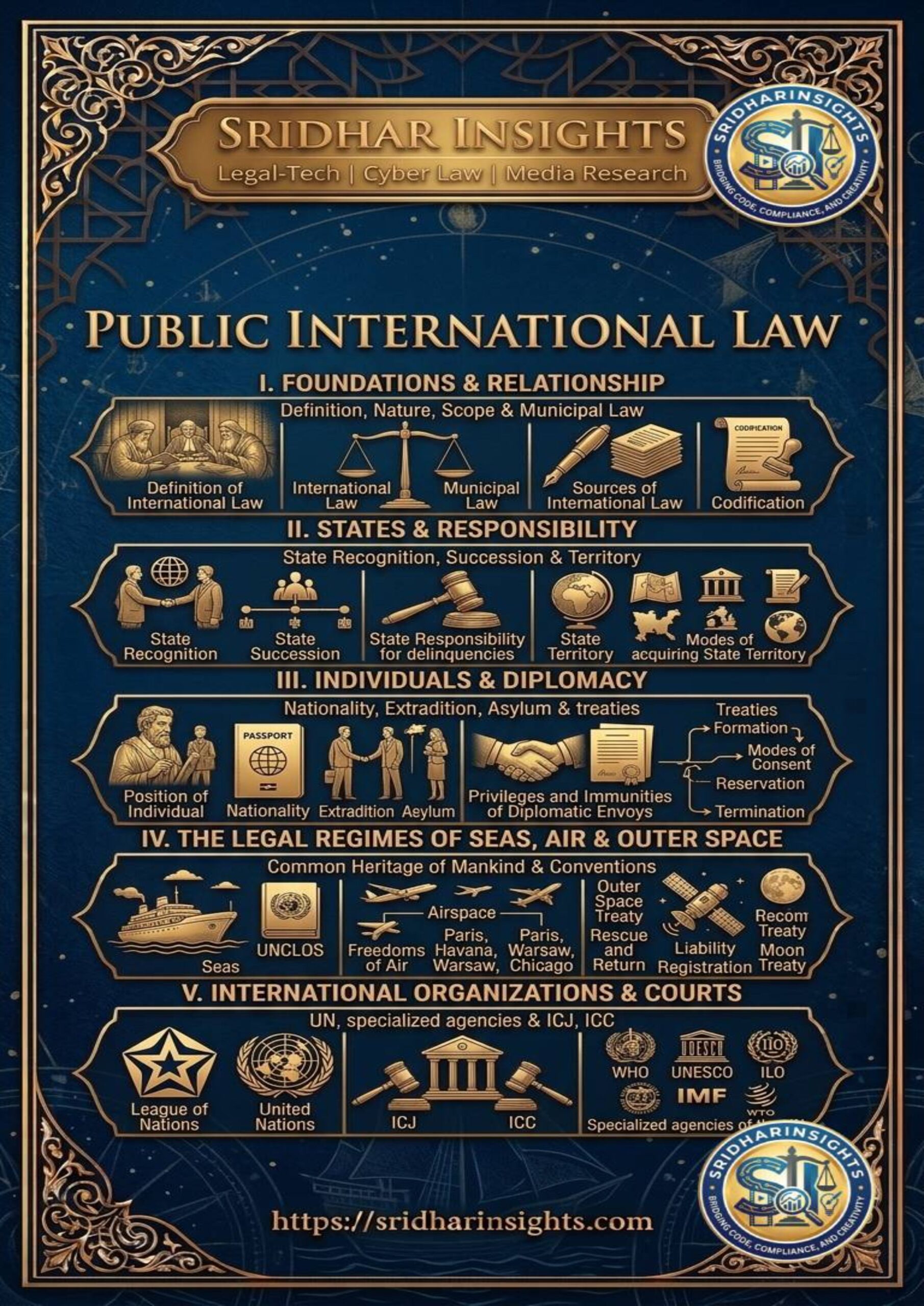
(11). [CLAT-PG 2022] The fundamental maxim of Airspace law, Cujus est solum, ejus est usque ad coelum, means:
[A]. The skies are free for all
[B]. Whoever owns the soil, it is theirs up to heaven
[C]. Aircraft cannot be taxed
[D]. Space belongs to the UN
Correct Answer: [B]. Whoever owns the soil, it is theirs up to heaven
(12). Which convention first firmly established the rule that a State has complete and exclusive sovereignty over the airspace above its territory?
[A]. Paris Convention, 1919
[B]. Warsaw Convention, 1929
[C]. Chicago Convention, 1944
[D]. Outer Space Treaty, 1967
Correct Answer: [A]. Paris Convention, 1919
(13). [AIBE 2019] The Warsaw Convention of 1929 primarily dealt with:
[A]. The rules of aerial warfare
[B]. The establishment of ICAO
[C]. The unification of rules relating to international carriage by air and limiting carrier liability
[D]. Space exploration
Correct Answer: [C]. The unification of rules relating to international carriage by air and limiting carrier liability
(14). The modern regulatory framework for international civil aviation is grounded in the:
[A]. Havana Convention
[B]. Paris Convention
[C]. Chicago Convention, 1944
[D]. Vienna Convention
Correct Answer: [C]. Chicago Convention, 1944
(15). [CLAT-PG 2021] Do foreign civil aircraft enjoy an automatic right of “innocent passage” through the airspace of another sovereign State?
[A]. Yes, identical to the Law of the Sea
[B]. No, entry into sovereign airspace requires prior authorization/treaty agreement
[C]. Only for helicopters
[D]. Only if flying below 10,000 feet
Correct Answer: [B]. No, entry into sovereign airspace requires prior authorization/treaty agreement
(16). The right of an airline to fly across the territory of a foreign State without landing is known as the:
[A]. First Freedom of the Air
[B]. Second Freedom of the Air
[C]. Third Freedom of the Air
[D]. Fifth Freedom of the Air
Correct Answer: [A]. First Freedom of the Air
(17). [AIBE 2022] The Second Freedom of the Air grants the right to:
[A]. Pick up passengers in a foreign country
[B]. Drop off passengers in a foreign country
[C]. Land for non-traffic/technical purposes (e.g., refueling, repair)
[D]. Conduct domestic flights within a foreign country (Cabotage)
Correct Answer: [C]. Land for non-traffic/technical purposes (e.g., refueling, repair)
(18). The right of an airline to carry passengers from its home State and drop them off in a foreign State is the:
[A]. First Freedom
[B]. Third Freedom
[C]. Fourth Freedom
[D]. Fifth Freedom
Correct Answer: [B]. Third Freedom
(19). [CLAT-PG 2018] “Cabotage” refers to:
[A]. Flying into outer space
[B]. The transport of goods/passengers between two points within the same foreign country by a foreign airline
[C]. Refueling mid-air
[D]. Crashing an aircraft
Correct Answer: [B]. The transport of goods/passengers between two points within the same foreign country by a foreign airline
(20). Article 7 of the Chicago Convention explicitly allows States to:
[A]. Refuse cabotage rights to foreign airlines
[B]. Shoot down civilian aircraft
[C]. Claim the moon
[D]. Ignore air traffic control
Correct Answer: [A]. Refuse cabotage rights to foreign airlines
(21). [AIBE 2023] The demarcation line generally accepted as the boundary between Earth’s atmosphere and outer space is the:
[A]. Equator
[B]. Karman Line (approx. 100 km above sea level)
[C]. Stratosphere
[D]. Ozone Layer
Correct Answer: [B]. Karman Line (approx. 100 km above sea level)
(22). The foundational treaty of international space law is the:
[A]. Moon Treaty, 1979
[B]. Outer Space Treaty, 1967
[C]. Chicago Convention, 1944
[D]. UNCLOS, 1982
Correct Answer: [B]. Outer Space Treaty, 1967
(23). [CLAT-PG 2019] Under Article II of the Outer Space Treaty, outer space, including the moon and other celestial bodies:
[A]. Belongs exclusively to the USA and Russia
[B]. Can be purchased by corporations
[C]. Is not subject to national appropriation by claim of sovereignty, by means of use or occupation, or by any other means
[D]. Belongs to the UN Security Council
Correct Answer: [C]. Is not subject to national appropriation by claim of sovereignty, by means of use or occupation, or by any other means
(24). Article IV of the Outer Space Treaty explicitly prohibits States from:
[A]. Sending humans to Mars
[B]. Placing in orbit around the Earth any objects carrying nuclear weapons or any other weapons of mass destruction
[C]. Using solar energy
[D]. Mining asteroids
Correct Answer: [B]. Placing in orbit around the Earth any objects carrying nuclear weapons or any other weapons of mass destruction
(25). [AIBE 2020] Under the Agreement on the Rescue and Return of Astronauts (1968), astronauts who land in foreign territory must be:
[A]. Held for ransom
[B]. Regarded as spies
[C]. Safely and promptly returned to the launching authority
[D]. Tried in domestic courts
Correct Answer: [C]. Safely and promptly returned to the launching authority
(26). The Liability Convention (1972) dictates that a launching State bears what type of liability for damage caused by its space object on the surface of the Earth?
[A]. Fault-based liability
[B]. Absolute liability
[C]. No liability
[D]. Joint liability with the UN
Correct Answer: [B]. Absolute liability
(27). [CLAT-PG 2022] If two satellites collide in outer space, the Liability Convention states that liability shall be determined based on:
[A]. Absolute liability
[B]. Fault
[C]. The size of the satellite
[D]. The nationality of the astronauts
Correct Answer: [B]. Fault
(28). Under Article VI of the Outer Space Treaty, who bears international responsibility for national activities in space carried out by non-governmental (private) entities like SpaceX?
[A]. The private corporation alone
[B]. The UN
[C]. The appropriate State Party to the Treaty (the launching state)
[D]. No one
Correct Answer: [C]. The appropriate State Party to the Treaty (the launching state)
(29). [AIBE 2018] The Convention on Registration of Space Objects (1975) mandates that launching States must:
[A]. Paint their flag on the rocket
[B]. Maintain a national registry and furnish details to the UN Secretary-General
[C]. Pay a launch tax
[D]. Seek ICJ approval before launch
Correct Answer: [B]. Maintain a national registry and furnish details to the UN Secretary-General
(30). The Moon Treaty (1979) differs from the Outer Space Treaty primarily because it explicitly declares the Moon and its resources to be the:
[A]. Property of the USA
[B]. Common Heritage of Mankind (CHM)
[C]. Property of the ISA
[D]. Terra Nullius
Correct Answer: [B]. Common Heritage of Mankind (CHM)
(31). [CLAT-PG 2021] Have major space-faring nations (USA, Russia, China) ratified the Moon Treaty?
[A]. Yes, all of them
[B]. No, very few states have ratified it, largely due to objections over the CHM mining regulations
[C]. Only the USA
[D]. Only China
Correct Answer: [B]. No, very few states have ratified it, largely due to objections over the CHM mining regulations
(32). “UNISPACE” stands for:
[A]. United Nations Space Agency
[B]. United Nations Conferences on the Exploration and Peaceful Uses of Outer Space
[C]. Universal Space Protocol
[D]. Union of Space Enthusiasts
Correct Answer: [B]. United Nations Conferences on the Exploration and Peaceful Uses of Outer Space
(33). [AIBE 2019] A primary focus of the UNISPACE III conference (1999) and the resulting Vienna Declaration was:
[A]. Planning a war on Mars
[B]. Mitigating space debris and using space technology for sustainable development/health
[C]. Selling lunar real estate
[D]. Banning satellite TV
Correct Answer: [B]. Mitigating space debris and using space technology for sustainable development/health
(34). Unlike outer space, which is Res Communis, Antarctica is currently governed by the Antarctic Treaty (1959) which:
[A]. Divides it among 5 nations
[B]. “Freezes” all territorial claims and dedicates the continent to peace and science
[C]. Sells it to corporations
[D]. Allows nuclear testing
Correct Answer: [B]. “Freezes” all territorial claims and dedicates the continent to peace and science
(35). [CLAT-PG 2023] The right of “Transit Passage” through international straits under UNCLOS:
[A]. Can be suspended by the coastal state at will
[B]. Cannot be suspended and applies to both civilian and military vessels/aircraft
[C]. Applies only to submarines
[D]. Requires a toll payment
Correct Answer: [B]. Cannot be suspended and applies to both civilian and military vessels/aircraft
(36). A coastal State’s Continental Shelf legally extends up to:
[A]. 12 NM always
[B]. The outer edge of the continental margin, or a minimum of 200 NM from the baseline
[C]. The High Seas
[D]. 10 NM
Correct Answer: [B]. The outer edge of the continental margin, or a minimum of 200 NM from the baseline
(37). [AIBE 2021] Deep seabed mining in “The Area” (beyond national jurisdiction) requires a contract from the:
[A]. International Maritime Organization (IMO)
[B]. International Seabed Authority (ISA)
[C]. World Bank
[D]. UN Security Council
Correct Answer: [B]. International Seabed Authority (ISA)
(38). The Fifth Freedom of the Air is crucial for airlines because it allows them to:
[A]. Fly over the ocean
[B]. Pick up and drop off traffic between two foreign countries on a flight originating from their home state
[C]. Sell duty-free goods
[D]. Ignore air traffic control
Correct Answer: [B]. Pick up and drop off traffic between two foreign countries on a flight originating from their home state
(39). [CLAT-PG 2020] Is outer space subject to the sovereignty of the State directly below it?
[A]. Yes, up to infinity
[B]. No, national sovereignty ends where outer space begins
[C]. Yes, but only for the USA
[D]. Yes, if the state has a space agency
Correct Answer: [B]. No, national sovereignty ends where outer space begins
(40). A foreign commercial aircraft entering Indian airspace without authorization:
[A]. Commits a violation of Indian sovereignty under the Chicago Convention
[B]. Is exercising innocent passage
[C]. Is exercising freedom of the high seas
[D]. Is protected by the Outer Space Treaty
Correct Answer: [A]. Commits a violation of Indian sovereignty under the Chicago Convention
(41). [AIBE 2017] The “Common Heritage of Mankind” principle fundamentally implies that:
[A]. The area can be conquered
[B]. The area cannot be appropriated, and its exploration/exploitation must benefit mankind as a whole
[C]. The area belongs to the UN Secretary-General
[D]. Only developed nations can use the area
Correct Answer: [B]. The area cannot be appropriated, and its exploration/exploitation must benefit mankind as a whole
(42). Who is liable if a defunct Soviet satellite crashes into a Canadian town?
[A]. The Canadian government
[B]. The UN
[C]. The launching State (Russia, as the successor to the USSR) under the Liability Convention
[D]. The victims
Correct Answer: [C]. The launching State (Russia, as the successor to the USSR) under the Liability Convention
(43). [CLAT-PG 2019] If an astronaut from a European space mission lands in the Indian Ocean and is rescued by the Indian Navy, India must:
[A]. Arrest the astronaut for illegal entry
[B]. Demand a ransom from Europe
[C]. Safely and promptly return the astronaut to the launching authority
[D]. Force the astronaut to work for ISRO
Correct Answer: [C]. Safely and promptly return the astronaut to the launching authority
(44). The concept of “Archipelagic States” (e.g., Indonesia, Philippines) under UNCLOS allows them to:
[A]. Claim the entire ocean
[B]. Draw straight baselines joining the outermost points of their outermost islands, enclosing “archipelagic waters”
[C]. Ban all foreign ships forever
[D]. Tax the High Seas
Correct Answer: [B]. Draw straight baselines joining the outermost points of their outermost islands, enclosing “archipelagic waters”
(45). [AIBE 2022] Which of the following is NOT an established Freedom of the High Seas?
[A]. Freedom of navigation
[B]. Freedom of piracy
[C]. Freedom of overflight
[D]. Freedom to lay submarine cables
Correct Answer: [B]. Freedom of piracy
(46). Under the Chicago Convention, State aircraft (military, customs, police):
[A]. Have the same rights as civil aircraft
[B]. Are completely exempt from the convention but cannot fly over another State without specific authorization
[C]. Must pay commercial taxes
[D]. Are banned
Correct Answer: [B]. Are completely exempt from the convention but cannot fly over another State without specific authorization
(47). [CLAT-PG 2021] The International Civil Aviation Organization (ICAO) is headquartered in:
[A]. Montreal, Canada
[B]. Paris, France
[C]. Geneva, Switzerland
[D]. New York, USA
Correct Answer: [A]. Montreal, Canada
(48). An artificial island constructed in the EEZ:
[A]. Possesses its own Territorial Sea
[B]. Does not possess the status of an island and has no territorial sea of its own (Article 60 UNCLOS)
[C]. Belongs to the UN
[D]. Becomes a sovereign state
Correct Answer: [B]. Does not possess the status of an island and has no territorial sea of its own (Article 60 UNCLOS)
(49). [AIBE 2023] The ultimate jurisprudential objective of the Outer Space Treaty is to:
[A]. Trigger a space arms race
[B]. Ensure space remains a peaceful, demilitarized zone dedicated to the exploration and benefit of all mankind
[C]. Establish a US monopoly on the moon
[D]. Privatize satellite orbits
Correct Answer: [B]. Ensure space remains a peaceful, demilitarized zone dedicated to the exploration and benefit of all mankind
(50). The synergy of Unit IV demonstrates that while a State has absolute sovereignty over its land and airspace, the realms of the High Seas and Outer Space are governed by:
[A]. The law of the jungle
[B]. Treaties prioritizing collective human interest, non-appropriation, and shared domains (Res Communis / CHM)
[C]. Absolute corporate ownership
[D]. The military might of the strongest nation
Correct Answer: [B]. Treaties prioritizing collective human interest, non-appropriation, and shared domains (Res Communis / CHM)