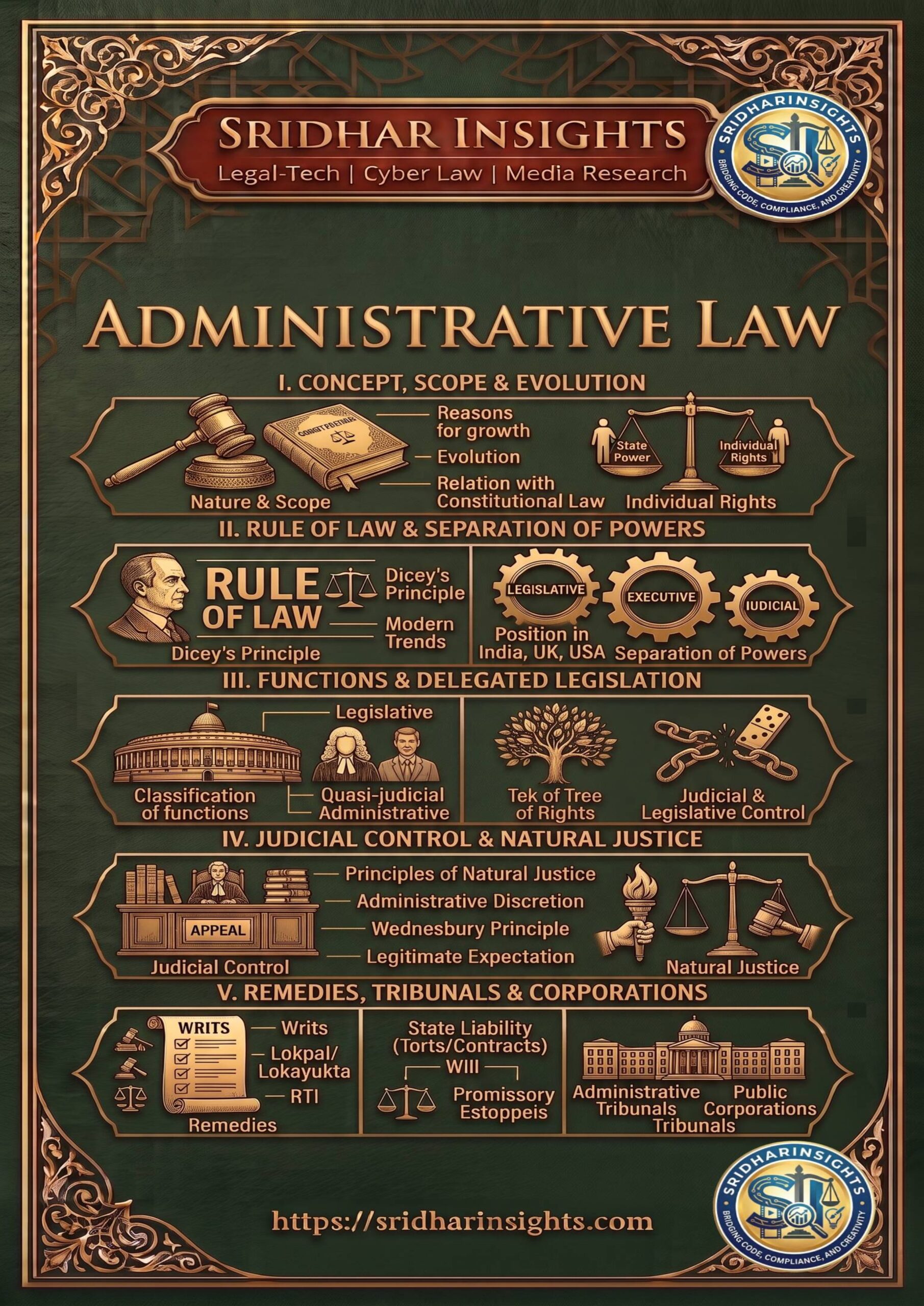
(1). [AIBE 2021] Which administrative function involves framing rules of general application that apply prospectively to an open class of people?
[A]. Quasi-Judicial function
[B]. Legislative function
[C]. Ministerial function
[D]. Administrative function
Correct Answer: [B]. Legislative function
(2). An administrative body conducts an inquiry, takes evidence, and decides a dispute between two contesting parties according to law. This function is:
[A]. Ministerial
[B]. Quasi-Judicial
[C]. Purely Legislative
[D]. Sovereign
Correct Answer: [B]. Quasi-Judicial
(3). [CLAT-PG 2019] A function where the authority has no discretion whatsoever and must perform an act mandated by law is known as:
[A]. Discretionary function
[B]. Ministerial function
[C]. Quasi-legislative function
[D]. Policy formulation
Correct Answer: [B]. Ministerial function
(4). Delegated legislation refers to:
[A]. Laws passed directly by Parliament after exhaustive debate
[B]. Rules, regulations, and bye-laws framed by executive authorities under powers given by a parent Act
[C]. Judgments delivered by the Supreme Court
[D]. International treaties signed by the President
Correct Answer: [B]. Rules, regulations, and bye-laws framed by executive authorities under powers given by a parent Act
(5). [AIBE 2023] The constitutional doctrine that prohibits Parliament from surrendering its core policy-making power to the executive is known as the prohibition against delegating:
(6). Which of the following is NOT a primary reason for the phenomenal growth of delegated legislation?
[A]. Lack of parliamentary time
[B]. Technical complexity of modern socio-economic issues
[C]. The desire of the executive to act as a dictator
[D]. Need for flexibility and emergency action
Correct Answer: [C]. The desire of the executive to act as a dictator
(7). [CLAT-PG 2020] Conditional legislation differs from delegated legislation because in conditional legislation:
[A]. The executive makes the law from scratch.
[B]. The legislature passes a complete law, but leaves it to the executive to determine the time or factual precondition for its application.
[C]. The judiciary frames the rules.
[D]. No parent act is required.
Correct Answer: [B]. The legislature passes a complete law, but leaves it to the executive to determine the time or factual precondition for its application.
(8). The Latin maxim Delegatus non potest delegare means:
[A]. The king can do no wrong
[B]. A delegate cannot further delegate rule-making power unless expressly permitted
[C]. Let the buyer beware
[D]. Justice must be seen to be done
Correct Answer: [B]. A delegate cannot further delegate rule-making power unless expressly permitted
(9). [AIBE 2018] If a subordinate rule framed by the executive violates a Fundamental Right guaranteed under Part III of the Constitution, the rule is:
[A]. Fully valid because it is executive policy
[B]. Substantive Ultra Vires the Constitution and void
[C]. Voidable only at the PM’s discretion
[D]. Protected by sovereign immunity
Correct Answer: [B]. Substantive Ultra Vires the Constitution and void
(10). When a delegated rule fails to follow a mandatory procedural step (such as prior publication or stakeholder consultation) prescribed by the parent act, it is:
[A]. Procedurally Ultra Vires
[B]. Substantively Ultra Vires
[C]. Valid conditional legislation
[D]. Immune from challenge
Correct Answer: [A]. Procedurally Ultra Vires
(11). [CLAT-PG 2022] The specialized parliamentary committee tasked with meticulously scrutinizing all executive-made rules and regulations in India is the:
[A]. Public Accounts Committee
[B]. Committee on Subordinate Legislation
[C]. Estimates Committee
[D]. Law Commission
Correct Answer: [B]. Committee on Subordinate Legislation
(12). What is the legal effect of a “Laying Clause” that specifies a negative resolution procedure?
[A]. The rule does not come into effect until Parliament votes to approve it.
[B]. The rule comes into effect immediately, but stands annulled if Parliament passes a resolution modifying or rejecting it within a specified timeframe.
[C]. The rule is sent to the President for a veto.
[D]. The rule is advisory only.
Correct Answer: [B]. The rule comes into effect immediately, but stands annulled if Parliament passes a resolution modifying or rejecting it within a specified timeframe.
(13). [AIBE 2019] In State of U.P. v. Babu Ram Upadhya, the Supreme Court held that valid statutory rules framed under delegated powers:
[A]. Have the same force and effect of law as the parent Act itself
[B]. Are inferior to executive circulars
[C]. Cannot be enforced by courts
[D]. Require re-enactment every year
Correct Answer: [A]. Have the same force and effect of law as the parent Act itself
(14). Can the executive levy a tax or a monetary fee through delegated legislation without explicit authorization in the parent Act?
[A]. Yes, executive power includes taxation
[B]. No, the power to tax or impose financial penalties must be strictly and expressly authorized by the parent Act
[C]. Yes, during financial emergencies
[D]. Only if approved by the RBI
Correct Answer: [B]. No, the power to tax or impose financial penalties must be strictly and expressly authorized by the parent Act
(15). [CLAT-PG 2021] In In Re Delhi Laws Act, the Constitution Bench examined the permissible limits of:
[A]. Judicial review
[B]. Delegated legislation and essential legislative functions
[C]. Presidential ordinances
[D]. Governor’s pardoning power
Correct Answer: [B]. Delegated legislation and essential legislative functions
(16). Which of the following is an example of Substantive Ultra Vires?
[A]. Failing to publish a rule in the official gazette
[B]. A rule that goes entirely beyond the scope, objects, and powers granted by the parent Act
[C]. Failing to present the rule before Parliament
[D]. Delaying publication by 2 days
Correct Answer: [B]. A rule that goes entirely beyond the scope, objects, and powers granted by the parent Act
(17). [AIBE 2022] Lord Hewart famously criticized the unchecked expansion of executive rule-making power in his 1929 book titled:
[A]. The Rule of Law
[B]. The New Despotism
[C]. Introduction to Administrative Law
[D]. Administrative Justice
Correct Answer: [B]. The New Despotism
(18). If a parent Act explicitly grants the power to sub-delegate rule-making authority to a subordinate official:
[A]. Sub-delegation is illegal and void.
[B]. Sub-delegation is legally valid and permissible.
[C]. It requires a fresh constitutional amendment.
[D]. Only the Supreme Court can exercise that power.
Correct Answer: [B]. Sub-delegation is legally valid and permissible.
(19). [CLAT-PG 2018] Which of the following mechanisms represents direct legislative control over delegated legislation?
[A]. Issuing a writ of mandamus
[B]. Parliamentary questions, debates, and motions concerning the subordinate rules
[C]. Filing a civil suit
[D]. Filing an FIR against the bureaucrat
Correct Answer: [B]. Parliamentary questions, debates, and motions concerning the subordinate rules
(20). The presumption of constitutionality attached to delegated legislation means:
[A]. Courts assume the rule is invalid until proven otherwise.
[B]. Courts start with the presumption that the rule is valid, placing the heavy burden of proving ultra vires on the challenger.
[C]. The executive can never be wrong.
[D]. Parliament cannot repeal the rule.
Correct Answer: [B]. Courts start with the presumption that the rule is valid, placing the heavy burden of proving ultra vires on the challenger.
(21). [AIBE 2023] Does judicial review of delegated legislation extend to examining the wisdom or expediency of the rule?
[A]. Yes, courts decide if the rule is economically smart.
[B]. No, courts only examine the legality and constitutionality (ultra vires), not its policy wisdom.
[C]. Yes, judges can rewrite executive rules.
[D]. Only if the Prime Minister requests it.
Correct Answer: [B]. No, courts only examine the legality and constitutionality (ultra vires), not its policy wisdom.
(22). Which Article of the Indian Constitution defines “law” to include ordinances, orders, bye-laws, rules, regulations, and notifications?
[A]. Article 14
[B]. Article 21
[C]. Article 13(3)(a)
[D]. Article 323A
Correct Answer: [C]. Article 13(3)(a)
(23). [CLAT-PG 2019] In State of M.P. v. Bharat Singh, a delegated executive order was struck down because it violated:
[A]. Tax laws
[B]. Fundamental Rights (Article 19)
[C]. Civil Procedure Code
[D]. Company law
Correct Answer: [B]. Fundamental Rights (Article 19)
(24). The power of an authority to amend, modify, or rescind rules it has previously issued is statutorily backed in India by:
[A]. Section 21 of the General Clauses Act, 1897
[B]. Article 356
[C]. The Indian Penal Code
[D]. The Contract Act
Correct Answer: [A]. Section 21 of the General Clauses Act, 1897
(25). [AIBE 2020] When a rule operates retrospectively to take away vested rights, courts look for:
[A]. Explicit authorization in the parent Act; retrospective delegation cannot be implied.
[B]. Verbal approval from the cabinet.
[C]. Registration with the UN.
[D]. Nothing; all rules are automatically retrospective.
Correct Answer: [A]. Explicit authorization in the parent Act; retrospective delegation cannot be implied.
(26). The classification of administrative functions is primarily undertaken to determine:
[A]. The salary of the bureaucrat
[B]. The applicable procedural safeguards, such as whether the Principles of Natural Justice apply
[C]. Which political party is in power
[D]. The color of the government gazette
Correct Answer: [B]. The applicable procedural safeguards, such as whether the Principles of Natural Justice apply
(27). [CLAT-PG 2022] Which of the following jurists categorized administrative actions into administrative, executive, and judicial based on clear analytical distinctions?
[A]. Salmond and Wade
[B]. Jain & Jain
[C]. Austin
[D]. Kelsen
Correct Answer: [A]. Salmond and Wade
(28). If a minister issues a general policy directive to a public corporation without any statutory backing, it is classified as:
[A]. Delegated legislation
[B]. Pure executive/administrative action
[C]. Judicial adjudication
[D]. Primary legislation
Correct Answer: [B]. Pure executive/administrative action
(29). [AIBE 2018] A writ of Mandamus can be successfully issued against an official refusing to perform a:
[A]. Legislative rule-making act
[B]. Purely discretionary act
[C]. Mandatory ministerial duty
[D]. Cabinet policy decision
Correct Answer: [C]. Mandatory ministerial duty
(30). The primary objective of the Committee on Subordinate Legislation is to check:
[A]. If the executive is bypassing Parliament by creating excessive, unauthorized, or unreasonable rules
[B]. The personal income of ministers
[C]. Court judgments
[D]. Foreign exchange reserves
Correct Answer: [A]. If the executive is bypassing Parliament by creating excessive, unauthorized, or unreasonable rules
(31). [CLAT-PG 2021] In Hukum Chand v. State of Haryana, the Supreme Court held that failure to comply with mandatory statutory provisions regarding the making of rules renders the rules:
[A]. Perfectly valid
[B]. Procedurally ultra vires and void
[C]. Voidable only after 5 years
[D]. Subject to presidential pardon
Correct Answer: [B]. Procedurally ultra vires and void
(32). The process where a legislature delegates power to the executive, which in turn delegates it to a lower authority, is known as:
[A]. Sub-delegation
[B]. Primary legislation
[C]. Conditional enactment
[D]. Judicial usurpation
Correct Answer: [A]. Sub-delegation
(33). [AIBE 2019] Can a rule framed under delegated legislation impose criminal imprisonment or heavy fines without express statutory authorization in the parent Act?
[A]. Yes, executives have inherent penal powers.
[B]. No, penal liability and imprisonment cannot be created by subordinate rules unless the parent Act explicitly grants such power.
[C]. Yes, if notified in two newspapers.
[D]. Only for traffic offenses.
Correct Answer: [B]. No, penal liability and imprisonment cannot be created by subordinate rules unless the parent Act explicitly grants such power.
(34). The distinction between an administrative act and a quasi-judicial act historically turned on whether the authority was under a duty to:
[A]. Earn a profit
[B]. Act judicially (observe a lis and hear parties)
[C]. Consult the Prime Minister
[D]. Wear black robes
Correct Answer: [B]. Act judicially (observe a lis and hear parties)
(35). [CLAT-PG 2023] In A.K. Kraipak, the Supreme Court abolished the artificial barrier between:
[A]. Civil and criminal law
[B]. Administrative and quasi-judicial powers regarding natural justice
[C]. Centre and State jurisdictions
[D]. Fundamental Rights and DPSP
Correct Answer: [B]. Administrative and quasi-judicial powers regarding natural justice
(36). Which type of delegated legislation involves the executive bringing an Act into operation upon the satisfaction of a specific factual condition?
[A]. Sub-delegation
[B]. Conditional legislation
[C]. Taxing legislation
[D]. Penal legislation
Correct Answer: [B]. Conditional legislation
(37). [AIBE 2021] If a parent Act provides that “The Central Government may, by notification, make rules to carry out the purposes of this Act,” this is a classic formula for:
[A]. Delegated legislation
[B]. Judicial decree
[C]. Constitutional amendment
[D]. Private contract
Correct Answer: [A]. Delegated legislation
(38). The doctrine of Ultra Vires in administrative law operates as a shield to ensure that:
[A]. Administrative authorities do not exceed the legal boundaries set by Parliament and the Constitution
[B]. Courts never interfere with government policy
[C]. Parliament can dissolve the judiciary
[D]. Citizens cannot file writ petitions
Correct Answer: [A]. Administrative authorities do not exceed the legal boundaries set by Parliament and the Constitution
(39). [CLAT-PG 2020] Under parliamentary oversight, a “Positive Resolution” laying clause requires that:
[A]. The rule is active immediately and stays active forever.
[B]. The rule does not come into force until expressly approved by a resolution of Parliament.
[C]. The rule is rejected automatically unless hidden.
[D]. The Prime Minister signs it twice.
Correct Answer: [B]. The rule does not come into force until expressly approved by a resolution of Parliament.
(40). The growth of Administrative Law and Delegated Legislation proves that modern governance requires:
[A]. Absolute rigidity
[B]. Administrative discretion guided by statutory standards and judicial oversight
[C]. Total abolition of Parliament
[D]. Rule by military decree
Correct Answer: [B]. Administrative discretion guided by statutory standards and judicial oversight
(41). [AIBE 2017] When an administrative authority exercises a purely administrative (discretionary) function, courts will primarily review it for:
[A]. Absolute perfection
[B]. Arbitriness, mala fides, unreasonableness, and abuse of discretion (Wednesbury unreasonableness)
[C]. Grammatical correctness
[D]. Profitability
Correct Answer: [B]. Arbitriness, mala fides, unreasonableness, and abuse of discretion (Wednesbury unreasonableness)
(42). The Wednesbury test of unreasonableness (often applied in judicial review of administrative action) originates from English administrative law and examines whether a decision is:
[A]. So absurd that no sensible authority could ever have dreamed it up
[B]. Approved by the King
[C]. Involving more than 10 crores
[D]. Written in English
Correct Answer: [A]. So absurd that no sensible authority could ever have dreamed it up
(43). [CLAT-PG 2019] Which of the following is an example of an unconstitutional delegation of essential legislative function?
[A]. Delegating the power to fix minor toll rates
[B]. Delegating absolute power to the executive to repeal or amend any act of Parliament at its whim (often called a “Henry VIII clause” without adequate legislative safeguards)
[C]. Delegating rule-making for municipal sanitation
[D]. Delegating the date of enforcement of an act
Correct Answer: [B]. Delegating absolute power to the executive to repeal or amend any act of Parliament at its whim (often called a “Henry VIII clause” without adequate legislative safeguards)
(44). The legal status of rules framed under valid delegated legislation is that they are treated as part of:
[A]. The parent statute itself
[B]. Private corporate bylaws
[C]. International customary law
[D]. Moral guidelines only
Correct Answer: [A]. The parent statute itself
(45). [AIBE 2022] If an authority uses its delegated power for a purpose other than what Parliament intended (improper motive), the action is void under the doctrine of:
[A]. Malice in Law / Improper Purpose
[B]. Res Judicata
[C]. Caveat Emptor
[D]. Stare Decisis
Correct Answer: [A]. Malice in Law / Improper Purpose
(46). Which of the following committees examines government assurances, promises, and undertakings given on the floor of Parliament, working alongside the Subordinate Legislation Committee?
[A]. Committee on Government Assurances
[B]. Public Undertakings Committee
[C]. Privilege Committee
[D]. Rules Committee
Correct Answer: [A]. Committee on Government Assurances
(47). [CLAT-PG 2021] The ultimate objective of both Legislative and Judicial control over Delegated Legislation is to uphold:
[A]. Bureaucratic efficiency
[B]. The Rule of Law and Constitutional democracy
[C]. Judicial supremacy over Parliament
[D]. Executive autocracy
Correct Answer: [B]. The Rule of Law and Constitutional democracy
(48). Under Section 21 of the General Clauses Act, the power to issue a notification or rule includes the power to:
[A]. Amend, vary, or rescind it, subject to the same conditions
[B]. Arrest violators immediately
[C]. Declare war
[D]. Impeach judges
Correct Answer: [A]. Amend, vary, or rescind it, subject to the same conditions
(49). [AIBE 2023] In summary, Delegated Legislation is constitutionally permissible in India provided that:
[A]. Parliament retains essential legislative policy and provides adequate guidelines, and the rules remain intra vires the parent act and the Constitution.
[B]. The executive ignores Parliament entirely.
[C]. The judiciary drafts the rules.
[D]. There is no judicial review.
Correct Answer: [A]. Parliament retains essential legislative policy and provides adequate guidelines, and the rules remain intra vires the parent act and the Constitution.
(50). The phrase Delegatus non potest delegare ensures that rule-making power remains anchored to:
[A]. The primary delegate chosen by Parliament, preventing unauthorized cascading delegation of legislative authority.
[B]. Private citizens.
[C]. The police department.
[D]. Foreign consulates.
Correct Answer: [A]. The primary delegate chosen by Parliament, preventing unauthorized cascading delegation of legislative authority.
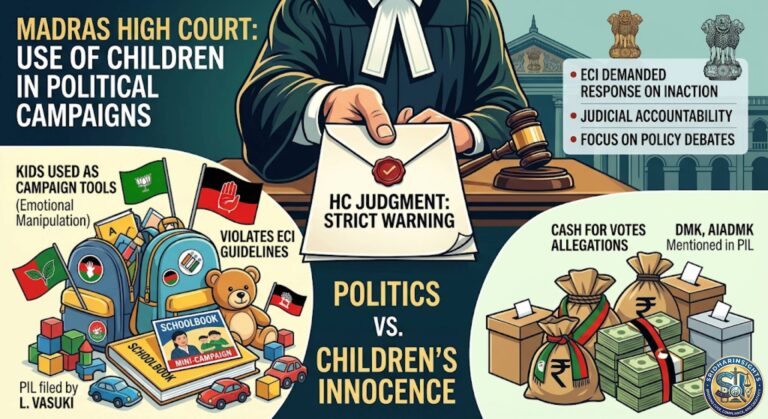
Children should play with toys, not political propaganda. Yet, recent elections witnessed a disturbing trend. Politicians allegedly used young kids to emotionally manipulate adult voters. Now, the Madras High Court has stepped in with a stern and powerful warning. Recently, the Court clearly stated that using children for election campaigns is fundamentally bad. Let us…
Imagine having a blank space on your birth certificate. It can cause deep emotional pain for a child. Recently, the Kerala High Court fixed such an issue. The court allowed adding the father’s name in birth records. This was for a child conceived through IVF. The child was born in 2012. The Parents’ Back-story Let…