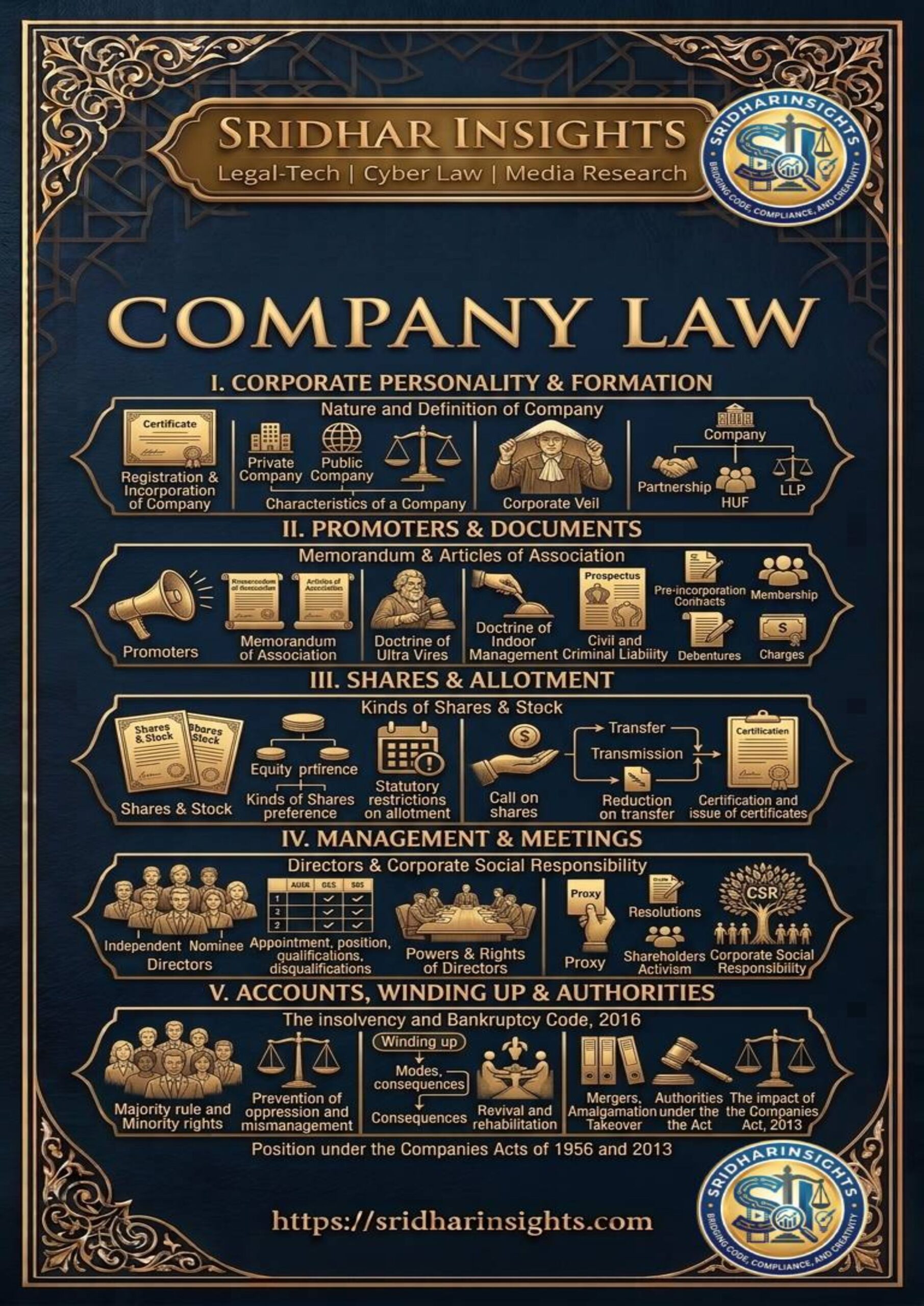
Company Law | Legal | Quiz
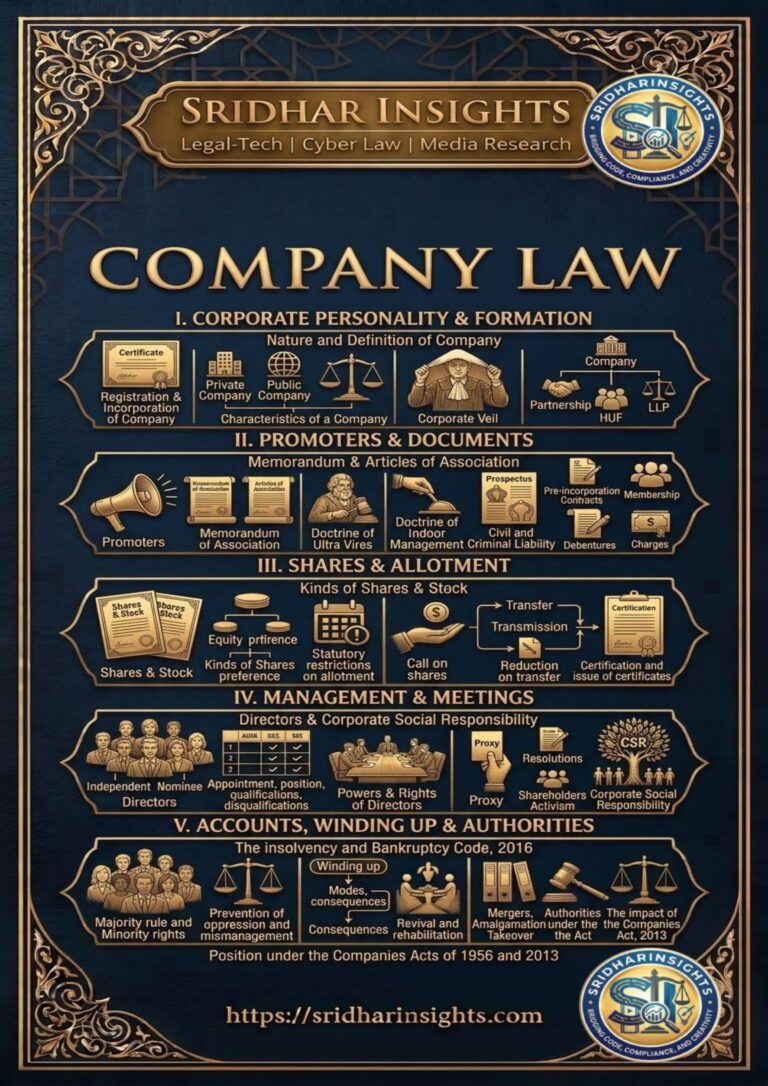
Directors, meetings, shareholder activism, and CSR | Company Law | MCQ Quiz with Answers | Test Your Legal Knowledge
Company Law MCQ Quiz – (1–50)
(1). What is the minimum number of directors required for a Public Company under Section 149 of the 2013 Act?
- [A]. 1
- [B]. 2
- [C]. 3
- [D]. 7
(2). A person cannot be appointed as a director unless they have been allotted a:
- [A]. Corporate Identification Number (CIN)
- [B]. Director Identification Number (DIN)
- [C]. Permanent Account Number (PAN)
- [D]. Aadhaar Card
(3). Under Section 149(3), every company must have at least one director who has stayed in India for a total period of not less than:
- [A]. 90 days in the previous financial year
- [B]. 182 days during the financial year
- [C]. 365 days
- [D]. 5 years
(4). The duties of Directors, including the duty to act in good faith and protect the environment, were explicitly codified for the first time in India under:
- [A]. Section 166 of the Companies Act, 2013
- [B]. Companies Act, 1956
- [C]. SEBI Act, 1992
- [D]. Specific Relief Act
(5). In Percival v. Wright, it was held that directors owe their fiduciary duties to:
- [A]. The majority shareholders
- [B]. Individual minority shareholders
- [C]. The company as a whole
- [D]. The government
(6). Which of the following disqualifies a person from being appointed as a director under Section 164?
- [A]. Being over 60 years of age
- [B]. Being an undischarged insolvent
- [C]. Not holding a university degree
- [D]. Being a foreign national
(7). If a company fails to file financial statements or annual returns for ________ continuous financial years, its directors are disqualified for 5 years.
- [A]. 2
- [B]. 3
- [C]. 5
- [D]. 7
(8). The maximum number of directors a company can have is 15. Can this limit be increased?
- [A]. No, it is absolute.
- [B]. Yes, by passing an Ordinary Resolution.
- [C]. Yes, by passing a Special Resolution.
- [D]. Only with High Court approval.
(9). The foundational principle that courts will not interfere in the internal irregularities of a company at the instance of a minority (The Rule of Majority) was established in:
- [A]. Salomon v. Salomon
- [B]. Foss v. Harbottle
- [C]. Rylands v. Fletcher
- [D]. Derry v. Peek
(10). Which type of meeting was a mandatory requirement for public companies under the 1956 Act but was completely abolished in the 2013 Act?
- [A]. Annual General Meeting
- [B]. Extraordinary General Meeting
- [C]. Statutory Meeting
- [D]. Board Meeting
(11). What is the minimum length of notice required to be given to members to call a valid general meeting?
- [A]. 7 clear days
- [B]. 14 clear days
- [C]. 21 clear days
- [D]. 30 clear days
(12). For a private company, the statutory quorum for a general meeting is personally present:
- [A]. 2 members
- [B]. 5 members
- [C]. 15 members
- [D]. All members
(13). In a public company with 2000 members, the quorum for a general meeting under Section 103 is:
- [A]. 5 members
- [B]. 15 members
- [C]. 30 members
- [D]. 50 members
(14). If a quorum is not present within 30 minutes of the scheduled time, the meeting generally:
- [A]. Is cancelled permanently
- [B]. Proceeds legally anyway
- [C]. Stands adjourned to the same day in the next week
- [D]. Directors are fired
(15). A Proxy appointed to attend a meeting:
- [A]. Can speak in debates
- [B]. Can vote on a show of hands
- [C]. Can vote only on a poll and cannot speak
- [D]. Is counted for quorum
(16). To pass an Ordinary Resolution, the votes cast in favor must:
- [A]. Exactly equal the votes against
- [B]. Exceed the votes cast against it (> 50%)
- [C]. Be at least 75%
- [D]. Be 100% unanimous
(17). A Special Resolution requires the votes cast in favor to be at least:
- [A]. Two times the votes against (66%)
- [B]. Three times the votes against (75%)
- [C]. Four times the votes against (80%)
- [D]. 100% (Unanimous)
(18). The written, signed record of the proceedings of a company meeting, which serves as prima facie evidence of what occurred, is called:
- [A]. The Agenda
- [B]. The Minutes
- [C]. The Prospectus
- [D]. The Articles
(19). Minutes of proceedings of a general meeting must be prepared and signed within:
- [A]. 7 days
- [B]. 15 days
- [C]. 30 days
- [D]. 60 days
(20). If a company defaults in holding an Annual General Meeting, which authority has the power to order the calling of the AGM under Section 97?
- [A]. The Prime Minister
- [B]. The Registrar of Companies (ROC)
- [C]. The National Company Law Tribunal (NCLT)
- [D]. The High Court
(21). An Extraordinary General Meeting (EGM) can be called by the Board of Directors upon the requisition of members holding at least:
- [A]. 5% of the paid-up capital
- [B]. 10% of the paid-up capital
- [C]. 25% of the paid-up capital
- [D]. 50% of the paid-up capital
(22). Which legal doctrine prevents directors from delegating their core powers without statutory backing?
- [A]. Caveat Emptor
- [B]. Delegatus non potest delegare
- [C]. Stare Decisis
- [D]. Res Judicata
(23). Under Section 135 of the Companies Act 2013, the CSR mandate applies to companies with a Net Worth of at least:
- [A]. ₹100 Crore
- [B]. ₹500 Crore
- [C]. ₹1000 Crore
- [D]. ₹5 Crore
(24). The mandatory CSR spending requirement is calculated as:
- [A]. 2% of the average net profits of the preceding 3 financial years
- [B]. 5% of the gross revenue
- [C]. 10% of the net worth
- [D]. 1% of total assets
(25). The concept of “Class Action Suits” empowering shareholders and depositors to seek remedies against oppressive management was introduced in the 2013 Act under Section:
- [A]. 166
- [B]. 135
- [C]. 245
- [D]. 447
(26). E-voting provisions in the 2013 Act have primarily contributed to:
- [A]. Less shareholder participation
- [B]. Widespread Shareholder Activism by allowing remote proxy-free voting
- [C]. Abolition of the Board of Directors
- [D]. Slower AGMs
(27). A meeting of only the Preference Shareholders to modify their specific dividend rights is classified as a:
- [A]. Board Meeting
- [B]. Class Meeting
- [C]. Statutory Meeting
- [D]. Annual General Meeting
(28). If an AGM is held on a National Holiday, the meeting is:
- [A]. Valid
- [B]. Invalid, as AGMs cannot be held on National Holidays
- [C]. Valid only if the President attends
- [D]. Adjourned automatically for a month
(29). The “Casting Vote” in a company meeting belongs to:
- [A]. The Managing Director
- [B]. The Chairman of the meeting (if authorized by the Articles) to break a tie
- [C]. The Auditor
- [D]. The Proxy
(30). An Independent Director’s term of office:
- [A]. Is for life
- [B]. Is up to 5 consecutive years (can be re-appointed for one more term via special resolution)
- [C]. Is 1 year
- [D]. Ends when the promoter dies
(31). The appointment of a Woman Director is:
- [A]. Illegal under Indian law
- [B]. Optional for all companies
- [C]. Mandatory for all listed companies and certain large public companies under the 2013 Act
- [D]. Mandatory for One Person Companies
(32). When a director vacates their office ipso facto due to a statutory disqualification, it means they vacate:
- [A]. By the fact itself (automatically by operation of law)
- [B]. Only after a court order
- [C]. Only if shareholders vote
- [D]. Only if they resign
(33). Which of the following is considered “Ordinary Business” at an AGM?
- [A]. Altering the Articles of Association
- [B]. Declaring a dividend
- [C]. Changing the name of the company
- [D]. Issuing bonus shares
(34). Any business transacted at an AGM other than the four standard ordinary businesses is considered:
- [A]. Illegal Business
- [B]. Special Business (requiring an explanatory statement)
- [C]. Void Business
- [D]. Secret Business
(35). In LIC v. Escorts Ltd., the Supreme Court established that when members issue a valid requisition for an EGM, the directors:
- [A]. Can reject it if the members have hostile motives
- [B]. Must call the meeting; they cannot question the commercial motives of the requisitionists
- [C]. Can delay it indefinitely
- [D]. Must resign immediately
(36). A “Nominee Director” is usually appointed by:
- [A]. The minority shareholders
- [B]. External lending institutions, banks, or the government to protect their interests
- [C]. The Registrar of Companies
- [D]. The Auditors
(37). The “Business Judgment Rule” protects directors from liability when they:
- [A]. Steal company funds
- [B]. Make a rational, informed business decision in good faith, even if it leads to losses
- [C]. Fail to hold an AGM
- [D]. Do not pay taxes
(38). Under the 2013 Act, can unspent CSR funds simply be explained away in the Board’s report as under the 1956 Act?
- [A]. Yes, “comply or explain” is still the absolute rule.
- [B]. No, modern amendments mandate transferring unspent amounts to specified state funds, backed by penal provisions.
- [C]. Yes, if the auditor approves.
- [D]. Yes, it can be paid out as dividends.
(39). The Chairman of a general meeting is generally elected by:
- [A]. The ROC
- [B]. The members personally present, by show of hands (unless Articles provide otherwise)
- [C]. The Prime Minister
- [D]. The NCLT
(40). Secretarial Standards (SS-1 for Board Meetings, SS-2 for General Meetings) are issued by which body?
- [A]. The Bar Council of India
- [B]. The Institute of Company Secretaries of India (ICSI)
- [C]. The Reserve Bank of India
- [D]. The Supreme Court
(41). A resolution passed at an adjourned meeting is deemed to have been passed on the date:
- [A]. Of the original meeting
- [B]. It was actually passed at the adjourned meeting
- [C]. Of the notice
- [D]. Of incorporation
(42). Who cannot be appointed as a proxy?
- [A]. A non-member (generally allowed, but some restrictions exist in Sec 8 companies)
- [B]. A minor
- [C]. An illiterate person
- [D]. A body corporate
(43). If the Articles of Association restrict the maximum number of directors to 10, but the company wishes to appoint 12 directors (within the statutory 15 limit), it must first:
- [A]. Amend the Articles by a Special Resolution
- [B]. Pass an Ordinary Resolution
- [C]. Get ROC approval
- [D]. Bribe the auditor
(44). Directors act as “Agents” of the company because:
- [A]. The company is an artificial person that needs human agents to act on its behalf
- [B]. They work for free
- [C]. They are government employees
- [D]. They are immortal
(45). The primary focus of Shareholder Activism is to:
- [A]. Destroy the company
- [B]. Hold management accountable, demand ESG compliance, and protect minority value
- [C]. Evade taxes
- [D]. Bribe the ROC
(46). A “Casual Vacancy” in the office of a director (e.g., due to sudden death) can be filled by:
- [A]. The ROC
- [B]. The Board of Directors at a board meeting
- [C]. The local police
- [D]. The remaining shareholders exclusively
(47). If a company borrows money exceeding the aggregate of its paid-up capital and free reserves without a Special Resolution, the borrowing is:
- [A]. Perfectly valid
- [B]. Ultra vires the directors (Sec 180)
- [C]. Voidable by the ROC
- [D]. A criminal offense by the bank
(48). Under the 1956 Act, CSR was primarily:
- [A]. Punishable by death
- [B]. Voluntary and philanthropic
- [C]. A strict 5% mandate
- [D]. Controlled by foreign investors
(49). The overarching purpose of Unit IV’s rules on meetings, resolutions, and proxy mechanics is to ensure:
- [A]. Corporate dictatorship
- [B]. Fair, transparent corporate democracy where majorities rule lawfully and minorities are heard
- [C]. Secret financial dealings
- [D]. Endless litigation
(50). The synergy of Directors’ fiduciary duties (Sec 166) and Mandatory CSR (Sec 135) demonstrates that the 2013 Act shifted Indian corporate law from a pure shareholder-wealth model to a:
- [A]. Feudal model
- [B]. Stakeholder-welfare model integrating society and environment
- [C]. Communist model
- [D]. Laissez-faire model