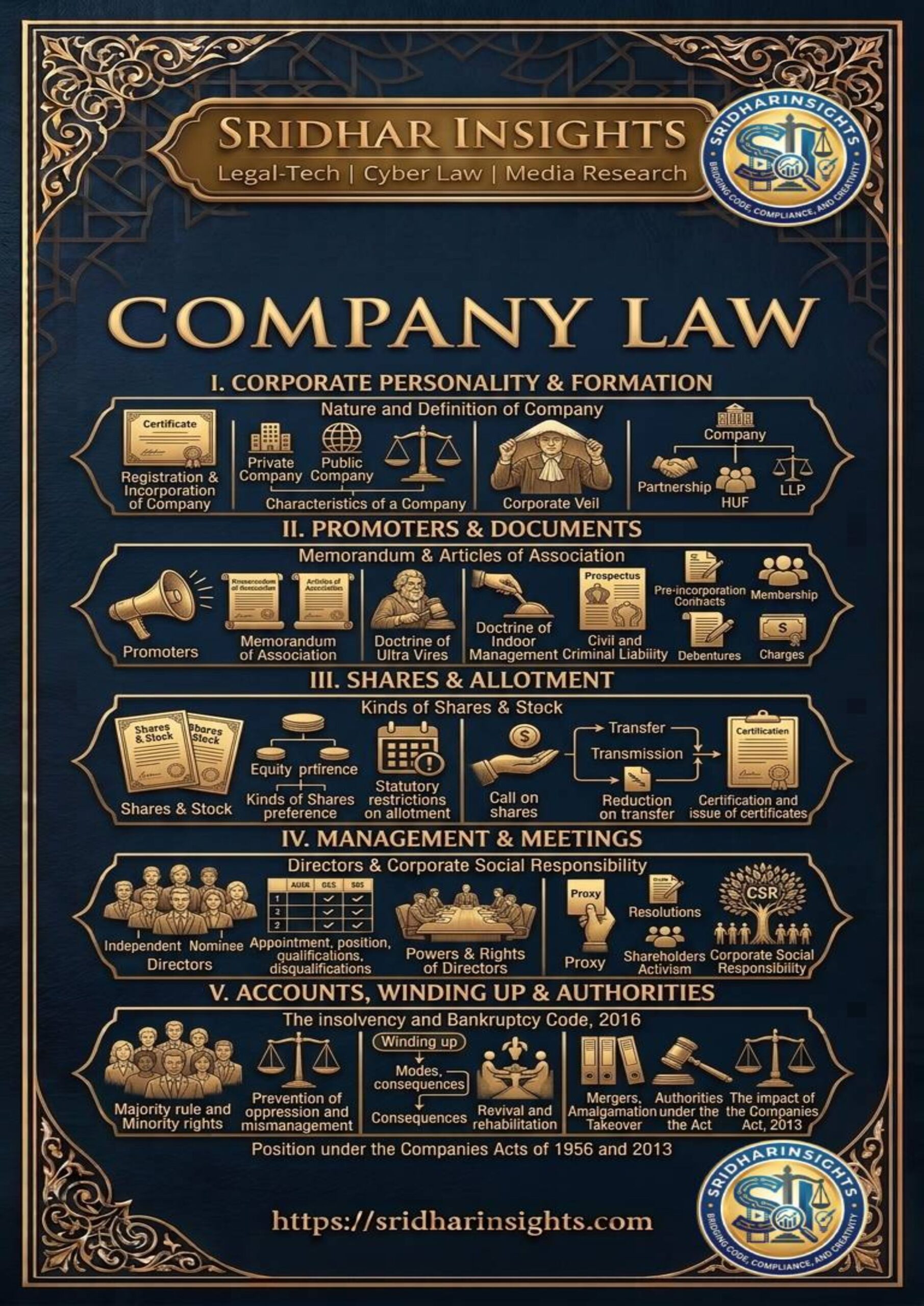
Company Law | Legal | Quiz
Shares, Share Capital, And Transfer Mechanisms | Company Law | MCQ Quiz with Answers | Test Your Legal Knowledge
Company Law MCQ Quiz – Unit III (1–50)
(1). [AIBE 2021] Which eminent jurist/judge defined a share as “the interest of a shareholder in the company measured by a sum of money”?
- [A]. Lord Macnaghten
- [B]. Justice Farwell
- [C]. Lord Denning
- [D]. Justice Bhagwati
(2). What is the primary legal difference between Shares and Stock?
- [A]. Shares cannot be transferred, stock can.
- [B]. Stock is the consolidation of fully paid-up shares and can be transferred in fractions, whereas shares have discrete definitive numbers.
- [C]. Stock applies only to private companies.
- [D]. There is no legal difference.
(3). [CLAT-PG 2019] Under Section 43 of the Companies Act, 2013, preference share capital enjoys preferential rights regarding:
- [A]. Voting rights and board appointments
- [B]. Payment of dividend and repayment of capital upon winding up
- [C]. Absolute control over management
- [D]. Attending statutory meetings
(4). Can a company directly issue “Stock” to the public during an IPO?
- [A]. Yes, absolutely.
- [B]. No, a company must issue shares first; only fully paid-up shares can be converted into stock.
- [C]. Only if the RBI approves.
- [D]. Yes, for foreign investors.
(5). [AIBE 2023] The statutory restriction preventing a company from allotting shares unless a certain threshold of applications is received is known as:
- [A]. Maximum allotment
- [B]. Minimum subscription (Section 39)
- [C]. Capital gearing
- [D]. Equity capping
(6). As per SEBI guidelines and the Companies Act, the minimum application money payable on shares must not be less than:
- [A]. 1% of the nominal amount
- [B]. 5% of the nominal amount
- [C]. 10% of the nominal amount
- [D]. 25% of the nominal amount
(7). [CLAT-PG 2020] If a company fails to receive the minimum subscription within 30 days, the application money must be refunded within:
- [A]. 5 days
- [B]. 15 days
- [C]. 30 days
- [D]. 60 days
(8). Which intermediary provides a guarantee to the company to purchase shares that the public fails to subscribe to, ensuring the minimum subscription is met?
- [A]. Statutory Auditor
- [B]. Underwriter
- [C]. Liquidator
- [D]. Registrar of Companies
(9). [AIBE 2018] A demand made by the Board of Directors upon shareholders to pay the whole or part of the unpaid amount on their shares is called a:
- [A]. Dividend
- [B]. Call
- [C]. Forfeiture
- [D]. Lien
(10). If a shareholder fails to pay the validly demanded call money, the company’s ultimate penal remedy is:
- [A]. Surrender of shares
- [B]. Forfeiture of shares
- [C]. Criminal imprisonment of the shareholder
- [D]. Liquidation of the company
(11). [CLAT-PG 2022] What is the statutory notice period typically required under the Articles (Table F) before shares can be forfeited for non-payment of calls?
- [A]. 7 days
- [B]. 14 days
- [C]. 21 days
- [D]. 30 days
(12). What is the legal effect of a valid forfeiture of shares on the shareholder’s membership?
- [A]. Membership is suspended temporarily.
- [B]. The shareholder ceases to be a member, but may remain liable as a past member for unpaid calls if wound up within a year.
- [C]. The shareholder receives a full refund.
- [D]. The shareholder becomes a secured creditor.
(13). [AIBE 2019] Forfeited shares become the property of the company and can be:
- [A]. Destroyed permanently
- [B]. Re-issued at a discount, provided the discount does not exceed the forfeited amount
- [C]. Gifted to the directors
- [D]. Converted into debentures
(14). The voluntary transfer of shares between a buyer and a seller is carried out using which statutory form?
- [A]. Form DIR-12
- [B]. Form SH-4
- [C]. Form INC-20A
- [D]. Form AOC-4
(15). [CLAT-PG 2021] Which of the following is true regarding the “Transmission” of shares?
- [A]. It requires an executed transfer deed.
- [B]. It is subject to heavy stamp duty.
- [C]. It occurs by operation of law (death/insolvency) without the need for a transfer deed or stamp duty.
- [D]. It applies only to private companies.
(16). Under Section 58 of the 2013 Act, if a private company refuses to register a transfer of shares, it must send a notice of refusal within:
- [A]. 15 days
- [B]. 30 days
- [C]. 45 days
- [D]. 60 days
(17). [AIBE 2022] Can the Board of Directors of a Public Company arbitrarily refuse to register a share transfer?
- [A]. Yes, they have absolute discretion.
- [B]. No, shares of a public company are freely transferable; refusal must be strictly for “sufficient cause.”
- [C]. Yes, if the transferee is poor.
- [D]. Only if the company is in losses.
(18). In V.B. Rangaraj v. V.B. Gopalakrishnan, the Supreme Court ruled that restrictions on the transfer of shares are legally binding only if:
- [A]. They are agreed upon verbally by all promoters.
- [B]. They are explicitly incorporated into the Articles of Association.
- [C]. They are written in a secret shareholders’ agreement.
- [D]. They are approved by the police.
(19). [CLAT-PG 2018] If a shareholder’s name is wrongly removed from the Register of Members, the statutory remedy is to file an appeal for “Rectification of Register” before the:
- [A]. Supreme Court
- [B]. National Company Law Tribunal (NCLT) under Section 59
- [C]. SEBI Appellate Tribunal
- [D]. Local Magistrate
(20). Under Section 56(4), a company must issue share certificates to the subscribers of the memorandum within:
- [A]. 1 month of incorporation
- [B]. 2 months of incorporation
- [C]. 6 months of incorporation
- [D]. 1 year of incorporation
(21). [AIBE 2023] The statutory time limit for a company to issue a share certificate after receiving a valid instrument of transfer is:
- [A]. 15 days
- [B]. 1 month
- [C]. 2 months
- [D]. 3 months
(22). A Share Certificate issued under the common seal of the company (or signed by authorized directors) acts as:
- [A]. Conclusive evidence of ownership
- [B]. Prima facie evidence of title to the shares (Section 46)
- [C]. A negotiable instrument
- [D]. A promissory note
(23). [CLAT-PG 2019] The equitable doctrine that prevents a company from denying the truth of statements made in a share certificate against a bona fide purchaser is:
- [A]. Estoppel
- [B]. Res Judicata
- [C]. Constructive Notice
- [D]. Lis Pendens
(24). If a company erroneously issues a share certificate stating the shares are “fully paid up”, and a bona fide purchaser buys them relying on this statement, what happens if the company later demands unpaid call money?
- [A]. The purchaser must pay.
- [B]. The company is estopped from demanding the money from the bona fide purchaser.
- [C]. The shares are automatically forfeited.
- [D]. The original seller is sent to jail.
(25). [AIBE 2020] In Re Bahia & San Francisco Railway Co., the company issued a new share certificate based on a forged transfer deed. When the true owner proved the forgery, the company was compelled to:
- [A]. Restore the true owner to the register AND compensate the bona fide purchaser who relied on the faulty certificate.
- [B]. Ignore the true owner.
- [C]. Arrest the purchaser.
- [D]. Dissolve the company.
(26). The “Certification of Transfer” occurs when:
- [A]. The ROC approves a merger.
- [B]. A shareholder sells only a part of their holding, lodges the original certificate with the company, and the company endorses the transfer deed.
- [C]. An auditor signs the balance sheet.
- [D]. Shares are converted to stock.
(27). [CLAT-PG 2022] A major difference between the 1956 Act and the 2013 Act is that the 2013 Act completely abolished:
- [A]. Equity shares
- [B]. Share Warrants (bearer instruments)
- [C]. Preference shares
- [D]. Stock conversions
(28). Why were Share Warrants abolished under the new corporate regime?
- [A]. They were too expensive to print.
- [B]. Being bearer instruments transferable by mere delivery, they facilitated anonymous ownership, tax evasion, and money laundering.
- [C]. They caused stock market crashes.
- [D]. The British government requested it.
(29). [AIBE 2018] What is the penalty under the 2013 Act for a person who fraudulently issues or transfers forged share certificates?
- [A]. A warning letter
- [B]. Action under Section 447 (Corporate Fraud), involving severe imprisonment and heavy fines
- [C]. A fine of ₹100
- [D]. Mandatory resignation
(30). In the context of Share Capital, what is a “Call”?
- [A]. A dividend announcement
- [B]. A demand for the payment of the unpaid portion of the share’s nominal value
- [C]. A shareholder meeting
- [D]. A court summons
(31). [CLAT-PG 2021] To constitute a valid Call on shares, the power must be exercised by the Board of Directors:
- [A]. Capriciously
- [B]. Bona fide and entirely for the benefit of the company (Fiduciary duty)
- [C]. To favor majority shareholders
- [D]. To bankrupt minority shareholders
(32). Can a company accept payment for shares in advance of calls?
- [A]. No, it is illegal.
- [B]. Yes, if authorized by the Articles, and it may pay interest on such “Calls in Advance” (Section 50).
- [C]. Only from foreign investors.
- [D]. Only in cash.
(33). [AIBE 2019] If an allotment is made without receiving the minimum subscription, the allotment is:
- [A]. Valid but irregular
- [B]. Voidable at the option of the applicant
- [C]. Absolutely void ab initio
- [D]. Ratifiable by the ROC
(34). Shares held in an electronic depository system (NSDL/CDSL) are known as:
- [A]. Bearer shares
- [B]. Dematerialized (Demat) shares
- [C]. Scrip shares
- [D]. Warrants
(35). [CLAT-PG 2023] When shares are held in Demat form, who is considered the “Registered Owner” in the books of the company?
- [A]. The individual investor
- [B]. The Depository
- [C]. The SEBI Chairman
- [D]. The Stock Broker
(36). The individual investor holding Demat shares is legally referred to under Section 2(55) as the:
- [A]. Fiduciary owner
- [B]. Beneficial Owner (and is treated as a full member)
- [C]. Ostensible owner
- [D]. Pledgee
(37). [AIBE 2021] Which of the following conditions is required for the conversion of shares into stock?
- [A]. The shares must be newly issued.
- [B]. The shares must be partly paid.
- [C]. The shares must be fully paid-up.
- [D]. The company must be in liquidation.
(38). The document transferring ownership of physical shares (Form SH-4) must be executed by:
- [A]. Only the transferor
- [B]. Only the transferee
- [C]. Both the transferor and transferee
- [D]. The Company Secretary
(39). [CLAT-PG 2020] Under Section 56, the instrument of transfer must be delivered to the company within what period from its execution?
- [A]. 15 days
- [B]. 30 days
- [C]. 60 days
- [D]. 120 days
(40). The statutory mandate forcing unlisted public companies to issue securities only in dematerialized form marks a shift towards:
- [A]. Increasing paper-based forgery
- [B]. Enhancing transparency, preventing physical certificate fraud, and improving regulatory tracking
- [C]. Abolishing the stock market
- [D]. Bypassing SEBI
(41). [AIBE 2017] A company issues a share certificate to X. X sells the shares to Y, giving Y the certificate and a blank transfer deed. Before Y registers the transfer, X fraudulently sells the same shares to Z and gets a duplicate certificate issued. Who has superior equity?
- [A]. X
- [B]. The company
- [C]. Y, as the bona fide purchaser holding the original certificate and transfer deed
- [D]. Z
(42). Forfeiture of shares is essentially in the nature of a:
- [A]. Reward mechanism
- [B]. Penal proceeding resulting in confiscation of property
- [C]. Dividend distribution
- [D]. Tax collection
(43). [CLAT-PG 2019] If the Articles of Association do not explicitly grant the Board of Directors the power to forfeit shares, can they still forfeit shares for non-payment of calls?
- [A]. Yes, it is an inherent corporate power.
- [B]. No, the power to forfeit must be expressly authorized by the Articles.
- [C]. Yes, with ROC permission.
- [D]. Only if the debt exceeds ₹1 lakh.
(44). A forged transfer deed lodged with a company is legally:
- [A]. Voidable
- [B]. A complete nullity (Void ab initio) and confers no title whatsoever
- [C]. Valid if stamped
- [D]. Ratifiable by the directors
(45). [AIBE 2022] If a company registers a forged transfer and removes the true owner’s name, the true owner can:
- [A]. Do nothing
- [B]. File a petition to compel the company to restore their name to the Register of Members
- [C]. Only sue the forger, not the company
- [D]. Ask for a refund
(46). Differential Voting Rights (DVRs) can be issued by a company in respect of which class of shares?
- [A]. Preference shares only
- [B]. Equity shares (subject to strict statutory conditions and limits)
- [C]. Debentures
- [D]. Stock
(47). [CLAT-PG 2021] The term “Transmission” of shares specifically excludes:
- [A]. Death of a sole shareholder
- [B]. Insolvency of a shareholder
- [C]. Voluntary sale of shares for money
- [D]. Lunacy of a shareholder
(48). Upon the death of a shareholder, the shares vest in their legal representative. Does the legal representative have to register themselves as a member to sell the shares?
- [A]. Yes, it is mandatory.
- [B]. No, Section 56(5) allows the legal representative to execute a valid transfer of the shares even without being registered as a member themselves.
- [C]. Only if they pay a fine.
- [D]. No, shares return to the company.
(49). [AIBE 2023] In summary, Unit III’s focus on shares, allotment, and transfer regulations ensures that:
- [A]. The company’s capital base is secure and investor titles are protected against fraud through stringent documentation and transparency.
- [B]. Promoters can manipulate share prices.
- [C]. Shares cannot be bought or sold.
- [D]. Foreigners control all Indian companies.
(50). The transition from the 1956 Act to the 2013 Act regarding share capital mechanisms primarily targeted:
- [A]. Reducing the rights of minority shareholders.
- [B]. The elimination of bearer instruments (warrants), shortening transfer timelines, and aggressively migrating to electronic (Demat) formats to eliminate paper fraud.
- [C]. Abolishing the NCLT.
- [D]. Allowing companies to issue shares for free.