Labour Law | Legal | Quiz
Labour Law | Trade Union Act | MCQ Quiz with Answers | Test Your Legal Knowledge
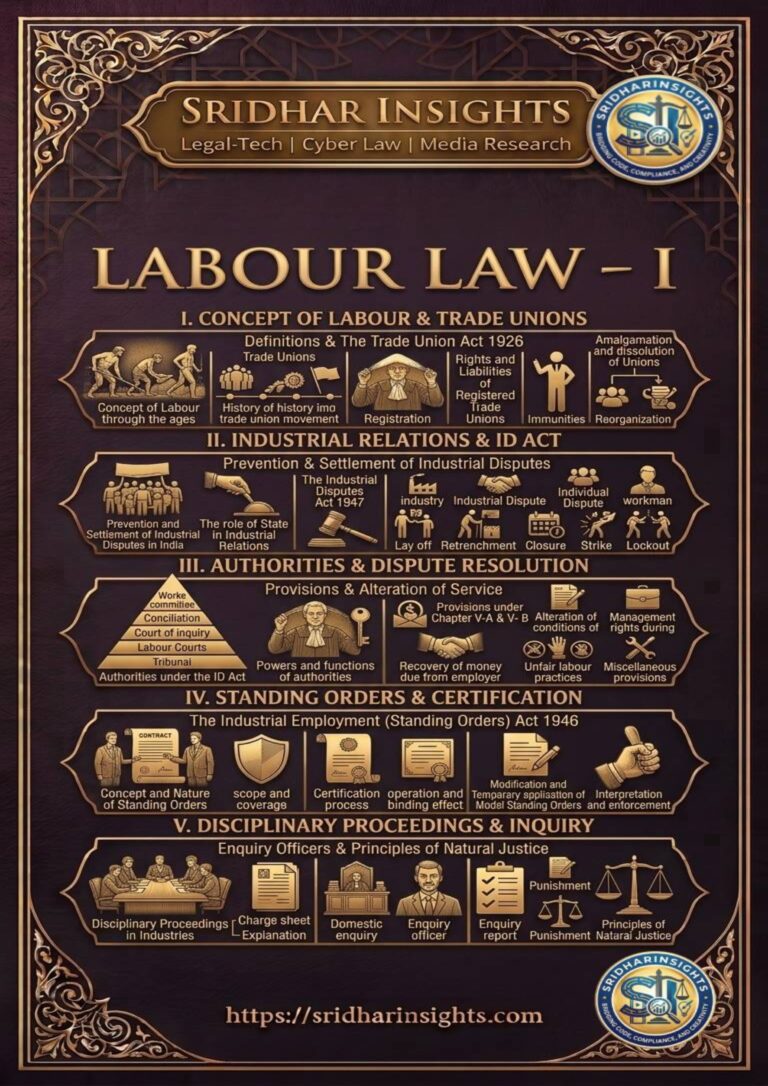
Labour Law MCQ Quiz – Trade Union Act, 1926 (1–50)
(1). [AIBE 2021] The foundational ILO maxim established in the Declaration of Philadelphia is:
- [A]. Labour is property
- [B]. Labour is not a commodity
- [C]. Labour is a fundamental duty
- [D]. Labour is governed by contract only
(2). During the Industrial Revolution, the state’s policy of non-interference in the relationship between employers and workers was known as:
- [A]. Welfare State
- [B]. Laissez-Faire
- [C]. Socialism
- [D]. Dictatorship
(3). [CLAT-PG 2019] The Tolpuddle Martyrs (1834) incident, which played a crucial role in the history of trade unionism, occurred in:
- [A]. India
- [B]. USA
- [C]. United Kingdom
- [D]. France
(4). Who among the following founded the Madras Labour Union in 1918, widely considered the first organized trade union in India?
- [A]. Mahatma Gandhi
- [B]. N.M. Joshi
- [C]. B.P. Wadia
- [D]. Lala Lajpat Rai
(5). [AIBE 2023] The outrage over the civil injunction granted against union leaders in which famous case accelerated the passing of the Trade Union Act in India?
- [A]. Rohtas Industries Case
- [B]. Buckingham & Carnatic Mills Case (1920)
- [C]. Jay Engineering Works Case
- [D]. Bangalore Water Supply Case
(6). The Trade Union Act was passed in India in the year:
- [A]. 1920
- [B]. 1926
- [C]. 1947
- [D]. 1950
(7). [CLAT-PG 2020] Under Section 2(h) of the Trade Union Act, 1926, the definition of “Trade Union” includes an association of:
- [A]. Workmen and Workmen
- [B]. Workmen and Employers
- [C]. Employers and Employers
- [D]. All of the above
(8). To apply for registration, what is the absolute minimum number of members required to sign the application?
- [A]. 2
- [B]. 5
- [C]. 7
- [D]. 10
(9). [AIBE 2018] Following the 2001 Amendment, a trade union shall not be registered unless at least ____________ of the workmen engaged in the establishment are its members.
- [A]. 5% or 50, whichever is less
- [B]. 10% or 100, whichever is less
- [C]. 20% or 200, whichever is less
- [D]. 51%
(10). The document issued by the Registrar which is conclusive evidence that a Trade Union has been duly registered is the:
- [A]. Memorandum of Association
- [B]. Charter of Demands
- [C]. Certificate of Registration (Section 9)
- [D]. License to Strike
(11). [CLAT-PG 2022] Which of the following is NOT an effect of registration under Section 13 of the Act?
- [A]. The union becomes a body corporate.
- [B]. The union gets perpetual succession and a common seal.
- [C]. The union leaders are immune from all criminal acts including murder.
- [D]. The union can hold and acquire property in its own name.
(12). Under Section 10, the Registrar can cancel the registration of a Trade Union if the certificate was obtained by:
- [A]. Fraud or mistake
- [B]. Paying a fee
- [C]. Peaceful strikes
- [D]. Approaching the High Court
(13). [AIBE 2019] Section 15 of the Trade Union Act deals with:
- [A]. Political Fund
- [B]. General Fund
- [C]. Strike Fund
- [D]. Dissolution
(14). Can the General Fund of a registered Trade Union be used to fund the election campaign of a political candidate?
- [A]. Yes, absolutely
- [B]. No, it is strictly prohibited. Political activities require a separate Political Fund (Section 16).
- [C]. Yes, if 51% of members agree
- [D]. Only during general elections
(15). [CLAT-PG 2021] Contribution to the Political Fund of a registered Trade Union is:
- [A]. Mandatory for all members
- [B]. Voluntary; no member can be compelled to contribute
- [C]. Deducted directly by the employer
- [D]. Mandated by the Registrar
(16). Section 17 of the Act protects office-bearers of a registered trade union from criminal liability regarding:
- [A]. Sedition
- [B]. Defamation
- [C]. Criminal conspiracy (Sec 120B IPC) to further the legal objects of the union
- [D]. Destruction of property
(17). [AIBE 2022] Does Section 17 provide immunity to union members if they conspire to commit violence or sabotage during a strike?
- [A]. Yes, all acts during a strike are protected.
- [B]. No, immunity does not extend to agreements to commit actual offenses/violence.
- [C]. Yes, if the strike is legal.
- [D]. Yes, if the employer was paying below minimum wage.
(18). Section 18 provides immunity to registered trade unions against:
- [A]. Criminal prosecution
- [B]. Civil suits for tortious acts like inducing a breach of contract in furtherance of a trade dispute
- [C]. Tax liabilities
- [D]. Environmental violations
(19). [CLAT-PG 2018] In the landmark case of Rohtas Industries Ltd. v. Rohtas Industries Staff Union, the Supreme Court held that:
- [A]. Employers can claim civil damages for financial loss caused by an illegal strike.
- [B]. Employers CANNOT claim civil damages from the union for financial loss caused by a strike due to statutory immunities.
- [C]. Strikes are completely illegal in India.
- [D]. Union leaders must pay for lost production.
(20). The tactic of physically surrounding managers and wrongfully confining them until demands are met is known as:
- [A]. Picketing
- [B]. Boycott
- [C]. Gherao
- [D]. Lockout
(21). [AIBE 2023] In Jay Engineering Works v. State of West Bengal, the High Court ruled that Gherao is:
- [A]. A legitimate weapon of collective bargaining
- [B]. A criminal offense (wrongful confinement) unprotected by Section 17 or 18
- [C]. Protected under the Constitution
- [D]. A civil tort only
(22). Section 19 of the Trade Union Act provides that an agreement between the members of a registered trade union shall not be void merely because its objects are:
- [A]. In restraint of trade
- [B]. Immoral
- [C]. Unconstitutional
- [D]. Fraudulent
(23). [CLAT-PG 2019] An unregistered trade union:
- [A]. Enjoys the same immunities as a registered one
- [B]. Is a body corporate
- [C]. Is an unincorporated association with no statutory immunities and cannot sue in its own name
- [D]. Cannot go on strike
(24). To change the name of a registered Trade Union (Section 23), the consent of not less than ____________ of the total number of members is required.
- [A]. One-half
- [B]. Two-thirds
- [C]. Three-fourths
- [D]. 100%
(25). [AIBE 2020] For the amalgamation of two or more registered trade unions, what percentage of members of each union must record their votes?
- [A]. At least 25%
- [B]. At least 50%
- [C]. At least 60%
- [D]. At least 75%
(26). Out of the votes recorded during an amalgamation vote, what percentage must be in favor of the amalgamation?
- [A]. 50%
- [B]. 60%
- [C]. 75%
- [D]. 90%
(27). [CLAT-PG 2022] A notice of dissolution of a trade union must be signed by the Secretary and how many members?
- [A]. 2
- [B]. 5
- [C]. 7
- [D]. 10
(28). Within how many days must the notice of dissolution be sent to the Registrar?
- [A]. 7 days
- [B]. 14 days
- [C]. 30 days
- [D]. 60 days
(29). [AIBE 2018] If the rules of a dissolving trade union do not specify how to distribute its funds, who decides the proportional distribution among members?
- [A]. The Employer
- [B]. The Registrar of Trade Unions
- [C]. The High Court
- [D]. The State Government
(30). Can a minor be a member of a registered Trade Union?
- [A]. Yes, any person above 15 years can be a member (Section 21) unless rules specify otherwise.
- [B]. No, a minor cannot enter contracts.
- [C]. Only with parental consent.
- [D]. Only if they are an orphan.
(31). [CLAT-PG 2021] Can a minor be chosen as an office-bearer (e.g., President or Secretary) of a Trade Union?
- [A]. Yes
- [B]. No, a person must have attained 18 years to be an office-bearer (Section 21A).
- [C]. Yes, if approved by the Registrar.
- [D]. Yes, for student unions only.
(32). What is the minimum proportion of office-bearers in a registered trade union who must be persons actually engaged or employed in the industry with which the union is connected?
- [A]. One-fourth
- [B]. One-half (50%)
- [C]. Three-fourths
- [D]. 100%
(33). [AIBE 2019] The provision requiring 50% of office bearers to be actually employed in the industry is designed to:
- [A]. Increase union fees
- [B]. Prevent complete takeover of unions by external politicians/outsiders
- [C]. Stop strikes
- [D]. Improve literacy
(34). The Constitution of India guarantees the fundamental right to “form associations or unions” under Article:
- [A]. 14
- [B]. 19(1)(c)
- [C]. 21
- [D]. 32
(35). [CLAT-PG 2023] Does the fundamental right to form a union under Article 19(1)(c) carry with it a fundamental right to strike?
- [A]. Yes, it is absolute.
- [B]. No, the right to strike is a statutory right, not a fundamental right (e.g., All India Bank Employees’ Association v. National Industrial Tribunal).
- [C]. Yes, but only for public sectors.
- [D]. Yes, guaranteed by the UN.
(36). Every registered trade union must submit audited general statements (Annual Returns) to the Registrar:
- [A]. Monthly
- [B]. Annually (Section 28)
- [C]. Once in 5 years
- [D]. Never
(37). [AIBE 2021] If a trade union fails to submit its annual returns, the legal consequence is:
- [A]. The members are jailed.
- [B]. It attracts a monetary penalty and risks cancellation of its registration.
- [C]. The employer can fire all workers.
- [D]. The union becomes a political party.
(38). Which of the following activities is purely a legitimate trade union activity?
- [A]. Peaceful picketing to persuade workers not to work
- [B]. Threatening non-striking workers with physical harm
- [C]. Destroying factory machinery
- [D]. Locking up the CEO
(39). [CLAT-PG 2020] A “Trade Dispute” under the Act includes disputes connected with:
- [A]. The employment or non-employment of any person
- [B]. The terms of employment
- [C]. The conditions of labour
- [D]. All of the above
(40). The Trade Union Act, 1926 is heavily based on which English legislation?
- [A]. The Combination Acts
- [B]. The British Trade Union Act of 1871 and 1906
- [C]. The Magna Carta
- [D]. The English Bill of Rights
(41). [AIBE 2017] Before the 1926 Act, Indian courts applied the English common law doctrine of ____________ to suppress strikes.
- [A]. Constructive trust
- [B]. Criminal and Civil Conspiracy
- [C]. Promissory Estoppel
- [D]. Res Judicata
(42). Who among the following is not included in the definition of “workmen” under the Trade Union Act?
- [A]. Persons employed in the specific industry
- [B]. Persons employed in a different industry but participating in the union
- [C]. Independent external politicians (as pure workmen)
- [D]. Both (a) and (b) are considered workmen under the broad definition of Sec 2(g). (Correct answer is c)
(43). [CLAT-PG 2019] If the Registrar refuses to register a Trade Union, the aggrieved union can appeal to:
- [A]. The Prime Minister
- [B]. The Civil Court / High Court (depending on jurisdiction, Sec 11)
- [C]. The Employer
- [D]. The Police
(44). The ILO motto “Labour is not a commodity” aims to shift the legal paradigm from:
- [A]. Welfare to Capitalism
- [B]. Laissez-Faire contract law to Human Rights and Social Justice
- [C]. Democracy to Monarchy
- [D]. Trade unions to individual contracts
(45). [AIBE 2022] If a union leader persuades suppliers to break their contracts with the employer during a strike, is the leader liable for the tort of inducing breach of contract?
- [A]. Yes, full damages must be paid.
- [B]. No, they are protected by Civil Immunity under Section 18.
- [C]. Yes, under the IPC.
- [D]. Only if the supplier goes bankrupt.
(46). To maintain registration post-2001, a union must at all times have how many members?
- [A]. 100% of the workforce
- [B]. 10% or 100 of the workmen, subject to a minimum of 7
- [C]. 50 workmen
- [D]. 10 workmen
(47). [CLAT-PG 2021] The All India Trade Union Congress (AITUC) was formed in the year:
- [A]. 1890
- [B]. 1918
- [C]. 1920
- [D]. 1947
(48). A combination of employers formed to regulate relations between employers and workmen, or to impose restrictive conditions on trade, is:
- [A]. An illegal cartel
- [B]. Fully eligible to be registered as a Trade Union under Section 2(h)
- [C]. A purely political party
- [D]. A government department
(49). [AIBE 2023] The overarching purpose of Unit I’s focus on the Trade Union Act is to demonstrate that:
- [A]. Employers have absolute power over workers.
- [B]. The law provides a structured, immune, and corporate framework for collective bargaining to balance power between capital and labour.
- [C]. Strikes are illegal.
- [D]. Unions are above the Constitution.
(50). The synergy between Section 17 (Criminal Immunity) and Section 18 (Civil Immunity) acts as a:
- [A]. License to commit violence
- [B]. Statutory shield protecting peaceful collective action and bargaining from common law suppression
- [C]. Tax exemption
- [D]. Corporate subsidy