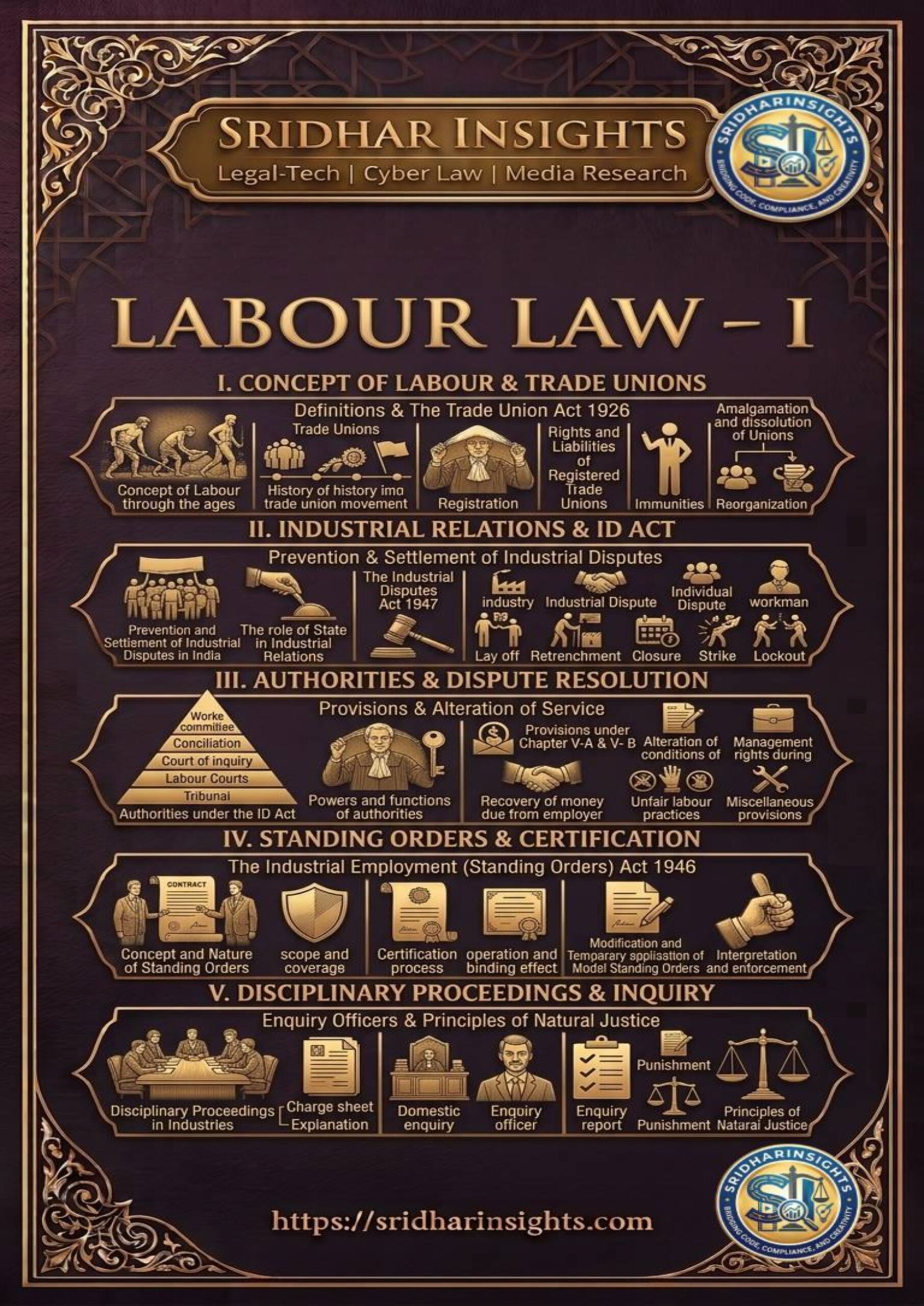
Labour Law | Legal | Quiz
Labour Law | Industrial Disputes Act | MCQ Quiz with Answers | Test Your Legal Knowledge
Labour Law MCQ Quiz – Industrial Disputes Act, 1947 (1–50)
(1). [AIBE 2021] The primary objective of the Industrial Disputes Act, 1947 is to:
- [A]. Maximize corporate profits
- [B]. Investigate and settle industrial disputes to ensure industrial peace
- [C]. Arrest trade union leaders
- [D]. Prevent citizens from forming unions
(2). A Works Committee under Section 3 of the IDA is required to be constituted in industrial establishments employing at least:
- [A]. 10 workmen
- [B]. 50 workmen
- [C]. 100 workmen
- [D]. 500 workmen
(3). [CLAT-PG 2019] If conciliation proceedings fail, the Conciliation Officer must submit a failure report to the:
- [A]. High Court
- [B]. Appropriate Government
- [C]. Supreme Court
- [D]. Trade Union
(4). The government’s power to make a reference of a dispute under Section 10 of the IDA is:
- [A]. A judicial function
- [B]. A quasi-judicial function
- [C]. An administrative function based on subjective satisfaction
- [D]. A legislative function
(5). [AIBE 2023] The landmark judgment that established the “Triple Test” for defining an Industry under Section 2(j) is:
- [A]. State of Bombay v. Hospital Mazdoor Sabha
- [B]. Bangalore Water Supply & Sewerage Board v. A. Rajappa
- [C]. University of Delhi v. Ram Nath
- [D]. Sundarambal v. Government of Goa
(6). According to the Triple Test, which of the following is NOT an essential requirement for an establishment to be an Industry?
- [A]. Systematic activity
- [B]. Profit motive or capital investment
- [C]. Cooperation between employer and employee
- [D]. Production/distribution of goods and services
(7). [CLAT-PG 2020] Under the current interpretation of Section 2(j), which of the following is absolutely EXCLUDED from the definition of an Industry?
- [A]. Hospitals
- [B]. Educational institutions
- [C]. Sovereign functions of the State (e.g., defense, police)
- [D]. Municipal corporations
(8). Section 2(k) defines “Industrial Dispute”. Which of the following is NOT an industrial dispute?
- [A]. Dispute between employers and employers
- [B]. Dispute between employers and workmen
- [C]. Dispute between workmen and workmen
- [D]. Dispute between a landlord and a tenant
(9). [AIBE 2018] Before the introduction of Section 2A, the dispute of an individual workman regarding dismissal was:
- [A]. Automatically an industrial dispute
- [B]. Not an industrial dispute unless espoused by a union or a substantial number of workers
- [C]. Dealt with by the Supreme Court directly
- [D]. Considered a criminal offense
(10). Section 2A of the IDA explicitly deems which of the following actions against an individual workman as an industrial dispute?
- [A]. Denial of a specific uniform color
- [B]. Dismissal, discharge, retrenchment, or termination
- [C]. Change in shift timings
- [D]. Refusal to grant casual leave
(11). [CLAT-PG 2022] Which of the following persons is expressly EXCLUDED from the definition of a “Workman” under Section 2(s)?
- [A]. A person doing manual work
- [B]. A person doing clerical work
- [C]. A person employed in a managerial or administrative capacity
- [D]. A highly skilled technical worker
(12). An employee working in a supervisory capacity is NOT a workman if their monthly wages exceed:
- [A]. ₹1,000
- [B]. ₹5,000
- [C]. ₹10,000
- [D]. ₹25,000
(13). [AIBE 2019] The failure, refusal, or inability of an employer to give employment to a workman on the muster roll due to a shortage of coal, power, or raw materials is defined as:
- [A]. Retrenchment
- [B]. Lockout
- [C]. Closure
- [D]. Lay-off
(14). What is the statutory compensation payable to a laid-off workman under Section 25C of the IDA?
- [A]. 100% of basic wages and DA
- [B]. 50% of basic wages and DA
- [C]. 25% of basic wages and DA
- [D]. Zero compensation
(15). [CLAT-PG 2021] Retrenchment under Section 2(oo) means termination of service of a workman by the employer for any reason, but EXCLUDES:
- [A]. Termination due to economic downsizing
- [B]. Termination inflicted as a punishment by way of disciplinary action
- [C]. Termination due to introduction of new technology
- [D]. Termination due to closure of a specific department
(16). Under Section 25F, a precondition for valid retrenchment is the payment of compensation equal to:
- [A]. 1 month’s pay for every completed year of service
- [B]. 15 days’ average pay for every completed year of continuous service
- [C]. 6 months’ salary in advance
- [D]. 10 days’ wages
(17). [AIBE 2022] The rule of “Last come, first go” applicable to retrenchment is statutorily enshrined in which section?
- [A]. Section 25F
- [B]. Section 25G
- [C]. Section 25H
- [D]. Section 2(oo)
(18). Chapter V-B of the IDA, which requires prior permission of the government for lay-off, retrenchment, and closure, applies to industrial establishments employing not less than:
- [A]. 20 workmen
- [B]. 50 workmen
- [C]. 100 workmen
- [D]. 500 workmen
(19). [CLAT-PG 2018] If an employer subject to Chapter V-B retrenches workers without obtaining the prior permission of the appropriate government, the retrenchment is:
- [A]. Valid but requires a fine
- [B]. Void and illegal, and workmen are entitled to all benefits as if they had not been retrenched
- [C]. Valid after a 6-month delay
- [D]. Validated by the Labour Court automatically
(20). The permanent closing down of a place of employment or part thereof is defined under the IDA as:
- [A]. Lay-off
- [B]. Lockout
- [C]. Closure
- [D]. Strike
(21). [AIBE 2023] A temporary closing of a place of employment or refusal by an employer to continue to employ any number of persons, used as a weapon to coerce workers, is called a:
- [A]. Closure
- [B]. Lay-off
- [C]. Lockout
- [D]. Retrenchment
(22). Which of the following involves a concerted refusal to work by a body of persons employed in an industry?
- [A]. Lockout
- [B]. Strike
- [C]. Closure
- [D]. Lay-off
(23). [CLAT-PG 2019] Under Section 22 of the IDA, workers in a Public Utility Service cannot go on strike without giving notice to the employer within:
- [A]. 2 weeks before striking
- [B]. 6 weeks before striking
- [C]. 10 days before striking
- [D]. 3 months before striking
(24). An employer in a Public Utility Service cannot declare a lockout until the expiry of how many days of giving the notice?
- [A]. 7 days
- [B]. 14 days
- [C]. 30 days
- [D]. 60 days
(25). [AIBE 2020] Under Section 23, a general prohibition of strikes and lockouts applies to all industrial establishments during the pendency of:
- [A]. An election
- [B]. Conciliation proceedings before a Board, and 7 days after the conclusion of such proceedings
- [C]. An internal management meeting
- [D]. A factory inspection
(26). Any strike or lockout commenced in contravention of Sections 22 or 23 is declared illegal under:
- [A]. Section 10
- [B]. Section 24
- [C]. Section 25F
- [D]. Section 2A
(27). [CLAT-PG 2022] An “Award” under Section 2(b) refers to the final determination of an industrial dispute by a:
- [A]. Conciliation Officer
- [B]. Labour Court, Industrial Tribunal, or National Tribunal
- [C]. High Court Judge
- [D]. Trade Union President
(28). An Award published by the appropriate government becomes enforceable upon the expiry of:
- [A]. 15 days from publication
- [B]. 30 days from publication
- [C]. 60 days from publication
- [D]. Immediately upon signature
(29). [AIBE 2018] Unlike a private contract that binds only the signatories, a settlement arrived at in the course of conciliation proceedings, or an award, binds:
- [A]. Only the trade union leaders
- [B]. All parties to the dispute, and all present and future workmen of the establishment (Section 18)
- [C]. The government alone
- [D]. Only the temporary workers
(30). A Labour Court constituted under Section 7 is typically tasked with adjudicating disputes listed in:
- [A]. Schedule I
- [B]. Schedule II (e.g., propriety of an employer’s order, dismissal of workmen)
- [C]. Schedule III
- [D]. Schedule IV
(31). [CLAT-PG 2021] Adjudication of wider disputes relating to wages, compensatory allowances, and hours of work (listed in Schedule III) falls primarily under the jurisdiction of:
- [A]. Works Committees
- [B]. Industrial Tribunals (Section 7A)
- [C]. Conciliation Officers
- [D]. Civil Courts
(32). Which adjudicatory body is appointed by the Central Government to decide disputes involving questions of national importance?
- [A]. Supreme Court
- [B]. National Tribunal (Section 7B)
- [C]. State Labour Court
- [D]. Central Board of Conciliation
(33). [AIBE 2019] If the termination of a workman is found by a Labour Court to be unjustified, the primary remedy traditionally awarded is:
- [A]. Imprisonment of the employer
- [B]. Reinstatement with full back wages
- [C]. A simple apology letter
- [D]. Transfer to a different company
(34). The exception to Retrenchment explicitly covering the termination of service due to non-renewal of a fixed-term employment contract is found in:
- [A]. Section 2(oo)(bb)
- [B]. Section 2(kkk)
- [C]. Section 2A
- [D]. Section 25F
(35). [CLAT-PG 2023] The voluntary reference of disputes to an independent arbitrator, formalized in a written agreement before the dispute is referred to a Labour Court, is governed by:
- [A]. Section 10A
- [B]. Section 22
- [C]. Section 25O
- [D]. Section 33
(36). Can a civil court issue an injunction against an ongoing strike by a registered trade union?
- [A]. Yes, automatically under the CPC.
- [B]. No, the jurisdiction to adjudicate legality of strikes and industrial disputes lies exclusively with the machineries under the IDA.
- [C]. Only if the strike is peaceful.
- [D]. Yes, if requested by the police.
(37). [AIBE 2021] The termination of a workman’s services on the ground of continued ill-health is:
- [A]. Treated as Retrenchment
- [B]. Expressly excluded from the definition of Retrenchment
- [C]. An illegal lockout
- [D]. Grounds for criminal prosecution
(38). The legal mechanism where workers attend the workplace but deliberately reduce the normal output of work is known as:
- [A]. Go-slow (often treated as misconduct or illegal strike)
- [B]. Lockout
- [C]. Lay-off
- [D]. Closure
(39). [CLAT-PG 2020] A “Pen-down” or “Tool-down” strike involves:
- [A]. Workers staying at home
- [B]. Workers entering the premises but refusing to perform any work
- [C]. Workers resigning en masse
- [D]. Employers shutting the factory gates
(40). The power to prohibit a strike or lockout in an establishment where the dispute has already been referred to a Board or Tribunal is vested in the:
- [A]. Appropriate Government (Section 10(3))
- [B]. Police Commissioner
- [C]. Trade Union leader
- [D]. District Magistrate
(41). [AIBE 2017] For the purpose of lay-off compensation, a workman must have completed at least:
- [A]. One month of continuous service
- [B]. One year of continuous service
- [C]. Five years of continuous service
- [D]. Ten years of continuous service
(42). If a workman refuses to accept alternative employment offered by the employer during a lay-off period (in the same or nearby establishment), the workman:
- [A]. Is entitled to double compensation
- [B]. Forfeits the right to claim lay-off compensation (Section 25E)
- [C]. Must be immediately arrested
- [D]. Is deemed retrenched automatically
(43). [CLAT-PG 2019] Notice of closure of an undertaking (not falling under Chapter V-B) must be given to the appropriate government at least:
- [A]. 15 days before intended closure
- [B]. 30 days before intended closure
- [C]. 60 days before intended closure (Section 25FFA)
- [D]. 90 days before intended closure
(44). The legal distinction between a Lockout and a Closure is that:
- [A]. Lockout is permanent; Closure is temporary.
- [B]. Lockout is a temporary coercive measure against workers; Closure is a permanent, irrevocable shutdown of business.
- [C]. Lockout is initiated by workers; Closure by employers.
- [D]. There is no legal distinction.
(45). [AIBE 2022] Does the term “Workman” include a person dismissed from service whose dismissal is the subject matter of an industrial dispute?
- [A]. No, dismissal severs all ties permanently.
- [B]. Yes, the definition under Section 2(s) explicitly includes any person who has been dismissed, discharged, or retrenched in connection with the dispute.
- [C]. Only if the employer agrees.
- [D]. Only if they are a union member.
(46). To claim the benefit of the “Last come, first go” rule under Section 25G, the workman must belong to a particular category of workmen, and the employer must retrench the workman who was:
- [A]. The most highly paid
- [B]. The last person to be employed in that category
- [C]. The oldest person
- [D]. The trade union president
(47). [CLAT-PG 2021] If a public utility service strike is commenced without the mandatory 14-day notice, the strike is:
- [A]. Valid but unprotected
- [B]. Absolutely illegal under Section 24
- [C]. Deemed a lockout
- [D]. A fundamental right
(48). A settlement arrived at otherwise than in the course of conciliation proceedings binds:
- [A]. All workers in the state
- [B]. Only the parties to the agreement (Section 18(1))
- [C]. Future employees
- [D]. The government
(49). [AIBE 2023] The ultimate jurisprudential objective of defining lay-offs, retrenchment, and closure strictly under the IDA is to:
- [A]. Ruin the employer financially
- [B]. Provide statutory financial security to workmen against arbitrary job loss and sudden economic distress
- [C]. Make firing employees completely impossible
- [D]. Promote unlimited corporate downsizing
(50). The synergy of the entire IDA 1947 framework demonstrates that the Indian State shifted from laissez-faire contracts to a regime of:
- [A]. Absolute corporate autocracy
- [B]. Compulsory adjudication, structured dispute resolution, and welfare-oriented job security
- [C]. Unregulated wildcat strikes
- [D]. Purely voluntary, unwritten settlements