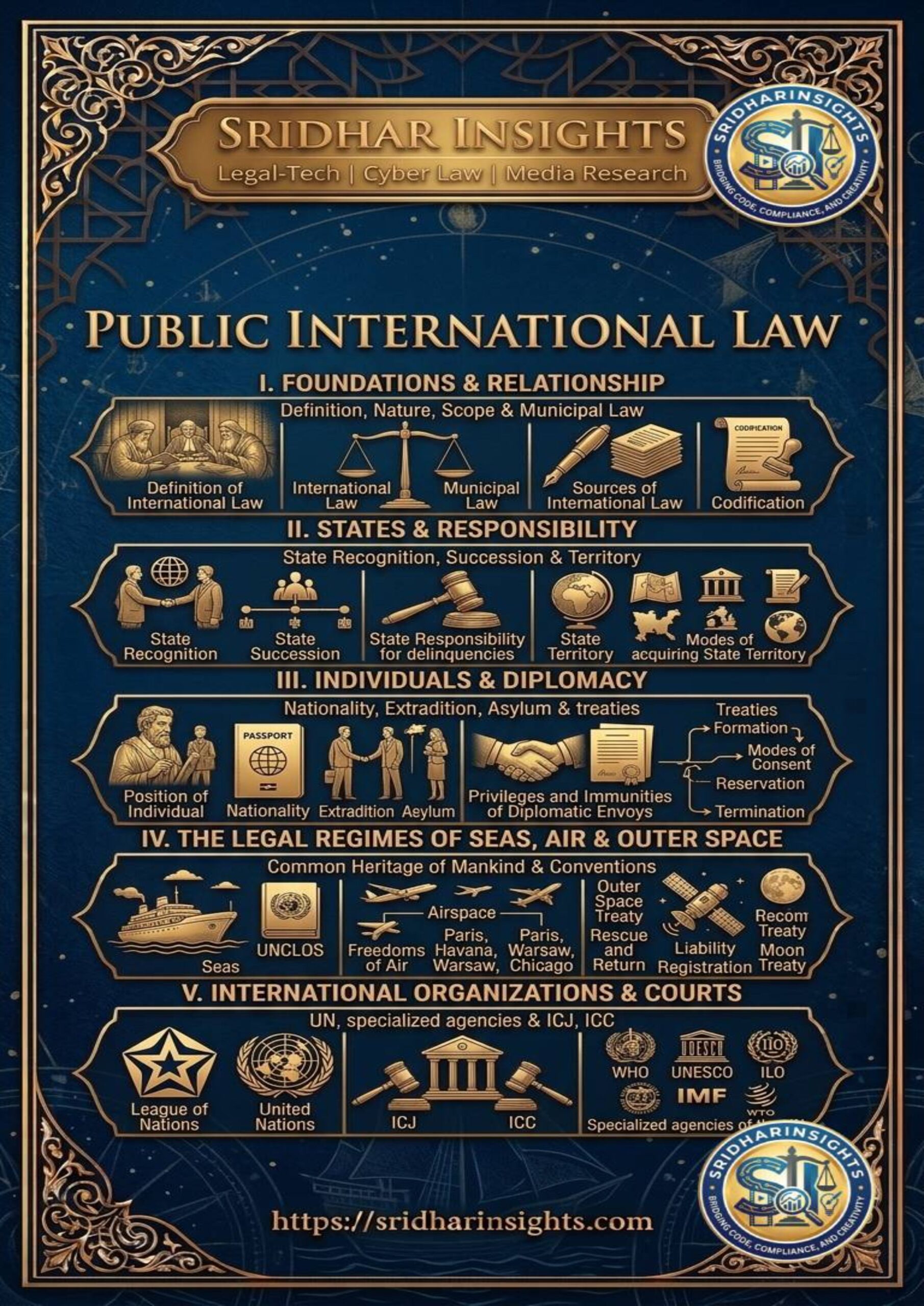
(1). [AIBE 2021] Who among the following jurists famously claimed that International Law is not true law, but merely “positive international morality”?
[A]. Lassa Oppenheim
[B]. John Austin
[C]. Hans Kelsen
[D]. J.G. Starke
Correct Answer: [B]. John Austin
(2). The modern definition of International Law expands its subjects to include:
[A]. States exclusively
[B]. States and International Organizations only
[C]. States, International Organizations, and Individuals
[D]. Corporations only
Correct Answer: [C]. States, International Organizations, and Individuals
(3). [CLAT-PG 2019] The principle that sovereign States may act in any way they wish so long as they do not contravene an explicit prohibition under International Law is known as the:
[A]. Calvo Clause
[B]. Drago Doctrine
[C]. Lotus Principle
[D]. Estrada Doctrine
Correct Answer: [C]. Lotus Principle
(4). Which Chapter of the UN Charter provides for structural sanctions and the use of force, proving that International Law possesses enforceable sanctions?
[A]. Chapter III
[B]. Chapter VI
[C]. Chapter VII
[D]. Chapter IX
Correct Answer: [C]. Chapter VII
(5). [AIBE 2023] The jurisprudential theory propounded by Triepel and Anzilotti, which treats International Law and Municipal Law as two entirely distinct legal systems, is:
[A]. Monism
[B]. Dualism
[C]. Realism
[D]. Naturalism
Correct Answer: [B]. Dualism
(6). According to the Dualist theory, for an international treaty to become binding in domestic courts, it requires:
[A]. Automatic incorporation
[B]. A specific act of transformation or legislation by the national parliament
[C]. A mere signature by the President
[D]. Approval by the United Nations
Correct Answer: [B]. A specific act of transformation or legislation by the national parliament
(7). [CLAT-PG 2020] Hans Kelsen is the chief proponent of which theory regarding the relationship between International and Municipal Law?
[A]. Dualism
[B]. Monism
[C]. Delegation Theory
[D]. Transformation Theory
Correct Answer: [B]. Monism
(8). Article 51(c) of the Constitution of India directs the State to:
[A]. Declare war unilaterally
[B]. Foster respect for international law and treaty obligations
[C]. Ignore the United Nations
[D]. Withdraw from all treaties
Correct Answer: [B]. Foster respect for international law and treaty obligations
(9). [AIBE 2018] Which Article of the Indian Constitution gives Parliament the exclusive power to make any law for the whole or any part of the territory of India for implementing any treaty?
[A]. Article 14
[B]. Article 21
[C]. Article 253
[D]. Article 370
Correct Answer: [C]. Article 253
(10). In which landmark case did the Supreme Court of India directly incorporate the CEDAW treaty into domestic law in the absence of municipal legislation?
[A]. Maneka Gandhi v. Union of India
[B]. Vishaka v. State of Rajasthan
[C]. Gramophone Co. of India v. Birendra Bahadur Pandey
[D]. Jolly George Varghese v. Bank of Cochin
Correct Answer: [B]. Vishaka v. State of Rajasthan
(11). [CLAT-PG 2022] In case of a direct, irreconcilable conflict between an International Treaty and a valid Municipal Statute in India:
[A]. The International Treaty prevails
[B]. The Municipal Statute prevails
[C]. Both become void
[D]. The matter is referred to the ICJ
Correct Answer: [B]. The Municipal Statute prevails
(12). The authoritative list of the sources of International Law is found in:
[A]. Article 38(1) of the ICJ Statute
[B]. Article 51 of the UN Charter
[C]. The Universal Declaration of Human Rights
[D]. The Geneva Conventions
Correct Answer: [A]. Article 38(1) of the ICJ Statute
(13). [AIBE 2019] Which of the following is NOT listed as a primary source of International Law under Article 38(1) of the ICJ Statute?
[A]. International Conventions
[B]. International Custom
[C]. General Principles of Law
[D]. Resolutions of the UN General Assembly
Correct Answer: [D]. Resolutions of the UN General Assembly
(14). For a practice to become an International Custom, it must possess two elements: State Practice (objective) and:
[A]. Pacta sunt servanda
[B]. Opinio juris sive necessitatis (subjective)
[C]. Res judicata
[D]. Stare decisis
Correct Answer: [B]. Opinio juris sive necessitatis (subjective)
(15). [CLAT-PG 2021] The necessity of Opinio Juris to establish a binding international custom was authoritatively established by the ICJ in:
[A]. The Asylum Case
[B]. The North Sea Continental Shelf Cases
[C]. The Corfu Channel Case
[D]. The Nottebohm Case
Correct Answer: [B]. The North Sea Continental Shelf Cases
(16). “General Principles of Law recognized by civilized nations” (Article 38(1)(c)) includes principles such as:
[A]. Res judicata and Estoppel
[B]. Nuclear deterrence
[C]. Space colonization
[D]. Domestic taxation
Correct Answer: [A]. Res judicata and Estoppel
(17). [AIBE 2022] According to Article 38(1)(d) of the ICJ Statute, judicial decisions and teachings of highly qualified publicists are:
[A]. Primary sources
[B]. Subsidiary means for the determination of rules of law
[C]. Binding precedents on all States
[D]. Irrelevant
Correct Answer: [B]. Subsidiary means for the determination of rules of law
(18). The doctrine of Stare Decisis (binding precedent) in the International Court of Justice:
[A]. Applies strictly to all future cases
[B]. Does not apply; decisions bind only the parties to the specific case under Article 59
[C]. Binds the UN Security Council
[D]. Binds all UN member states
Correct Answer: [B]. Does not apply; decisions bind only the parties to the specific case under Article 59
(19). [CLAT-PG 2018] Ex aequo et bono under Article 38(2) of the ICJ Statute empowers the Court to decide a case:
[A]. Based on religious texts
[B]. According to strict customary law only
[C]. Based on equity, fairness, and good conscience, provided the parties agree
[D]. By flipping a coin
Correct Answer: [C]. Based on equity, fairness, and good conscience, provided the parties agree
(20). A treaty is governed by the foundational maxim Pacta Sunt Servanda, which means:
[A]. Let the buyer beware
[B]. Agreements must be kept and performed in good faith
[C]. Treaties are voidable at will
[D]. Law of the sea
Correct Answer: [B]. Agreements must be kept and performed in good faith
(21). [AIBE 2023] Peremptory norms of general international law, from which no derogation is permitted (e.g., prohibition of genocide), are known as:
[A]. Jus dispositivum
[B]. Jus ad bellum
[C]. Jus cogens
[D]. Lex specialis
Correct Answer: [C]. Jus cogens
(22). Which of the following is a classic example of a Jus cogens norm?
[A]. Trade tariffs
[B]. Diplomatic immunity levels
[C]. The absolute prohibition of torture and slavery
[D]. Boundary delineations
Correct Answer: [C]. The absolute prohibition of torture and slavery
(23). [CLAT-PG 2019] The process of formulating and systematizing rules of international law in fields where there has already been extensive State practice is termed:
[A]. Codification
[B]. Nullification
[C]. Ratification
[D]. Extradition
Correct Answer: [A]. Codification
(24). Which Article of the UN Charter tasks the General Assembly with encouraging the progressive development and codification of international law?
[A]. Article 2(4)
[B]. Article 13(1)(a)
[C]. Article 51
[D]. Article 108
Correct Answer: [B]. Article 13(1)(a)
(25). [AIBE 2020] To fulfill its mandate of codification, the UN General Assembly established the:
[A]. International Criminal Court (ICC)
[B]. International Law Commission (ILC) in 1947
[C]. World Trade Organization (WTO)
[D]. Security Council
Correct Answer: [B]. International Law Commission (ILC) in 1947
(26). The International Law Commission (ILC) consists of:
[A]. 15 judges
[B]. 34 recognized experts in international law
[C]. 193 State ambassadors
[D]. 5 permanent members
Correct Answer: [B]. 34 recognized experts in international law
(27). [CLAT-PG 2022] One of the most monumental achievements of the ILC in codifying the law of treaties is the:
[A]. Geneva Conventions, 1949
[B]. Vienna Convention on the Law of Treaties (VCLT), 1969
[C]. Paris Agreement, 2015
[D]. Kyoto Protocol, 1997
Correct Answer: [B]. Vienna Convention on the Law of Treaties (VCLT), 1969
(28). A custom that binds only two states or a specific geographic region is known as a:
[A]. Universal custom
[B]. Regional / Local custom (e.g., Right of Passage Case)
[C]. Void custom
[D]. Jus cogens
Correct Answer: [B]. Regional / Local custom (e.g., Right of Passage Case)
(29). [AIBE 2018] The Right of Passage over Indian Territory Case (Portugal v. India) recognized the validity of:
[A]. Nuclear testing
[B]. Regional/Local customs
[C]. Outer space exploitation
[D]. Cyber warfare
Correct Answer: [B]. Regional/Local customs
(30). Who defined International Law as “the body of customary and treaty rules which are considered legally binding by States in their intercourse with each other”?
[A]. Lassa Oppenheim
[B]. Hugo Grotius
[C]. John Locke
[D]. Thomas Hobbes
Correct Answer: [A]. Lassa Oppenheim
(31). [CLAT-PG 2021] The “Delegation Theory” regarding the application of international law in the domestic sphere is associated with:
[A]. Natural Law
[B]. Monism (specifically Hans Kelsen)
[C]. Legal Realism
[D]. Dualism
Correct Answer: [B]. Monism (specifically Hans Kelsen)
(32). When domestic courts interpret national laws in a way that aligns with the State’s international treaty obligations, they are applying the principle of:
[A]. Harmonious Construction
[B]. Absolute Dualism
[C]. Eminent Domain
[D]. Strict Liability
Correct Answer: [A]. Harmonious Construction
(33). [AIBE 2019] In Jolly George Varghese v. Bank of Cochin, Justice Krishna Iyer emphasized the importance of aligning domestic law with which international instrument?
[A]. The WTO Charter
[B]. The International Covenant on Civil and Political Rights (ICCPR)
[C]. The Kyoto Protocol
[D]. The Outer Space Treaty
Correct Answer: [B]. The International Covenant on Civil and Political Rights (ICCPR)
(34). Which source of international law relies heavily on the “teachings of the most highly qualified publicists”?
[A]. Treaties
[B]. Custom
[C]. General Principles
[D]. Subsidiary means (Article 38(1)(d))
Correct Answer: [D]. Subsidiary means (Article 38(1)(d))
(35). [CLAT-PG 2023] The transformation of the UNCLOS (Law of the Sea) from fragmented customs into a massive multilateral treaty in 1982 is a prime example of:
[A]. Deregulation
[B]. Codification and Progressive Development
[C]. Diplomatic immunity
[D]. Piracy
Correct Answer: [B]. Codification and Progressive Development
(36). “Progressive development” of international law implies:
[A]. Writing down existing customs
[B]. Drafting conventions on subjects which have not yet been regulated by international law
[C]. Destroying old treaties
[D]. Ignoring the ICJ
Correct Answer: [B]. Drafting conventions on subjects which have not yet been regulated by international law
(37). [AIBE 2021] Under Monism, if a new international treaty is ratified by a State:
[A]. It becomes void
[B]. It must be ignored by judges
[C]. It automatically becomes part of municipal law without further legislative action
[D]. It requires a constitutional amendment
Correct Answer: [C]. It automatically becomes part of municipal law without further legislative action
(38). The United States Constitution (Article VI) states that treaties made under the authority of the US shall be the “supreme Law of the Land.” This reflects a lean towards:
[A]. Pure Dualism
[B]. Monism (Automatic Incorporation for self-executing treaties)
[C]. Feudalism
[D]. Anarchy
Correct Answer: [B]. Monism (Automatic Incorporation for self-executing treaties)
(39). [CLAT-PG 2020] In the context of custom, Opinio Juris means the State performs an act because it:
[A]. Finds it economically profitable
[B]. Is forced by the UN
[C]. Feels legally obligated to do so
[D]. Wants to please its neighbors
Correct Answer: [C]. Feels legally obligated to do so
(40). The International Court of Justice (ICJ) is located at the Peace Palace in:
[A]. New York
[B]. Geneva
[C]. The Hague
[D]. Vienna
Correct Answer: [C]. The Hague
(41). [AIBE 2017] According to Article 38 of the ICJ Statute, is there a strict formal hierarchy among Treaties, Customs, and General Principles?
[A]. Yes, General Principles always override Treaties.
[B]. No strict formal hierarchy, though Treaties and Custom are practically primary, and Lex specialis usually prevails.
[C]. Yes, Custom is always supreme.
[D]. Yes, UNGA Resolutions are supreme.
Correct Answer: [B]. No strict formal hierarchy, though Treaties and Custom are practically primary, and Lex specialis usually prevails.
(42). The maxim Lex specialis derogat legi generali means:
[A]. Special law overrides general law
[B]. General law overrides special law
[C]. Treaties are invalid
[D]. Customs are dead
Correct Answer: [A]. Special law overrides general law
(43). [CLAT-PG 2019] If an international custom and an international treaty conflict directly on the same subject matter between the same parties, usually:
[A]. The treaty (being a specific, subsequent agreement) prevails
[B]. The custom prevails
[C]. The ICJ refuses to hear the case
[D]. The UN dissolves the treaty
Correct Answer: [A]. The treaty (being a specific, subsequent agreement) prevails
(44). Which of the following is an example of an International Organization having legal personality (being a subject of International Law)?
[A]. Apple Inc.
[B]. The United Nations (UN)
[C]. The Red Cross NGO
[D]. Amnesty International
Correct Answer: [B]. The United Nations (UN)
(45). [AIBE 2022] The Reparation for Injuries Suffered in the Service of the UN Advisory Opinion established that:
[A]. The UN has international legal personality and can bring international claims
[B]. The UN is an illegal body
[C]. Individuals can sue the UN in civil courts
[D]. Treaties are void
Correct Answer: [A]. The UN has international legal personality and can bring international claims
(46). Which of the following bodies CANNOT directly seek binding rulings from the ICJ?
[A]. Sovereign States
[B]. Private Individuals and Corporations
[C]. The UN General Assembly (for advisory opinions)
[D]. Both a and c
Correct Answer: [B]. Private Individuals and Corporations
(47). [CLAT-PG 2021] The process of Codification primarily transforms:
[A]. Treaties into Municipal Law
[B]. Unwritten Customary International Law into written Multilateral Treaties
[C]. General Principles into UNGA Resolutions
[D]. Domestic law into International law
Correct Answer: [B]. Unwritten Customary International Law into written Multilateral Treaties
(48). The VCLT 1969, UNCLOS 1982, and VCDR 1961 are all successful outputs of the:
[A]. Security Council
[B]. International Criminal Court
[C]. International Law Commission (ILC)
[D]. World Health Organization
Correct Answer: [C]. International Law Commission (ILC)
(49). [AIBE 2023] The ultimate jurisprudential objective of Unit I’s focus on Sources and Codification is to demonstrate that International Law is:
[A]. A chaotic, unenforceable myth
[B]. A structured, evolving legal system moving from unwritten habits to codified treaties ensuring global certainty
[C]. Strictly limited to European states
[D]. Subordinate to all municipal laws
Correct Answer: [B]. A structured, evolving legal system moving from unwritten habits to codified treaties ensuring global certainty
(50). The synergy between Monism, Dualism, and Article 253 of the Indian Constitution confirms that India:
[A]. Rejects international law entirely
[B]. Operates on a Dualist framework requiring parliamentary legislation to enforce treaties, though courts interpret statutes harmoniously with international norms
[C]. Is a pure Monist state where treaties override the Constitution
[D]. Allows the UN to draft its national budget
Correct Answer: [B]. Operates on a Dualist framework requiring parliamentary legislation to enforce treaties, though courts interpret statutes harmoniously with international norms
Recently, a Division Bench of the Delhi High Court set aside a Single Judge’s earlier order. This previous order had refused to entertain a writ petition against a passport impounding. Therefore, this new ruling is a major victory for fundamental rights. Moreover, the case of Shravan Gupta v. Union of India gives us a…
Have you ever waited years for a court decision? Endless delays completely shatter public trust in the legal system. Litigants often wait several months just to hear a judgment after the final arguments end. However, the Supreme Court of India is finally fixing this broken system. Recently, the apex court issued strict, binding guidelines to…