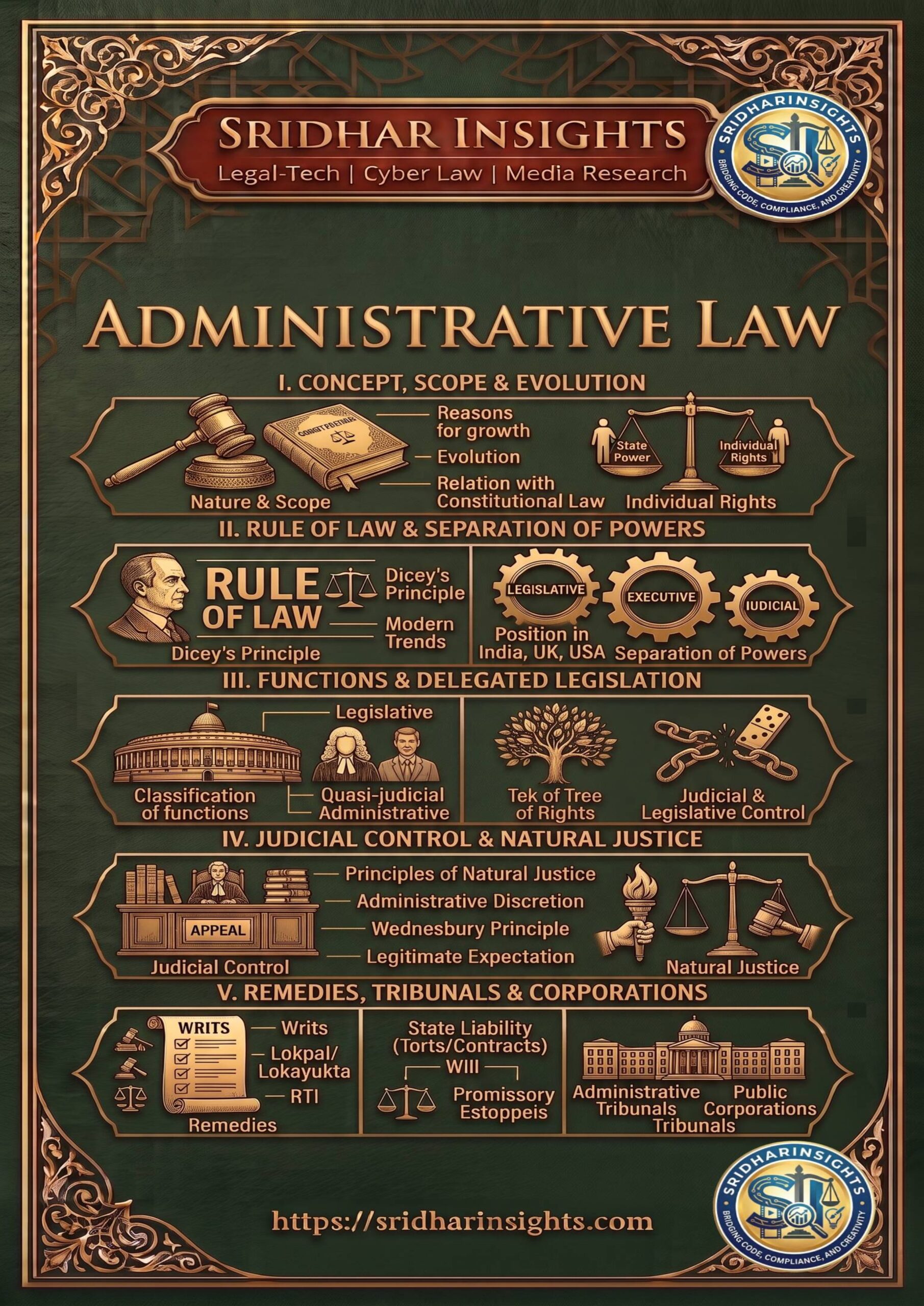
Administrative Law MCQ Quiz – Writs, RTI & Lokpal (1–50)
(1). [AIBE 2021] Which writ is issued by a superior court to command a public authority to perform a mandatory public duty?
[A]. Habeas Corpus
[B]. Mandamus
[C]. Quo-Warranto
[D]. Prohibition
Correct Answer: [B]. Mandamus
(2). The ombudsman institution established at the national level in India by the 2013 Act is called:
[A]. Lokayukta
[B]. Lokpal
[C]. Central Vigilance Commission
[D]. Law Commission
Correct Answer: [B]. Lokpal
(3). [CLAT-PG 2019] Under the Right to Information Act, 2005, what is the standard time limit within which a Public Information Officer must provide information?
[A]. 10 days
[B]. 30 days
[C]. 45 days
[D]. 90 days
Correct Answer: [B]. 30 days
(4). Which of the following is considered a “Sovereign Function” granting the State tortious immunity?
[A]. Running a state transport bus
[B]. Maintaining the armed forces and conducting military operations
[C]. Operating government printing presses
[D]. Running state-owned hotels
Correct Answer: [B]. Maintaining the armed forces and conducting military operations
(5). [AIBE 2023] Which constitutional article governs the formal execution of all executive contracts entered into by the Union or State governments?
[A]. Article 14
[B]. Article 21
[C]. Article 299
[D]. Article 323A
Correct Answer: [C]. Article 299
(6). The Rule of Promissory Estoppel prevents the government from:
[A]. Passing new laws
[B]. Arbitrarily going back on its clear promises or representations relied upon by citizens to their detriment
[C]. Levying income tax
[D]. Arresting criminals
Correct Answer: [B]. Arbitrarily going back on its clear promises or representations relied upon by citizens to their detriment
(7). [CLAT-PG 2020] In L. Chandra Kumar v. Union of India, the Supreme Court held that:
[A]. Administrative tribunals are unconstitutional.
[B]. High Courts’ power of judicial review under Article 226 over tribunal orders is part of the basic structure and cannot be excluded.
[C]. Tribunals can abolish the Supreme Court.
[D]. Tribunals have final authority with no court review.
Correct Answer: [B]. High Courts’ power of judicial review under Article 226 over tribunal orders is part of the basic structure and cannot be excluded.
(8). A Commission of Inquiry appointed under the Commissions of Inquiry Act, 1952 submits a report that is:
[A]. Legally binding on the courts
[B]. Strictly recommendatory and non-binding on the government
[C]. A final criminal sentence
[D]. Subject to police execution
Correct Answer: [B]. Strictly recommendatory and non-binding on the government
(9). [AIBE 2018] A public corporation established by a special statute is deemed to be “State” under which Article of the Constitution?
[A]. Article 12
[B]. Article 19
[C]. Article 32
[D]. Article 226
Correct Answer: [A]. Article 12
(10). Which writ is issued to inquire into the legality of a person holding a public office?
[A]. Certiorari
[B]. Prohibition
[C]. Quo-Warranto
[D]. Mandamus
Correct Answer: [C]. Quo-Warranto
(11). [CLAT-PG 2022] In State of Rajasthan v. Vidyawati, the Supreme Court held the State liable in tort because:
[A]. The driver was a cabinet minister.
[B]. Driving a state jeep negligently is a non-sovereign function.
[C]. The accident occurred during wartime.
[D]. Parliament passed a special act.
Correct Answer: [B]. Driving a state jeep negligently is a non-sovereign function.
(12). Under Section 8 of the RTI Act, which of the following information is exempt from disclosure?
[A]. Information affecting the sovereignty and integrity of India
[B]. Public road construction budgets
[C]. Panchayat expenditure reports
[D]. Minister salary details
Correct Answer: [A]. Information affecting the sovereignty and integrity of India
(13). [AIBE 2019] The Lokpal consists of a Chairperson and a maximum of how many members?
[A]. 4
[B]. 8
[C]. 12
[D]. 20
Correct Answer: [B]. 8
(14). If a government contract fails to comply with the mandatory requirements of Article 299 (e.g., not executed in the name of the Governor), the contract is:
[A]. Perfectly valid and enforceable
[B]. Void and unenforceable against the government
[C]. Voidable at the contractor’s option
[D]. Binding on the civil servant personally
Correct Answer: [B]. Void and unenforceable against the government
(15). [CLAT-PG 2021] The doctrine that prevents the State from reneging on tax exemptions promised to industries is:
[A]. Res Judicata
[B]. Promissory Estoppel
[C]. Lis Pendens
[D]. Caveat Emptor
Correct Answer: [B]. Promissory Estoppel
(16). Which writ is issued by a higher court to quash an order of an inferior tribunal passed without jurisdiction?
[A]. Habeas Corpus
[B]. Certiorari
[C]. Mandamus
[D]. Quo-Warranto
Correct Answer: [B]. Certiorari
(17). [AIBE 2022] The Central Administrative Tribunal (CAT) was established pursuant to which Constitutional Article?
[A]. Article 32
[B]. Article 226
[C]. Article 323A
[D]. Article 300
Correct Answer: [C]. Article 323A
(18). The emergency time limit under the RTI Act for providing information concerning life and liberty of a person is:
[A]. 24 hours
[B]. 48 hours
[C]. 7 days
[D]. 14 days
Correct Answer: [B]. 48 hours
(19). [CLAT-PG 2018] In Motilal Padampat Sugar Mills v. State of U.P., the Supreme Court held that the government can be bound by:
[A]. Verbal whispers
[B]. Promissory Estoppel, and cannot plead executive necessity to escape binding promises
[C]. Secret cabinet notes
[D]. International treaties
Correct Answer: [B]. Promissory Estoppel, and cannot plead executive necessity to escape binding promises
(20). Which of the following is an exception where intelligence organizations (like IB and RAW) are exempt from the RTI Act?
[A]. They are completely exempt from RTI for all purposes.
[B]. They are exempt except for allegations of corruption and human rights violations.
[C]. They are subject to RTI every Monday.
[D]. They are exempt only during war.
Correct Answer: [B]. They are exempt except for allegations of corruption and human rights violations.
(21). [AIBE 2023] Can a writ of Mandamus be issued against a private individual or private body?
[A]. Yes, always.
[B]. No, unless the private body is discharging a public duty or statutory function.
[C]. Only if approved by the police.
[D]. Only in criminal cases.
Correct Answer: [B]. No, unless the private body is discharging a public duty or statutory function.
(22). The chairperson of the Lokpal must be:
[A]. A serving bureaucrat
[B]. A current or retired Chief Justice of India, Supreme Court Judge, or eminent person
[C]. The Prime Minister
[D]. The Attorney General of India
Correct Answer: [B]. A current or retired Chief Justice of India, Supreme Court Judge, or eminent person
(23). [CLAT-PG 2019] The constitutional basis for awarding monetary compensation for violation of Fundamental Rights (Constitutional Torts) through writ petitions is found in:
[A]. Article 300 only
[B]. Articles 32 and 226
[C]. The Indian Penal Code
[D]. The Contract Act
Correct Answer: [B]. Articles 32 and 226
(24). The primary objective of the Right to Information Act, 2005 is to:
[A]. Promote transparency and accountability in the working of every public authority
[B]. Increase government secrecy
[C]. Replace the judiciary
[D]. Abolish Parliament
Correct Answer: [A]. Promote transparency and accountability in the working of every public authority
(25). [AIBE 2020] When a court issues a writ of Prohibition, it acts to:
[A]. Quash an order already passed
[B]. Forbid an inferior tribunal from continuing proceedings exceeding its jurisdiction
[C]. Release a prisoner
[D]. Remove a public official
Correct Answer: [B]. Forbid an inferior tribunal from continuing proceedings exceeding its jurisdiction
(26). Under Article 300, if Parliament or State Legislatures do not enact a specific law regarding state liability, the pre-constitution colonial liability rules:
[A]. Continue to apply
[B]. Become void automatically
[C]. Apply only to foreign states
[D]. Are abolished
Correct Answer: [A]. Continue to apply
(27). [CLAT-PG 2022] Which of the following bodies investigates corruption complaints against the Prime Minister of India, subject to specific exclusions?
[A]. Central Bureau of Investigation
[B]. Lokpal
[C]. Law Commission
[D]. Reserve Bank of India
Correct Answer: [B]. Lokpal
(28). If an RTI applicant is denied information by a Public Information Officer, who is the first authority to approach in appeal?
[A]. The Supreme Court
[B]. The First Appellate Authority within the public authority
[C]. The Prime Minister’s Office
[D]. The High Court
Correct Answer: [B]. The First Appellate Authority within the public authority
(29). [AIBE 2018] The doctrine of “Sovereign Immunity” in tort law has been:
[A]. Expanded to cover all state actions
[B]. Progressively narrowed by Indian courts, especially when fundamental rights under Article 21 are violated
[C]. Codified into a permanent absolute statute
[D]. Adopted from French law
Correct Answer: [B]. Progressively narrowed by Indian courts, especially when fundamental rights under Article 21 are violated
(30). A public corporation differs from a traditional government department in that it possesses:
[A]. Corporate personality, perpetual succession, and commercial/administrative autonomy
[B]. No legal identity
[C]. Absolute immunity from courts
[D]. The power to pass primary legislation
Correct Answer: [A]. Corporate personality, perpetual succession, and commercial/administrative autonomy
(31). [CLAT-PG 2021] Can the defense of “Executive Necessity” be successfully pleaded by the government to defeat a claim of Promissory Estoppel?
[A]. Yes, government policy can change freely.
[B]. No, the Supreme Court rejected this plea in Motilal Padampat, holding that the government must honor its promises unless overriding public interest demands otherwise.
[C]. Yes, during financial emergencies.
[D]. Always.
Correct Answer: [B]. No, the Supreme Court rejected this plea in Motilal Padampat, holding that the government must honor its promises unless overriding public interest demands otherwise.
(32). The powers of a Commission of Inquiry under the 1952 Act include:
[A]. Powers of a civil court for summoning witnesses and examining them on oath
[B]. Power to sentence criminals to life imprisonment
[C]. Power to dissolve Parliament
[D]. Power to alter the Constitution
Correct Answer: [A]. Powers of a civil court for summoning witnesses and examining them on oath
(33). [AIBE 2019] Which writ is literally translated as “We Command”?
[A]. Habeas Corpus
[B]. Mandamus
[C]. Certiorari
[D]. Quo-Warranto
Correct Answer: [B]. Mandamus
(34). The rule that an administrative tribunal cannot exercise absolute finality so as to bar High Court judicial review was established in:
[A]. L. Chandra Kumar Case
[B]. Kesavananda Bharati
[C]. Maneka Gandhi
[D]. GCHQ Case
Correct Answer: [A]. L. Chandra Kumar Case
(35). [CLAT-PG 2023] In a contract made with the Government of India, if the formal document does not satisfy Article 299, the contract is:
[A]. Ratifiable later by the cabinet
[B]. Ratification-proof, void, and cannot be sued upon even on the basis of implied contract or estoppel
[C]. Valid orally
[D]. Enforceable as a private agreement
Correct Answer: [B]. Ratification-proof, void, and cannot be sued upon even on the basis of implied contract or estoppel
(36). The Information Commission (CIC/SIC) under the RTI Act has the power to:
[A]. Impose statutory penalties on defaulting PIOs
[B]. Imprison ministers
[C]. Dissolve public corporations
[D]. Pass international treaties
Correct Answer: [A]. Impose statutory penalties on defaulting PIOs
(37). [AIBE 2021] Which of the following cases is the absolute authority for establishing that “Constitutional Torts” can be remedied via writ compensation under Articles 32 and 226?
[A]. Nilabati Behera v. State of Orissa
[B]. Kasturi Lal
[C]. Vidyawati
[D]. Anglo Afghan Agencies
Correct Answer: [A]. Nilabati Behera v. State of Orissa
(38). The Lokayukta functions at which level of governance in India?
[A]. National level
[B]. State level
[C]. International level
[D]. Municipal level only
Correct Answer: [B]. State level
(39). [CLAT-PG 2020] The writ of Habeas Corpus can be filed by:
[A]. Only the detained person
[B]. The detained person or any other person on their behalf (friend/relative)
[C]. Only the Attorney General
[D]. Only a police officer
Correct Answer: [B]. The detained person or any other person on their behalf (friend/relative)
(40). The protection of Promissory Estoppel cannot be invoked if the promise made by the government is:
[A]. Advantageous to citizens
[B]. Contrary to law or ultra vires the statute
[C]. Published in the gazette
[D]. Signed by a secretary
Correct Answer: [B]. Contrary to law or ultra vires the statute
(41). [AIBE 2017] When an administrative tribunal is created under Article 323A, its members are drawn from:
[A]. Judicial backgrounds and administrative/technical expertise
[B]. The military only
[C]. Private corporate executives
[D]. Foreign judges
Correct Answer: [A]. Judicial backgrounds and administrative/technical expertise
(42). The report of a Commission of Inquiry is submitted to:
[A]. The Supreme Court directly
[B]. The Appropriate Government that appointed it
[C]. The United Nations
[D]. The public via social media
Correct Answer: [B]. The Appropriate Government that appointed it
(43). [CLAT-PG 2019] Which test is applied by courts to determine if a government-owned company or society is an “instrumentality of the State” under Article 12?
[A]. The Ajay Hasia / International Airport Authority tests (deep and pervasive state control, public monopoly)
[B]. The profit-loss test
[C]. The number of employees test
[D]. The foreign exchange test
Correct Answer: [A]. The Ajay Hasia / International Airport Authority tests (deep and pervasive state control, public monopoly)
(44). The legal remedy for breach of a public duty by an administrative authority is primarily sought through:
[A]. A civil suit for defamation
[B]. A Writ Petition of Mandamus
[C]. Filing a criminal FIR
[D]. A private arbitration
Correct Answer: [B]. A Writ Petition of Mandamus
(45). [AIBE 2022] In summary, the multifaceted remedies and accountability structures in Unit V—from Writs to RTI and Lokpal—collectively ensure that:
[A]. The sovereign state remains fully accountable to the rule of law and transparent to its citizens.
[B]. Bureaucrats enjoy absolute legal immunity.
[C]. Courts manage all commercial businesses.
[D]. Citizens have no rights against the government.
Correct Answer: [A]. The sovereign state remains fully accountable to the rule of law and transparent to its citizens.
(46). Which of the following best captures the evolution of State Liability in India?
[A]. Static colonial immunity
[B]. Gradual erosion of crown immunity through constitutional torts, public law remedies, and statutory accountability
[C]. Complete abolition of all government liability
[D]. Exclusive reliance on private insurance
Correct Answer: [B]. Gradual erosion of crown immunity through constitutional torts, public law remedies, and statutory accountability
(47). [CLAT-PG 2021] If a public authority refuses to disclose information under RTI without citing a valid exemption under Section 8, the applicant’s remedy is to file:
[A]. A police complaint
[B]. An appeal before the First Appellate Authority
[C]. A bankruptcy petition
[D]. A divorce suit
Correct Answer: [B]. An appeal before the First Appellate Authority
(48). The rule that an administrative tribunal must follow the Principles of Natural Justice even though it is not bound by the strict rules of the CPC is enshrined in:
(49). [AIBE 2023] The ultimate goal of establishing Public Corporations, Administrative Tribunals, and Anti-Corruption Ombudsmen is to:
[A]. Expand bureaucratic red tape
[B]. Combine administrative efficiency with robust legal accountability and public trust
[C]. Eliminate the judiciary
[D]. Increase taxation
Correct Answer: [B]. Combine administrative efficiency with robust legal accountability and public trust
(50). The synergy between state liability, writs, RTI, and tribunals demonstrates that Indian Administrative Law has successfully transitioned from a system of crown privilege to a system of:
[A]. Constitutionalism and Citizen-Centric Accountability
[B]. Absolute executive discretion
[C]. Feudal autocracy
[D]. Judicial dictatorship
Correct Answer: [A]. Constitutionalism and Citizen-Centric Accountability
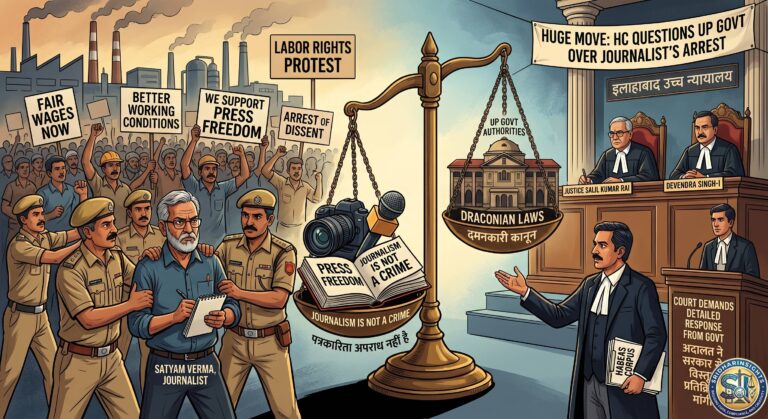
Imagine being arrested simply for reporting on labor rights. Recently, a major controversy erupted following massive worker protests in Noida. Police arrested a 60-year-old senior journalist, Satyam Verma. Authorities completely blamed him for instigating violence during the labor strike. However, the Allahabad High Court just took serious notice of his ongoing detention. The Court officially…
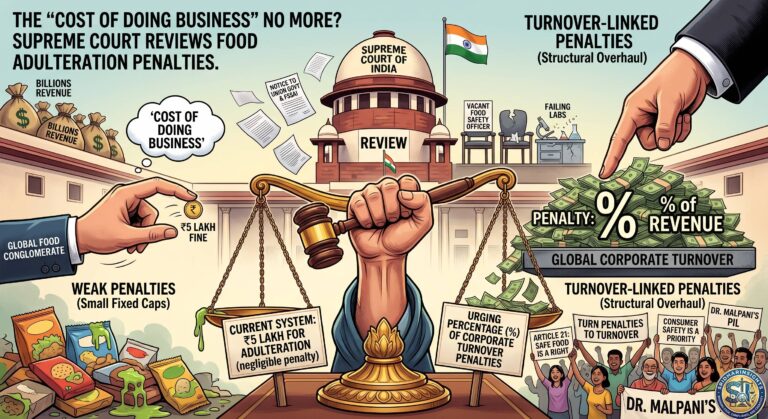
When a massive multinational food corporation gets caught selling sub-standard or adulterated products in India, the maximum penalty is often just a few lakh rupees. For companies raking in billions, these fines are barely a slap on the wrist. In fact, many corporate giants simply write off these negligible penalties as a routine “cost of…